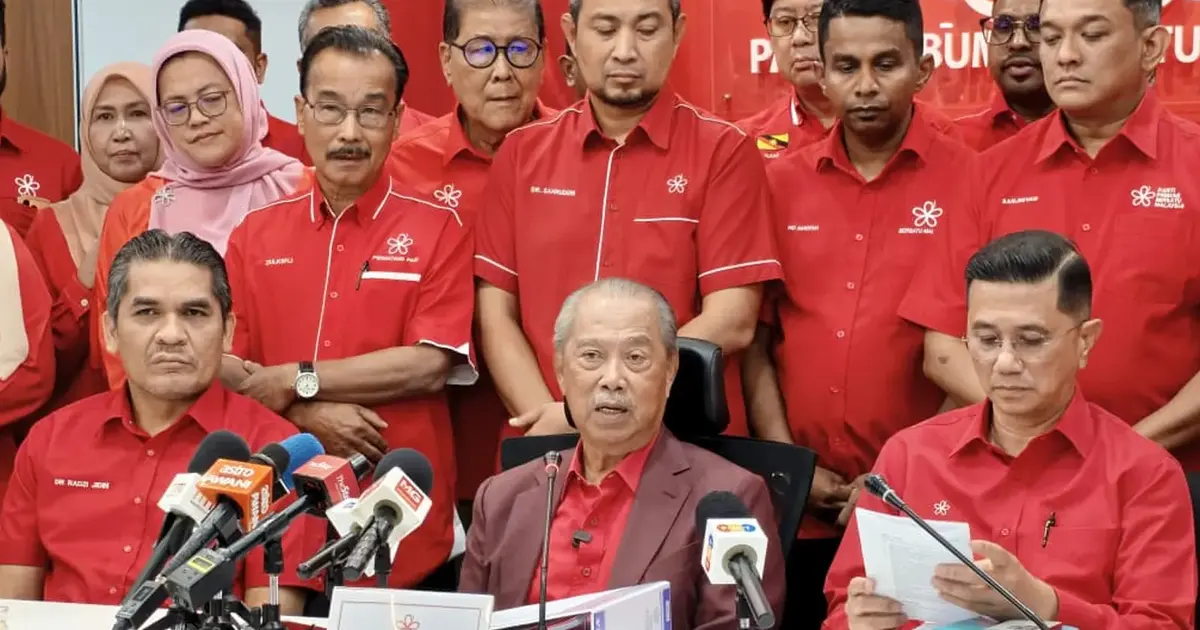
Bersatu's decision to persist as a member of the Perikatan Nasional alliance reflects a deliberate political gambit by party president Muhyiddin Yassin, who has made clear that the coalition partnership rests primarily on public endorsement rather than backroom agreements or parliamentary mathematics. The Malay-Muslim party, which emerged from the fractious collapse of the Pakatan Harapan government in 2020, has maintained an often fraught relationship with its larger coalition partners, yet leadership insists that voter sentiment provides the strongest rationale for continuing the arrangement.
Muhyiddin's framing of the decision around general public acceptance carries significant political weight in Malaysia's volatile multiparty environment. Rather than emphasising institutional stability or electoral arithmetic—the traditional currencies of coalition politics—the Bersatu president is attempting to ground the party's coalition commitment in a broader narrative of popular legitimacy. This rhetorical strategy suggests that party strategists believe their electoral support depends on maintaining the PN brand identity and its appeal to a specific demographic, primarily Malay-Muslim voters who may view the coalition as preferable to competing political alliances.
The timing of this reaffirmation matters considerably given the prevailing instability within Malaysia's federal coalition arrangements. Since the 2022 general election, which produced no clear winner and catalysed the formation of the current PN-led federal government, multiple political realignments have tested the durability of every significant coalition partnership. Bersatu's position remains particularly delicate, as the party occupies middle ground between the more dominant Perikatan partners and the opposition bloc, making it vulnerable to poaching attempts from rival alliances seeking to improve their arithmetic in parliament.
Bersatu's historical trajectory illuminates the context of this commitment. The party's formation in 2016 by Muhyiddin and other UMNO defectors positioned it as a nationalist alternative within Malay politics. Following its merger into Perikatan Nasional alongside PAS and smaller component parties, Bersatu benefited from the coalition's electoral performance while simultaneously becoming dependent on maintaining that partnership for parliamentary viability. Without the PN brand, Bersatu would struggle to compete independently against UMNO's superior organisational machinery and established grassroots networks.
The assertion that public acceptance provides the foundation for coalition membership also carries implications for how Bersatu frames its political identity to voters. If the party truly believes that ordinary Malaysians have endorsed the PN as a governing model, then Bersatu leaders can argue they are responding to electoral mandates rather than engaging in unprincipled coalition-switching. This positioning becomes particularly important for a party whose leadership has previously switched allegiances multiple times, a history that leaves Bersatu vulnerable to accusations of opportunism whenever coalition arrangements shift.
For Southeast Asian observers monitoring Malaysian political development, Bersatu's commitment reflects broader patterns visible throughout the region's democracy experience. Coalitions in Thailand, Indonesia, and the Philippines similarly struggle between institutional stability and the fluid preferences of elected representatives. Malaysia's situation differs somewhat because of its constitutional constraints and Westminster traditions, yet the underlying tension between maintaining coalition cohesion and responding to parliamentary incentives remains remarkably consistent across Southeast Asia's democracies.
Within Malaysia specifically, Bersatu's position affects the broader balance between federal and state-level political power. The party holds significant influence in several states where it controls substantial legislative representation, particularly in East Malaysia. These state-level strongholds provide Bersatu with leverage within PN negotiations and insulate the party from complete dependence on federal coalition arrangements. Party leaders can plausibly argue that Bersatu's ground-level support, especially in states like Sabah and Sarawak, validates the commitment to continuing the PN partnership.
However, the explicit invocation of public acceptance as rationale for coalition membership also suggests underlying fragility. When political leaders feel compelled to publicly justify coalition continuation by reference to external validation, observers typically interpret this as indicating internal doubts about the arrangement's durability. Stronger coalitions rarely require such elaborate legitimation narratives; they simply persist through accumulated institutional interests and accumulated political capital. Muhyiddin's emphasis on public acceptance may therefore signal that PN unity requires constant attention to maintain.
The statement also carries implications for potential defections or realignments. If Bersatu leaders have genuinely convinced themselves and their base that PN membership reflects public preference, then departing the coalition would require them to reverse this narrative. Such a reversal would be politically costly, potentially exposing party leadership to accusations of having misread public sentiment or abandoned their own stated principles. This rhetorical bind, while self-imposed, nonetheless provides some structural constraint against Bersatu simply abandoning the coalition for better parliamentary terms elsewhere.
Looking toward Malaysia's next general election, Bersatu's commitment to Perikatan Nasional will likely persist regardless of short-term coalition tensions. The party lacks viable alternatives that would preserve its political relevance and influence. Opposition alliances would struggle to accommodate Bersatu given the party's Malay-Muslim nationalist positioning, which often conflicts with DAP's non-communal appeal within Pakatan Harapan. Similarly, Bersatu cannot credibly rejoin UMNO given the bitter fractures that created the party's separate existence. The Perikatan platform, for all its internal complexities, remains the only coalition framework in which Bersatu maintains genuine political standing and ministerial portfolio control.