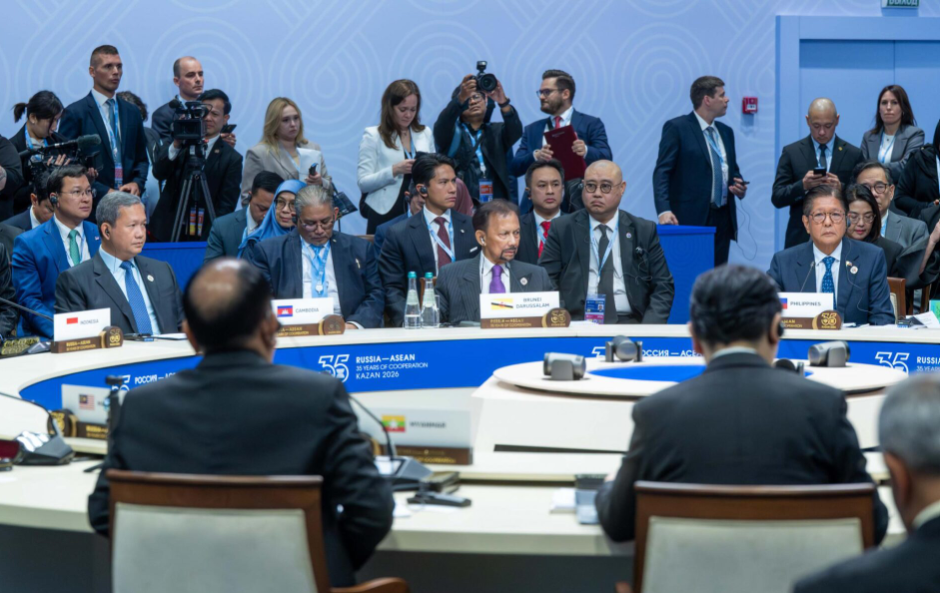
Sultan Hassanal Bolkiah used the Asean-Russia Commemorative Summit in Kazan, Russia on June 18 to reaffirm the significance of bilateral engagement between Southeast Asia and Russia, thanking Russian President Vladimir Putin for the warm reception extended to regional leaders at the event held at the Kazan Expo International Exhibition Centre. The Brunei monarch, accompanied by Foreign Minister Prince 'Abdul Mateen, also recognised the hospitality of Tatarstan's government and the people of Kazan, while extending condolences to Thailand's Prime Minister Anutin Charnvirakul following the death of Princess Bajrakitiyabha.
Reflecting on three and a half decades of formal dialogue between the two sides, Sultan Hassanal Bolkiah characterised the relationship as remarkably resilient and increasingly critical as the world grapples with unprecedented challenges. The partnership, he noted, has proven its adaptability and durability, expanding substantially across the three pillars of the Asean Community framework — the political-security pillar, the economic pillar, and the socio-cultural pillar. This multi-dimensional engagement demonstrates that Asean-Russia ties extend far beyond traditional diplomatic channels, encompassing substantive collaboration in areas touching directly on the welfare and prosperity of citizens across the region.
The concrete benefits realised through decades of cooperation have not been limited to governmental interactions, according to the Sultan's assessment. People-to-people connections have strengthened considerably, creating networks of understanding and collaboration that transcend official structures and contribute to a more stable regional environment. These grassroots linkages prove particularly valuable in an era of geopolitical fragmentation, where non-state actors and civil society increasingly shape regional dynamics alongside formal diplomatic arrangements.
Looking forward to Asean's Vision 2045 roadmap, the Sultan emphasised that sustained Russian engagement remains indispensable for navigating the complex array of global threats facing the region. Specifically, he identified political tensions, economic fragmentation, climate change, and rapid technological transformation as priority concerns requiring coordinated action. For Southeast Asian nations, many of which face existential challenges from rising sea levels and shifting weather patterns, Russian expertise and resources in environmental management and clean energy transition offer valuable partnerships. Similarly, the region's vulnerability to economic disruption from global supply chain fragmentation makes Russian cooperation in trade and investment particularly relevant.
Energy security emerged as a central theme in the Sultan's remarks, reflecting Asean's critical dependence on stable hydrocarbon supplies and growing interest in diversifying energy sources. Russia, as a major global energy producer with significant hydrocarbon reserves and technological expertise in nuclear and renewable energy, represents a strategic partner for the region's long-term energy independence. Food security received similar emphasis, particularly significant given the widespread concerns across Southeast Asia about agricultural productivity in a changing climate and the geopolitical disruptions affecting global grain markets.
Disaster management and non-traditional security challenges — encompassing pandemics, cybersecurity threats, maritime piracy, and human trafficking — constitute additional domains where the Sultan identified mutual benefit from enhanced cooperation. These transnational threats respect no borders and demand collaborative frameworks that transcend bilateral arrangements. Russia's experience managing natural disasters across its vast territory and its technological capabilities in cybersecurity and information warfare offer practical lessons for developing Asean responses to emerging security challenges.
The Sultan's emphasis on human capital development underscores recognition that technological and institutional progress requires sustained investment in education and skills training. Educational exchanges, fellowships, and capacity-building programmes between Asean nations and Russia facilitate knowledge transfer while cultivating long-term networks of professionals and policymakers with deep understanding of partner countries' perspectives and priorities. This generational investment helps insulate bilateral relations from short-term political fluctuations, creating institutional foundations that persist across administrations and shifting geopolitical alignments.
The formal outcome documents adopted at the summit's conclusion substantiate this renewed commitment. The Kazan Declaration 2026 establishes the framework for the relationship's next phase, while the Comprehensive Plan of Action spanning 2026 to 2030 provides specific targets and deliverables. Notably, dedicated joint statements on energy and cultural cooperation highlight areas where both sides identify particular potential for expanded engagement, reflecting practical recognition of shared interests and complementary capabilities.
The second plenary session, conducted as a working lunch addressing integration processes across Eurasia, situated the Asean-Russia partnership within the broader context of continental political economy and institutional architecture. Participation by the Shanghai Cooperation Organisation secretary-general and the Eurasian Economic Commission chairman demonstrated interconnections between Asean engagement with Russia and the bloc's relationships with other Eurasian institutions and players. For Malaysia and other Southeast Asian nations, these multilayered institutional connections create additional channels for advancing regional interests while navigating complex great power dynamics.
The concurrent Asean-Russia Business Forum on June 17 signalled renewed emphasis on commercial dimensions of the partnership, addressing private sector interests in Russian markets and investment opportunities. For Malaysian companies operating in energy, finance, and technology sectors, expanded commercial links with Russia and coordination with fellow Asean businesses through such forums offers strategic opportunities for market diversification and regional value chain development.
The summit's emphasis on unity amid diversity reflects Asean's traditional diplomatic approach of building consensus-based frameworks that accommodate diverse national interests. Russia's participation in this inclusive model demonstrates recognition that sustainable regional engagement requires respecting Asean's institutional autonomy and decision-making processes, differentiating Moscow's approach from more coercive or divisive great power strategies. This positioning enhances Russia's appeal to Southeast Asian governments seeking partnerships that strengthen their strategic autonomy rather than constraining it.
For Malaysia specifically, the enhanced Asean-Russia framework creates opportunities for advancing bilateral interests through collective regional mechanisms while maintaining the flexibility of independent diplomatic manoeuvre. Malaysian investments in Russia and Russian investments in Malaysian energy and technology sectors stand to benefit from the improved institutional environment and dialogue frameworks established through the summit process. The emphasis on climate action and sustainable development also aligns with Malaysia's own national priorities under its green development agenda.
%22%2F%3E%3C%2Fpattern%3E%3C%2Fdefs%3E%3Crect%20width%3D%22100%25%22%20height%3D%22100%25%22%20fill%3D%22url(%23ph4p9rmg)%22%2F%3E%3Crect%20width%3D%22100%25%22%20height%3D%22100%25%22%20fill%3D%22url(%23ph4p9rmp)%22%2F%3E%3Ctext%20x%3D%2250%25%22%20y%3D%2250%25%22%20text-anchor%3D%22middle%22%20dominant-baseline%3D%22central%22%20fill%3D%22rgba(255%2C255%2C255%2C0.95)%22%20font-family%3D%22Georgia%2C%20'Times%20New%20Roman'%2C%20serif%22%20font-weight%3D%22700%22%20font-size%3D%22320%22%20letter-spacing%3D%22-0.02em%22%3EKTMB%3C%2Ftext%3E%3C%2Fsvg%3E)