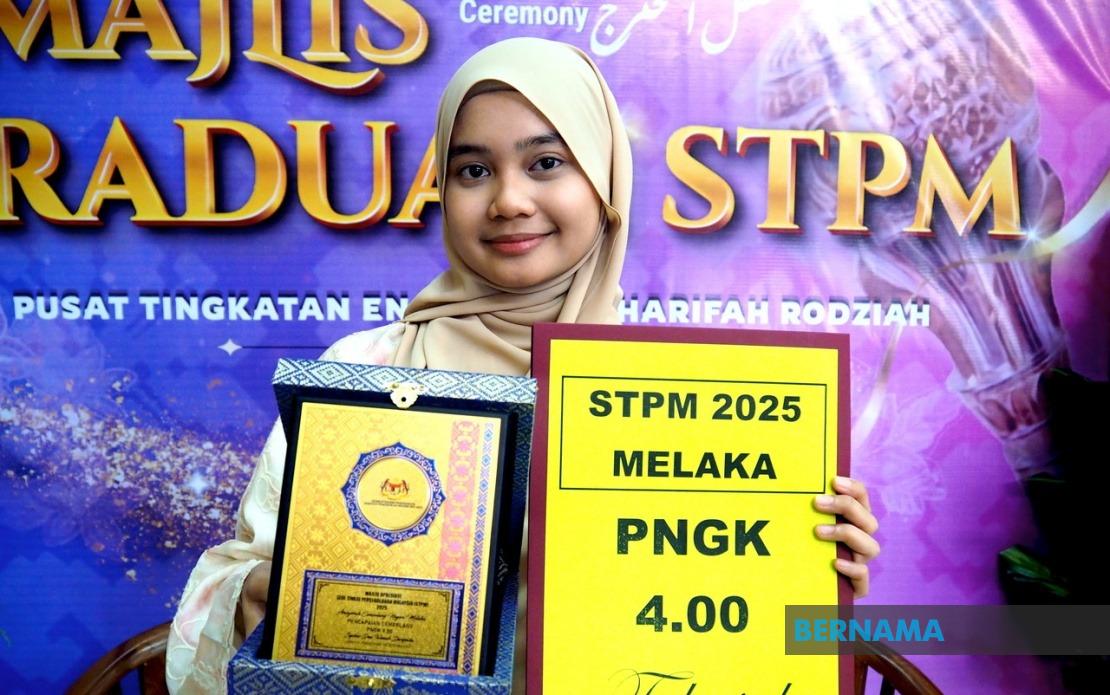
Nurfariesya Nasywa Hamedee's path to academic excellence took shape not in the comfort of stability but amid profound personal loss. The 21-year-old student from Sekolah Menengah Kebangsaan Agama (SMKA) Sharifah Rodziah has achieved a perfect Cumulative Grade Point Average (CGPA) of 4.00 in the 2025 Sijil Tinggi Persekolahan Malaysia (STPM) examination, a distinction announced this week in Melaka. Yet what distinguishes her accomplishment is not merely the numerical perfection of her score, but the resilience and determination that anchored her through grief to reach it. Her achievement was formally celebrated during the Announcement of the 2025 Melaka State STPM Results, officiated by the State Deputy Exco for Education, Higher Education, and Religious Affairs, Datuk Rosli Abdullah.
The catalyst for Nurfariesya's unwavering commitment to her studies arrived in the most unexpected and devastating form. Her father, Hamedee Asri, aged 43, suffered a fatal heart attack a week before she was scheduled to sit her Sijil Pelajaran Malaysia (SPM) trial examination. In that moment of immense sorrow, when grief threatened to derail her educational journey entirely, her late father's parting counsel became her guiding light. Through her mother, Yusnita Ruslan, Hamedee Asri had conveyed a singular message: that Nurfariesya should not squander her abilities and potential. This advice, simple yet profoundly meaningful, crystallised into the central pillar of her motivation moving forward.
The weight of loss bore down heavily on the young student in those initial months. Confronted with the sudden absence of a parent and the financial pressures that death inevitably brings to a family, Nurfariesya found herself entertaining the possibility of abandoning her education altogether. The thought of leaving school to enter the workforce and contribute to her family's resources felt like the responsible course of action. Yet each time doubt threatened to overwhelm her resolve, she returned to her father's parting words—the instruction to study hard, to value her education, to refuse to waste the potential he had always seen in her. What began as inherited grief gradually transformed into inherited purpose. The third of four siblings channelled her sorrow into an inexhaustible dedication to academic excellence, establishing a pattern of rigorous study that would eventually yield extraordinary results.
When the STPM results were announced, Nurfariesya herself was astonished at the magnitude of her achievement. Based on her trial examination results and preliminary calculations conducted throughout the examination period, she had reasonably expected a final CGPA of approximately 3.92. The jump to a perfect 4.00 exceeded even her own optimistic projections and reflected not only her intellectual capability but also the intensity of her concentration and effort during the examination period. Her performance becomes all the more remarkable when considered against the backdrop of the emotional turmoil she had navigated during her secondary school years. She had already demonstrated substantial academic ability during her SPM examination, securing seven A grades—a creditable achievement that would have satisfied most students. Yet her trajectory continued upward through sixth form, suggesting that the personal challenges she faced may have intensified rather than diminished her commitment to learning.
Nurfariesya's choice of subjects reflects a carefully considered academic pathway aligned with her long-term professional ambitions. She undertook General Studies, Arabic, Usuluddin (Islamic Theology), History, and Shariah—a combination that speaks to both intellectual breadth and specific depth of focus. Since her secondary school days, she had nurtured a compelling interest in Shariah law, a field that combines her religious education with practical jurisprudence. Her aspiration to become a Shariah lawyer represents an ambition that bridges her faith-based interests with professional accomplishment. The recent completion of an interview session for a Bachelor's Degree programme at Universiti Malaya represents the concrete manifestation of these long-held career goals, and her exceptional STPM results substantially strengthen her candidacy for admission.
When asked about the formula for her academic success, Nurfariesya deliberately rejected the notion of any mysterious shortcut or hidden technique. Instead, she articulated principles that resonate throughout educational literature yet demand genuine commitment to enact: studying with consistency and focus, refusing to surrender when obstacles emerge, and maintaining profound faith in divine guidance. These principles, she emphasises, do not constitute revolutionary discoveries but rather timeless truths that yield results only through honest application. Her willingness to attribute success partly to spiritual conviction reflects the broader cultural and religious context within which Malaysian education operates, particularly in Islamic schools and institutions. For Nurfariesya, academic achievement and religious devotion are not competing priorities but complementary dimensions of her personal development.
Nurfariesya's deliberate selection of STPM over other post-secondary pathways demonstrates strategic educational planning. She recognised STPM as offering a compressed timeline to degree-level study compared with certain alternative routes, whilst simultaneously providing broad access to quality higher learning institutions. This calculated approach—viewing STPM not merely as a default continuation of schooling but as an optimal strategic choice—reflects a level of educational sophistication that many secondary students lack. Her understanding of how qualification pathways connect to university entry and programme options indicates that she approached her final years of schooling with clear strategic purpose rather than passive progression through the system.
Elsewhere in Melaka's STPM results, another exceptional student has brought distinction to the state at the national level. Ng Zhen Hong, aged 20, from Kolej Tingkatan Enam Tun Fatimah, has been recognised as the recipient of the National-Level Best Student Award for the Science Stream in the 2025 STPM examination. This distinction places him among the most accomplished science students across the entire nation's STPM cohort, a recognition that reflects extraordinary capability in scientific reasoning and problem-solving. Ng himself has emerged as an exemplary model of how rigorous academic pursuit combines with systematic revision and genuine intellectual passion to generate outstanding results.
Ng's achievement stems from foundations laid during his SPM examination, where he secured ten A grades across his subjects. The eldest of two siblings, he benefited substantially from continuous parental support and guidance from his teachers throughout his sixth form years. Yet beyond these external supports lay an intrinsic enthusiasm for science disciplines, particularly those involving mathematical calculation and analytical problem-solving. His daily commitment to revision, typically dedicating between one and two hours each day to reviewing and deepening his understanding of scientific concepts, demonstrates the investment required to reach national-level performance. Rather than viewing scientific challenges as sources of anxiety or discouragement, Ng has cultivated the habit of interpreting them as motivational opportunities—each difficult problem presents an invitation to sharpen his analytical capabilities.
Ng's ambitions point toward advanced engineering disciplines, with his primary focus on either Chemical Engineering or Electrical Engineering programmes at Universiti Malaya. These highly competitive fields demand precisely the combination of mathematical proficiency, practical problem-solving ability, and sustained intellectual commitment that Ng has demonstrated throughout his secondary and sixth form studies. His achievement as the national-level best student for the science stream substantially enhances his positioning for admission to prestigious engineering programmes and provides strong credentials for potential scholarship opportunities.
Taken together, Nurfariesya's and Ng's achievements illustrate the diverse pathways through which Malaysian students reach educational excellence. Nurfariesya's triumph emphasises the role of personal resilience and emotional fortitude in overcoming genuine hardship, whilst her commitment to Shariah law reflects the particular intellectual traditions valued within religious education frameworks. Ng's national recognition highlights the continuing strength of science education within Malaysia's secondary system and the capacity of dedicated students to compete at the highest levels. Both students exemplify how excellence emerges not from a single decisive moment but from sustained daily commitment, meaningful support from family and educators, and personal motivation rooted in clearly articulated long-term goals. Their successes in the 2025 STPM examination signal the continuing vitality of Malaysia's pre-university education system and the calibre of students emerging prepared for higher learning.