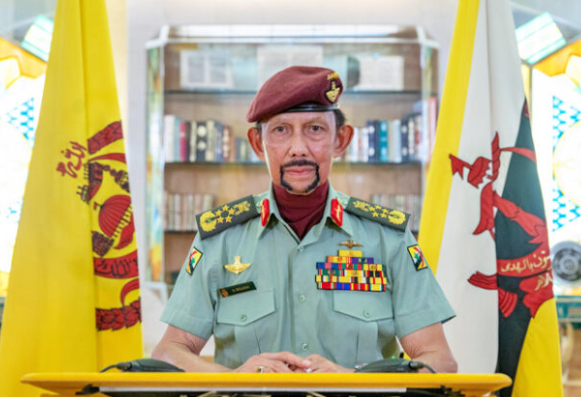
Brunei's Sultan Hassanal Bolkiah has seized the occasion of the Islamic New Year 1448 Hijrah to articulate a vision of national progress grounded in both material advancement and spiritual deepening. In remarks that underscored the interconnectedness of economic development and religious commitment, the monarch stressed that meaningful achievement across these complementary dimensions demands sustained effort and unwavering dedication from the entire nation. His message reframed the start of a new calendar year not as a moment to begin fresh initiatives, but rather as an opportunity to reinvigorate existing resolve and recommit to long-standing objectives that define Brunei's trajectory.
The Sultan identified the dual pillars upon which national progress must rest: the material sphere, encompassing economic vitality and physical infrastructure development, and the spiritual sphere, anchored in the pursuit of knowledge, quality education, and dakwah—the Islamic call to faith. By explicitly naming these domains in his address, the monarch sought to dispel any notion that development could meaningfully occur in isolation from religious and moral grounding. This framing resonates across Southeast Asia, where Muslim-majority nations grapple with balancing rapid modernisation against the preservation of Islamic values and communal cohesion.
Casting his remarks within a broader global context, the Sultan acknowledged the turbulent international environment characterised by persistent conflicts and multifaceted challenges. He painted a sobering portrait of war's consequences, noting that armed conflict generates suffering and hardship that spare no party from its destructive reach. This contextualisation serves an important rhetorical function: it establishes gratitude as an appropriate response to Brunei's own circumstances. The nation's preservation of peace and stability, insulated from the devastating cycles of warfare that plague other regions, emerges in his telling as something deserving of profound appreciation rather than complacency.
The Sultan further elevated national good fortune by attributing Brunei's relative tranquility to spiritual factors. He credited the country's freedom from natural disasters and maintenance of stability to the protective effects of sustained prayer, remembrance of God through zikir, and devoted recitation of the Quran. This invocation of spiritual causation—the notion that collective religious observance generates tangible national blessings—represents a core component of how Islamic governance legitimises itself in Southeast Asia. It positions religious practice not as a private matter but as a public good with measurable consequences for state welfare.
Yet despite this rosy assessment of Brunei's comparative advantages, the Sultan refused to ignore emerging threats to social order. Crime emerged as his primary concern, with particular emphasis on drug-related offences that he identified as especially corrosive to national well-being. Beyond the obvious law-and-order dimensions, the Sultan framed criminal activity as fundamentally incompatible with Islamic teaching, thereby mobilising religious authority to underscore the moral imperative to combat such behaviour. Theft and other criminal acts, in his view, simultaneously damage Brunei's international standing and violate core religious principles.
This framing carries particular significance for Malaysia and the broader region, where drug trafficking and consumption have become persistent policy challenges. By anchoring the anti-crime agenda in Islamic doctrine rather than purely in state security concerns, the Sultan advanced a religiously grounded argument for law enforcement that may resonate with populations in neighbouring countries struggling with similar phenomena. The integration of religious and civil authority in combating crime represents a distinctive Southeast Asian approach to governance that differs markedly from secular frameworks.
The Sultan called upon relevant government agencies, specifically those managing security and religious affairs, to respond with urgency and effectiveness. This division of labour—tasking both security specialists and religious authorities with addressing crime—reflects a sophisticated understanding of how modern states must mobilise multiple institutional resources to address complex social problems. The religious sector, he argued, bears special responsibility for strengthening Islamic education and intensifying dakwah efforts that cultivate societal awareness of and resistance to drug abuse and criminal activity.
The monarch's emphasis on religious education as a crime-prevention tool represents a particularly Southeast Asian strategy for social control. Rather than relying solely on enforcement and punishment, the Sultan proposed that deeper religious knowledge and commitment naturally generate rejection of behaviour deemed incompatible with faith. This preventive approach, rooted in spiritual formation rather than external coercion alone, reflects assumptions about human motivation that differ from purely secular criminology frameworks prevalent in Western policy discussions.
In perhaps his most striking rhetorical move, the Sultan positioned prayer for national safety and protection as a legitimate and necessary component of crime prevention strategy. He urged the Muslim population to maintain vigilant watchfulness whilst simultaneously intensifying supplication to Allah for divine safeguarding. This dual emphasis—combining active human effort with reliance on divine intervention—represents a characteristically Islamic approach to governance challenges. It avoids presenting state action as either wholly dependent on human agency or wholly reliant on spiritual forces, instead weaving both into an integrated framework.
The Sultan's insistence on vigilance against complacency carries particular weight given Brunei's experience of relative stability. He warned that the blessing of peace and order must not breed negligence or false confidence. This concern reflects a realistic understanding that social problems, once established, prove difficult to eradicate and that prevention through constant awareness and effort represents a more efficient approach than reactive crisis management. For Malaysian policymakers similarly concerned with maintaining social order amid rapid change, this message offers a cautionary reminder about the dangers of assuming that past stability guarantees future security.
Crucially, the Sultan framed safeguarding both the Islamic community and the nation as a collective responsibility transcending institutional boundaries. Neither government agencies alone nor religious authorities in isolation could achieve this objective; rather, the entire populace must embrace their role as guardians of national welfare. This emphasis on shared accountability resonates across Southeast Asia, where societies increasingly recognise that complex challenges require mobilisation of civil society alongside state institutions.
The Sultan and royal family extended formal greetings for the Hijrah New Year 1448 to all residents of Brunei Darussalam, a seemingly ceremonial gesture that nonetheless reinforces inclusive national identity transcending religious categorisation. This inclusive framing demonstrates sophisticated statecraft, extending New Year wishes to both Muslim and non-Muslim inhabitants whilst maintaining the explicitly Islamic framework of governance. For Malaysia and other pluralistic Southeast Asian states, such rhetorical balance offers lessons in maintaining Islamic governance frameworks whilst respecting religious diversity.
Ultimately, the Sultan's address articulated a vision of national progress fundamentally rooted in spiritual renewal and collective vigilance. Rather than offering grand pronouncements about economic transformation or infrastructure development, he grounded his message in the less glamorous but arguably more important project of cultivating the moral and spiritual resources upon which sustainable national development depends. In an era of rapid social change and globalisation, his emphasis on the enduring relevance of faith-based community cohesion and shared values offers a counternarrative to purely technocratic approaches to governance.