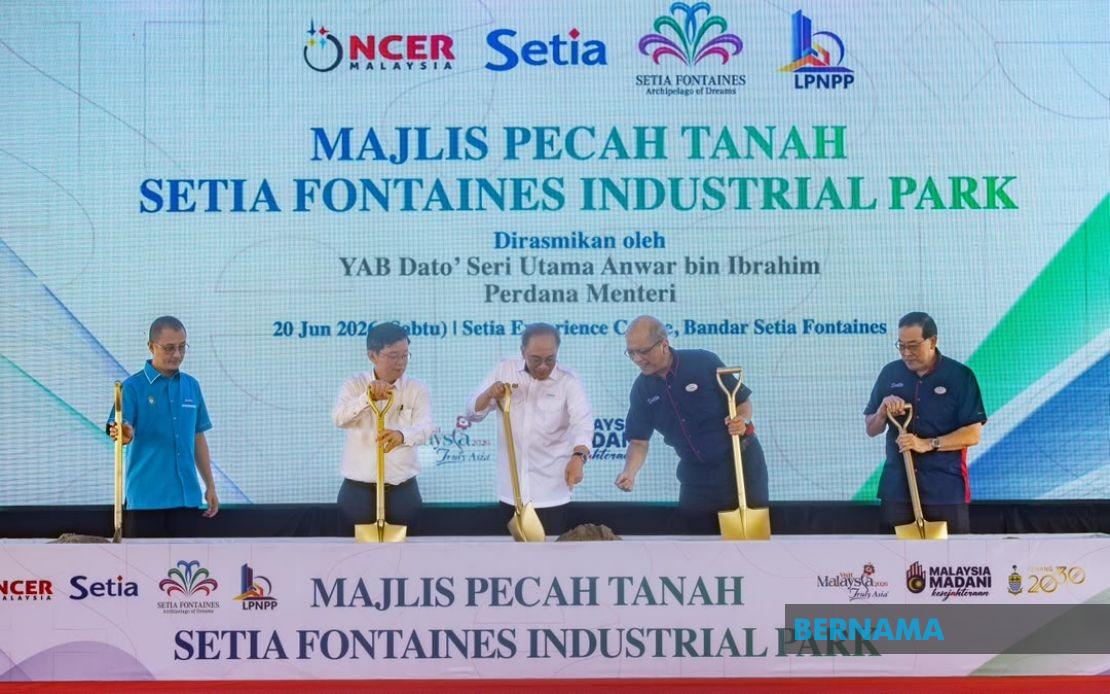
Prime Minister Datuk Seri Anwar Ibrahim has called on both government-linked companies and the private sector to embed economic opportunities for lower- and middle-income groups into their development projects, cautioning that Malaysia faces a growing inequality problem if current investment patterns remain unchanged. Speaking at the groundbreaking ceremony for the Setia Fontaines Industrial Park in Bandar Setia Fontaines, Kepala Batas, Anwar stressed that approvals granted to major institutional investors—including Khazanah Nasional Berhad, Permodalan Nasional Berhad, the Employees Provident Fund, and private enterprises—must be conditional on tangible benefits reaching Malaysians across the income spectrum.
The Prime Minister's remarks reflect growing political attention to wealth distribution concerns in Malaysia, where rapid economic growth has not uniformly translated into shared prosperity. Anwar framed inclusive development as essential to social cohesion, arguing that concentrating opportunities among privileged segments while constraining pathways for ordinary Malaysians would produce a fractured society. His intervention signals that the federal government intends to use its approval mechanisms for major projects as leverage to enforce distributional requirements, moving beyond rhetorical commitment to structural enforcement of equity considerations.
Anwar challenged conventional development metrics that treat growth statistics as the primary success indicator, contending instead that projects must be evaluated by their capacity to improve living standards for ordinary citizens. This philosophical reorientation rejects the trickle-down economic assumption that rising aggregate investment automatically benefits lower-income populations. Instead, it posits that intentional design and resource allocation mechanisms must be built into projects from inception to prevent wealth accumulation at the top of the income pyramid while opportunity remains scarce for those below.
The Setia Fontaines Industrial Park exemplifies the type of development Anwar envisions as part of Seberang Perai's economic acceleration. The project represents an effort to ensure that the mainland peninsula district experiences comparable prosperity to Penang Island and the state's southern regions, which have absorbed disproportionate shares of recent investment. By positioning the industrial park as an instrument for geographically equitable development, Anwar underscored how regional inequality intersects with income-based disparities, requiring coordinated solutions that address both dimensions simultaneously.
The industrial park's potential to generate high-quality manufacturing and technology employment sits at the centre of Anwar's strategy to upgrade Malaysia's economic positioning. As the country transitions from labour-intensive, back-end manufacturing toward advanced technology sectors, the availability of skilled workers becomes the binding constraint on competitive advantage. Anwar recognized that employment quantity alone—merely creating job openings—proves insufficient if the workforce lacks the competencies these positions demand, effectively creating structural unemployment masquerading as labour market tightness.
To address this skills mismatch, Anwar advocated for enhanced collaboration among industry employers, technical and vocational education institutions, and universities including Universiti Sains Malaysia. This tripartite model acknowledges that curriculum development cannot remain disconnected from employer requirements or follow lengthy lag periods between skill identification and educational programme deployment. The urgency reflects how rapidly technological change occurs; competencies become obsolete within months as industrial processes evolve, necessitating continuous alignment between training providers and evolving employer needs.
The Prime Minister's remarks carry particular significance for Southeast Asia's broader development conversation. Malaysia faces a critical inflection point where continued reliance on low-cost labour advantages becomes untenable as regional competitors and automation accelerate. The inclusive growth framework Anwar articulates suggests Malaysia must simultaneously upgrade its workforce capabilities while ensuring that transition benefits distribute reasonably across social groups. Without deliberate inclusion mechanisms, economic upgrading risks becoming a process that elevates already-advantaged populations while leaving lower-income communities in stagnant sectors with declining relative prospects.
Anwar's insistence that government approval mechanisms incorporate distributional requirements represents a departure from purely technocratic decision-making frameworks that emphasize financial returns or aggregate productivity metrics. By conditioning approvals on equity provisions, the government signals that institutional investors cannot treat social outcomes as externalities to be managed separately from core business decisions. This approach requires investors to demonstrate credible pathways for meaningful lower-income participation rather than token corporate social responsibility gestures.
The industrial park announcement occurs amid broader Malaysian policy attention to inclusive growth, reflecting both political calculation and genuine concern about social stability. Middle-income trap anxieties extend beyond economists' discussions of per-capita GDP stagnation to encompass real public anxiety about opportunity scarcity and intergenerational mobility. Anwar's emphasis suggests the government recognizes that sustainable growth depends on broad-based confidence in upward mobility prospects, not merely aggregate economic statistics.
Implementing Anwar's vision requires clarity on enforcement mechanisms and accountability standards. How will government agencies verify that development projects genuinely create meaningful opportunities for target populations rather than superficial compliance through low-wage positions or tokenistic hiring? The gap between political commitment and institutional capacity to monitor and enforce inclusive development provisions remains unclear, presenting implementation challenges that will determine whether this rhetorical emphasis translates into actual distributional outcomes.
Looking forward, the Setia Fontaines Industrial Park will serve as a test case for whether Malaysia's inclusive growth ambitions can operate at scale. Success would require demonstrating that competitive industrial parks can simultaneously attract global investment and provide accessible opportunity pathways for workers without advanced qualifications. The project's outcomes will likely influence whether similar distributional requirements become standard across major Malaysian development initiatives or remain aspirational statements without systematic enforcement.
%22%2F%3E%3C%2Fpattern%3E%3C%2Fdefs%3E%3Crect%20width%3D%22100%25%22%20height%3D%22100%25%22%20fill%3D%22url(%23ph2wtq6g)%22%2F%3E%3Crect%20width%3D%22100%25%22%20height%3D%22100%25%22%20fill%3D%22url(%23ph2wtq6p)%22%2F%3E%3Ctext%20x%3D%2250%25%22%20y%3D%2250%25%22%20text-anchor%3D%22middle%22%20dominant-baseline%3D%22central%22%20fill%3D%22rgba(255%2C255%2C255%2C0.95)%22%20font-family%3D%22Georgia%2C%20'Times%20New%20Roman'%2C%20serif%22%20font-weight%3D%22700%22%20font-size%3D%22320%22%20letter-spacing%3D%22-0.02em%22%3ETV3%3C%2Ftext%3E%3C%2Fsvg%3E)
%22%2F%3E%3C%2Fpattern%3E%3C%2Fdefs%3E%3Crect%20width%3D%22100%25%22%20height%3D%22100%25%22%20fill%3D%22url(%23ph3gf80g)%22%2F%3E%3Crect%20width%3D%22100%25%22%20height%3D%22100%25%22%20fill%3D%22url(%23ph3gf80p)%22%2F%3E%3Ctext%20x%3D%2250%25%22%20y%3D%2250%25%22%20text-anchor%3D%22middle%22%20dominant-baseline%3D%22central%22%20fill%3D%22rgba(255%2C255%2C255%2C0.95)%22%20font-family%3D%22Georgia%2C%20'Times%20New%20Roman'%2C%20serif%22%20font-weight%3D%22700%22%20font-size%3D%22170%22%20letter-spacing%3D%22-0.02em%22%3ENational%3C%2Ftext%3E%3C%2Fsvg%3E)
%22%2F%3E%3C%2Fpattern%3E%3C%2Fdefs%3E%3Crect%20width%3D%22100%25%22%20height%3D%22100%25%22%20fill%3D%22url(%23ph4jjg8g)%22%2F%3E%3Crect%20width%3D%22100%25%22%20height%3D%22100%25%22%20fill%3D%22url(%23ph4jjg8p)%22%2F%3E%3Ctext%20x%3D%2250%25%22%20y%3D%2250%25%22%20text-anchor%3D%22middle%22%20dominant-baseline%3D%22central%22%20fill%3D%22rgba(255%2C255%2C255%2C0.95)%22%20font-family%3D%22Georgia%2C%20'Times%20New%20Roman'%2C%20serif%22%20font-weight%3D%22700%22%20font-size%3D%22170%22%20letter-spacing%3D%22-0.02em%22%3EJudicial%3C%2Ftext%3E%3C%2Fsvg%3E)