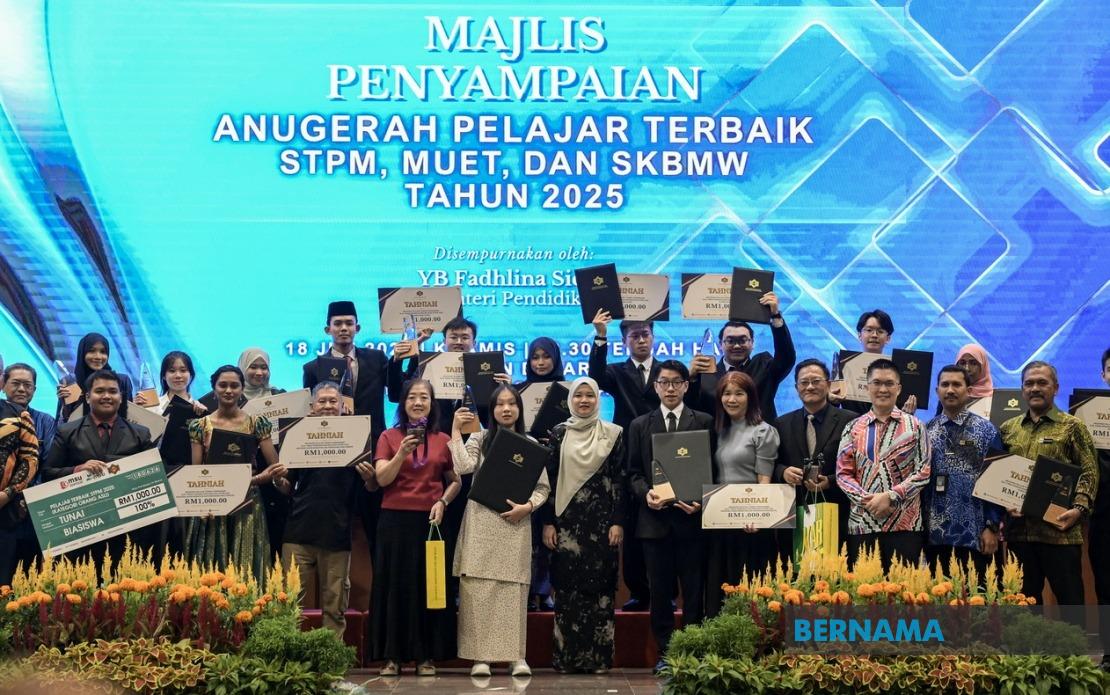
Eighteen of Malaysia's highest-achieving STPM 2025 students will gain access to tuition scholarships offered by public universities, under a newly launched government initiative designed to recognise academic excellence and bolster the Form Six education stream. Education Minister Fadhlina Sidek unveiled the scholarship programme during an awards ceremony at the Malaysian Examinations Council (MPM) Building in Kuala Lumpur on June 18, positioning the move as part of broader efforts to make the pre-university route more attractive to school leavers seeking alternatives to the matriculation pathway.
The scholarship scheme represents a coordinated commitment from Malaysia's public higher education sector, with each institution pledging to sponsor the top-performing STPM candidates for undergraduate study. Rather than offering cash grants, the sponsorships cover tuition fees directly, ensuring financial support reaches students at the point of enrolment. Fadhlina expressed gratitude to all participating universities, framing their participation as a collective investment in the nation's young talent and a recognition that excellence at Form Six level merits institutional support at the tertiary stage.
This initiative sits within a wider government strategy to revitalise and expand the Form Six ecosystem, which has faced declining enrolment as students increasingly opt for the matriculation system or international qualifications. The Education Ministry has implemented complementary measures including establishment of additional Form Six Colleges, provision of classroom technology such as smartboards, early assistance schemes for economically disadvantaged students, and the MADANI Book Vouchers programme designed to improve access to learning materials. Together, these initiatives signal official commitment to positioning Form Six as a competitive and well-resourced pathway to university education.
Performance data from the 2025 STPM cohort offers encouraging signs for the pre-university system. The national Overall Grade Point Average (CGPA) climbed to 2.88 in 2025, up from 2.85 the previous year, indicating marginal but consistent improvement in student outcomes. While the gain appears incremental, Fadhlina characterised the result as reflective of strengthened educational quality, suggesting that recent infrastructural and support investments are beginning to translate into measurable academic gains across the Form Six population.
For Malaysian students, the scholarship programme addresses a practical barrier to university access: the financial burden of undergraduate tuition. By removing or significantly reducing this cost for top performers, public universities lower entry obstacles for high-achieving students from middle and lower-income families who might otherwise defer higher education or seek cheaper private alternatives. The scheme simultaneously creates competitive incentive within Form Six colleges, as students understand that exceptional performance carries tangible rewards at the university level.
The timing of this announcement reflects broader regional education trends. Throughout Southeast Asia, governments are experimenting with merit-based scholarship models to attract talent into preferred educational pathways. Malaysia's approach differs from purely need-based assistance by explicitly rewarding academic excellence, aligning with international best practice where top scholars enjoy subsidised entry into premier institutions. This meritocratic dimension may resonate particularly with ambitious students and their families, potentially reversing years of decline in Form Six applications.
From an institutional perspective, the scholarship initiative signals that public universities are accepting responsibility for undergraduate talent acquisition and retention. Rather than relying solely on government allocations or student fees, universities are dedicating resources to attract the strongest STPM candidates early in their tertiary education journey. This proactive approach may improve the calibre of entrants, enhance institutional rankings, and foster stronger connections between secondary and tertiary education sectors that have historically operated with limited coordination.
The programme also carries implications for educational equity and social mobility. If the 18 scholarships are distributed proportionally across Malaysia's diverse student population, they may support high achievers from underrepresented regions, lower-income backgrounds, or minority communities who might otherwise be unable to afford university fees despite academic merit. However, the scheme's actual distributional impact will depend on how selection criteria are constructed and how many recipients come from advantaged versus disadvantaged socioeconomic backgrounds.
Critical questions remain regarding scheme sustainability and scale. Eighteen scholarships across multiple public universities represents a modest initial cohort; whether the programme expands significantly in subsequent years, or remains numerically limited, will determine its broader reach and public perception. Additionally, the focus on tuition sponsorship alone leaves other cost barriers intact, including accommodation, books, and living expenses that often deter capable students from completing tertiary study. A comprehensive scholarship covering all relevant costs might prove more transformative than tuition-only support.
For prospective students currently in Form Five or lower, the announcement signals that high achievement in STPM yields tangible rewards. This messaging could stimulate enrolment growth in Form Six, reversing a decade-long trend toward matriculation. Guidance counsellors and school administrators may now highlight the scholarship opportunity when advising students on post-secondary pathways, potentially shifting family conversations about whether Form Six represents a viable and rewarding option.
The initiative also reflects government acknowledgment that the pre-university system requires differentiated support compared to matriculation. Where matriculation students benefit from integrated pathways within public universities, Form Six students traditionally compete for limited places in a separate admissions process. By institutionalising scholarships specifically for top STPM performers, the Education Ministry is creating a parallel incentive structure that acknowledges and rewards Form Six academic success in ways comparable to matriculation privileges.
Deputy Education Minister Wong Kah Woh, MPM chairman Prof Datuk Dr Md Amin Md Taff, and Education Malaysia director-general Datuk Dr Mohd Azam Ahmad attended the awards ceremony, underlining the initiative's institutional significance and whole-of-government support. This high-level presence suggests the scheme reflects deliberate policy priority rather than institutional goodwill alone, with senior officials positioned to oversee implementation and ensure public universities maintain commitment as the programme matures.
Looking forward, success of this scholarship initiative will be measured not only by the 18 initial recipients but by whether the programme catalyses broader institutional change. If public universities maintain and expand scholarships in subsequent years, if STPM enrolment stabilises or grows, and if participating students complete their degrees successfully, the programme will merit expansion as a model worth scaling. For now, it represents an important first step toward rebuilding government confidence in Form Six as a credible and attractive pre-university pathway.