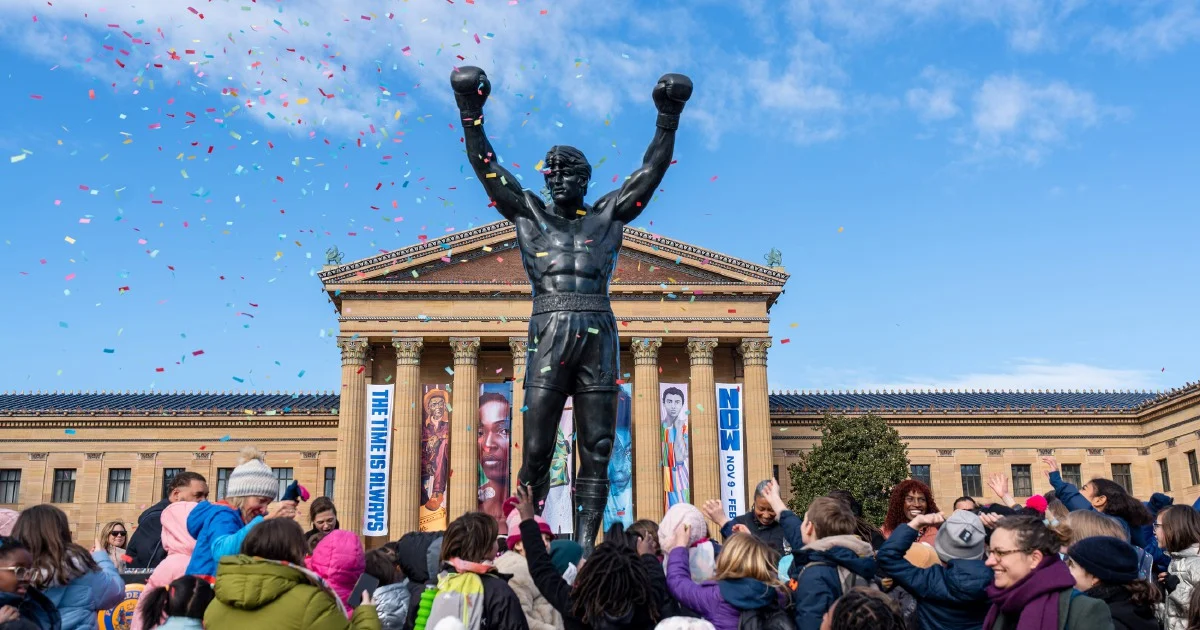
The French Football Association took the unusual step of cautioning its supporters gathered in Philadelphia on Saturday against interacting with the city's most famous monument to fictional pugilism—the Rocky Balboa statue—over concerns that a well-documented curse might undermine the nation's World Cup campaign. The warning, delivered amid the high-stakes atmosphere of international football competition, reflects how deeply superstition has embedded itself in professional sport, where rational analysis and mystical thinking often coexist uneasily.
The statue, which immortalises Sylvester Stallone's beloved character scaling Philadelphia's steps in the 1976 film, has become a tourist destination and focal point for visiting fan groups. What began as innocent traditions, however, has allegedly transformed into a jinx of notable proportions. Numerous international teams whose supporters dressed the bronze figure in their national colours or otherwise marked it with their presence have subsequently experienced competitive disasters. These coincidences, whether genuinely causal or merely coincidental, have accumulated enough credibility within football circles to warrant official intervention.
Such warnings reflect the peculiar intersection of modern sports management and ancient human psychology. Sports organisations worldwide have long grappled with how to address superstitious beliefs among players and supporters without either dismissing them as mere folklore or appearing to endorse irrational thinking. The French Football Association's decision to issue this advisory suggests that the governing body considers the reputational and psychological risks significant enough to warrant a public statement, even if the underlying mechanism defies scientific explanation.
For Malaysian readers, this phenomenon resonates within our own sporting culture, where numerology, traditional beliefs, and ritualistic practices frequently influence team decisions and fan behaviour. Just as athletes across Southeast Asia consult spiritual advisors before major competitions or avoid certain colours and numbers, the French warning demonstrates that superstition transcends geographical and cultural boundaries. Whether in Kuala Lumpur or Philadelphia, the impulse to manage invisible forces through behavioural control remains deeply human.
The historical record of purported Rocky statue curses demonstrates a pattern that has accumulated through multiple World Cup cycles. Teams from various nations have found themselves positioned near the statue during their respective campaigns, and subsequent poor performances have been retrospectively linked to the interaction. These narratives, once established, develop their own momentum within fan communities and eventually reach official channels, where they cannot be casually dismissed regardless of their empirical validity.
The psychological dimension of such warnings warrants serious consideration. If French supporters believe that touching the statue invites misfortune, that belief itself could theoretically influence team morale and performance through entirely conventional mechanisms—stress, anxiety, and reduced confidence. In this interpretation, the curse operates not through supernatural means but through the collective psychology of millions of supporters whose emotional state directly impacts players. The French Football Association's warning thus serves as a circuit-breaker, attempting to prevent a potential psychological feedback loop before it can establish itself.
Philadelphia's iconic Rocky monument has evolved from a cinematic prop into a genuine pilgrimage site for sports fans worldwide. The city's civic pride in the statue has made it a natural gathering point for international supporters, yet this very popularity has created the conditions for curse narratives to develop and proliferate. Each new team's misfortune gets added to the mythological repository, while successful teams conveniently receive no attention within these narratives—a cognitive bias that strengthens rather than weakens belief in the curse's power.
The warning also reflects practical concerns beyond mere superstition. World Cup campaigns involve intense scrutiny of every variable, from training conditions to psychological preparation. France's coaching staff, facing extreme pressure to deliver success, would understandably want to eliminate potential sources of distraction or negative sentiment among supporters. By issuing the advisory, the federation demonstrates responsiveness to fan concerns while simultaneously reinforcing the message that World Cup success depends on unity and focus rather than extraneous factors.
For Southeast Asian football enthusiasts following France's World Cup journey, this episode reveals something essential about international sport: the vast machinery of professional football—with its analytics teams, sports science departments, and technical expertise—still operates alongside currents of belief and tradition that resist rational reduction. The tension between these forces plays out in real time, with organisations like the French Football Association navigating the space between scientific rigour and cultural acknowledgment.
Ultimately, whether the Rocky Balboa statue genuinely carries a curse matters less than the fact that millions of people believe it might. In this sense, the French warning represents not a capitulation to irrational thinking but rather a sophisticated recognition that human perception shapes reality in contexts where billions of dollars and national pride hang in the balance. The team that ignores such currents entirely does so at its own risk, whatever one's personal stance on the existence of sporting curses might be.