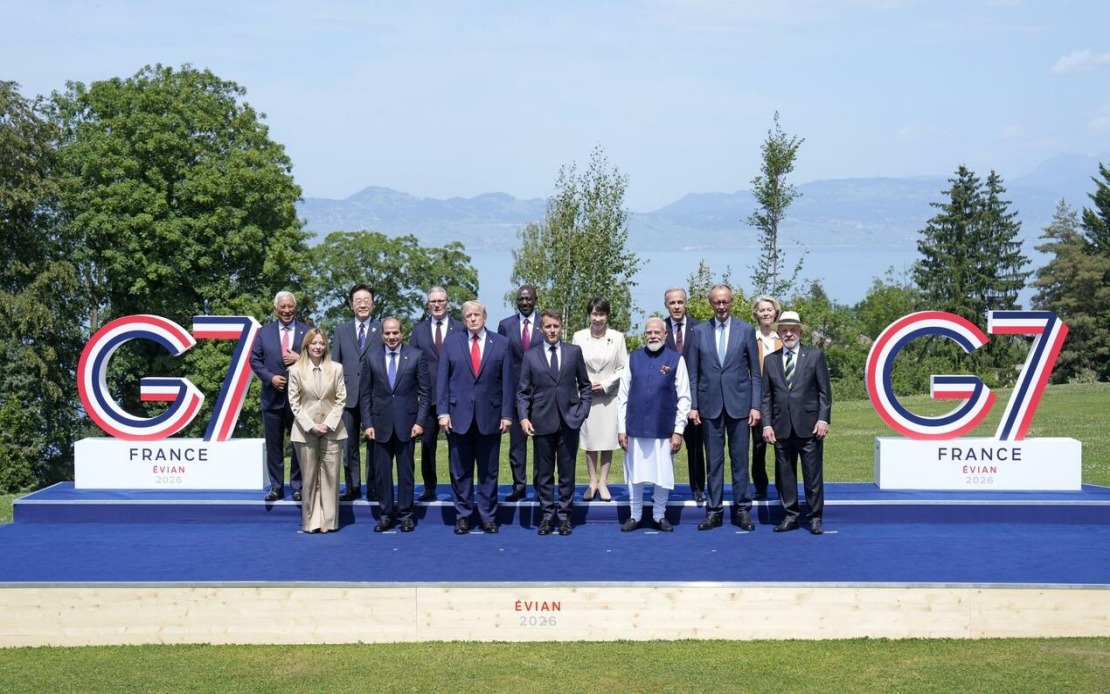
The world's most powerful democracies have signalled fresh determination to sustain Ukraine's position in its conflict with Russia, cementing this resolve at their annual summit in the Alpine French resort town of Evian-les-Bains on the shores of Lake Geneva. Yet the show of solidarity masked deeper divisions within the Western alliance, particularly between Donald Trump and his European counterparts over trade policy, NATO burden-sharing, and competing visions for resolving global security crises. The concord achieved on Ukraine underscores how the two-year-old war has become a defining test of Western cohesion, even as individual member states pursue divergent strategic calculations.
Trump seized the opportunity to broadcast his negotiation-focused approach, telling reporters that Russia faces enormous human losses and should consider a settlement rather than prolonging the conflict. His framing presented itself as pragmatic realism—a bid to end suffering through direct engagement—yet it jarred with European expectations that Washington would maintain unwavering backing for Kyiv. The American President drew a parallel to his recent dealings with Iran, suggesting that the temporary easing of sanctions he had initiated to stabilise global oil markets could be reversed once the Iran situation stabilised fully. This linkage between Middle Eastern affairs and the Ukraine conflict revealed how Trump views these crises through the lens of transactional statecraft and resource control, a departure from the values-based rhetoric that characterises much European diplomacy.
Ukrainian President Volodymyr Zelenskyy participated directly in discussions with the G7 collective, setting out his immediate priorities with clarity. He emphasised the critical need to strengthen air defence systems for Ukraine, a practical demand reflecting the ongoing Russian campaign to degrade Ukrainian civilian and military infrastructure through aerial bombardment. Beyond hardware, Zelenskyy highlighted the importance of sustained diplomatic engagement aimed at compelling Russia to cease hostilities. His messaging reflected the reality that Ukrainian military success increasingly depends on European engagement alongside American support, a dynamic that has shifted since the conflict's opening phase when Washington played the dominant role in Western assistance.
Japanese Prime Minister Sanae Takaichi articulated the necessity of maintaining G7 unity as leverage against Russia, warning that Moscow must demonstrate responsiveness through tangible and timely actions. Her remarks carried particular weight given Japan's own security concerns regarding Russian military deepening with both North Korea and China. Takaichi's emphasis on preventing unilateral territorial changes through force offered an implicit critique of Russian behaviour while also signalling concern about broader patterns of coercion in the Indo-Pacific region. The statement reflected how the Ukraine conflict has become entwined with security anxieties across multiple regions, particularly for nations monitoring Chinese and Russian military cooperation with alarm.
For Southeast Asian observers, the G7 dynamics carry significant implications. The alliance's capacity to maintain a unified front on Ukraine determines its credibility in addressing other regional challenges, from the South China Sea tensions to Myanmar's instability. Malaysia and other ASEAN members have pursued studied neutrality on the Ukraine question, unwilling to alienate either Russia or the collective West. Yet the apparent fractures within the G7—evidenced by Trump's willingness to suggest sanctions relief and his broader friction with European leaders—could embolden actors who perceive Western resolve as weakening. The summit's outcome suggests the West retains sufficient consensus to prevent a sudden capitulation to Russian demands, but questions linger about the sustainability of this position if American strategic priorities shift further.
The summit's agenda expanded well beyond Ukraine, encompassing the unfolding situation in West Asia where a preliminary agreement between the United States and Iran has promised to reopen the Strait of Hormuz and ease regional tensions. The G7 collectively welcomed this development, recognising that stability in this critical shipping chokepoint carries global economic consequences. Leaders from invited nations including Egypt, Qatar, and the United Arab Emirates participated in substantive discussions, acknowledging that durable peace requires broader regional participation beyond traditional Western forums. This expansion of the G7 format reflects a recognition that contemporary security challenges demand inclusive approaches, even if this complicates decision-making and introduces competing interests.
France, holding the rotating G7 presidency, leveraged the summit to advance its agenda on development finance reform, an initiative born from recognition that traditional official development assistance has proven insufficient to meet the needs of developing economies. The joint declaration committed member states to reshaping development partnerships around mutual benefit rather than donor-recipient hierarchies, a subtle but significant reorientation. This reflects growing awareness that poorer nations have expanded options for partnership and cannot be taken for granted. The emphasis on mobilising private capital for long-term infrastructure projects signals an attempt to compete with alternative development models, particularly China's Belt and Road Initiative, which has gained traction across Asia and Africa through its apparent willingness to finance mega-projects regardless of traditional governance concerns.
The inclusion of Brazil, India, South Korea and other nations outside the traditional G7 circle demonstrates how Western leadership structures have evolved to acknowledge multipolar realities. These countries possess significant economic weight and geopolitical influence that the G7 cannot ignore. For Malaysia and the broader ASEAN community, such invitations signal that Western powers recognise the region's importance and seek to cultivate alignment on global issues. Yet ASEAN's preference for non-alignment and strategic ambiguity remains the wiser course, allowing the bloc to benefit from competition for its affections whilst avoiding entanglement in disputes that do not directly threaten core regional interests.
Trump's apparent eagerness to broker agreements across multiple theatres—Ukraine, Iran, and potentially others—reflects a transactional worldview that privileges tangible outcomes over ideological alignment. This approach carries both advantages and risks for traditional allies. The potential benefit lies in accelerated resolution of intractable conflicts; the risk involves premature concessions that leave vulnerable parties exposed. For Ukraine specifically, the concern centres on whether American negotiating pressure might culminate in a settlement that formalises Russian territorial gains, a possibility that generates anxiety in Kyiv and parts of Europe. The contrast between Trump's emphasis on negotiations and European insistence on supporting Ukraine until a just resolution emerges highlights the philosophical divergence that may constrain Western unity going forward.
The summit's closing position—reaffirming support for Ukraine while acknowledging the desirability of peace—represents a careful balance between competing imperatives. Whether this consensus can withstand sustained pressure depends partly on battlefield developments, partly on American domestic political evolution, and partly on Russian willingness to engage seriously in negotiations. For Malaysia and Southeast Asia, the crucial takeaway involves recognising that Western unity, however strained, remains central to the regional balance. A wholesale fragmentation of the G7 would diminish Western capacity to underwrite the rules-based order that protects smaller nations from predatory behaviour by larger powers. Consequently, regional powers have a stake in the West's ability to manage internal differences whilst maintaining sufficient coherence on fundamental principles.