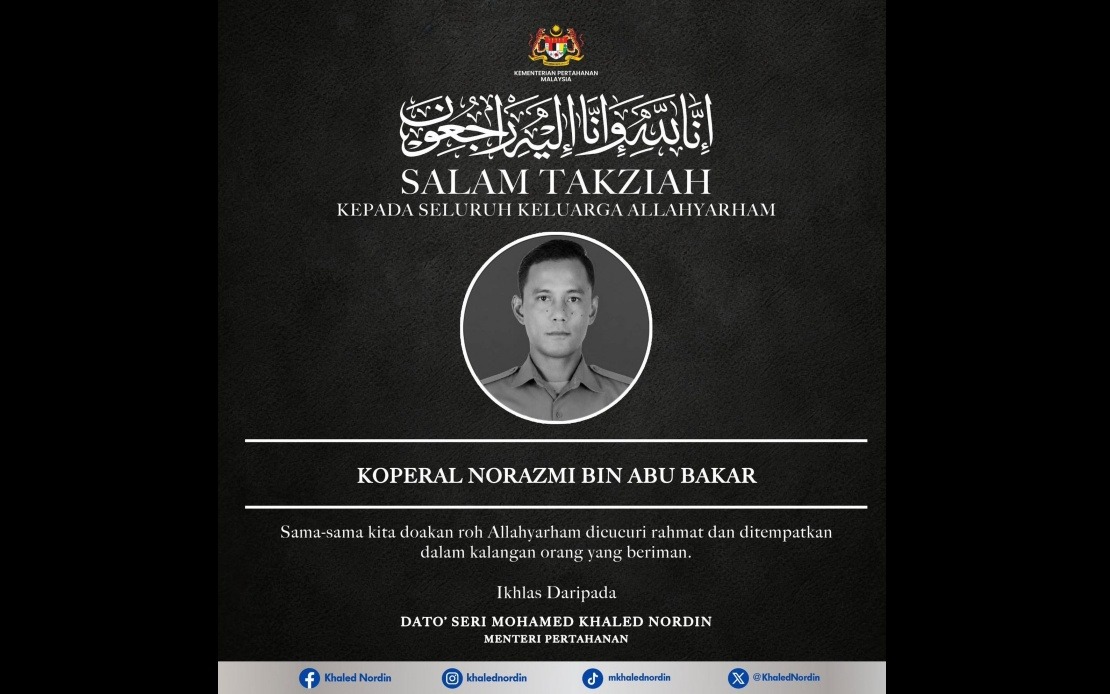
The Malaysian government and Ministry of Defence are grieving the loss of two army personnel who died in a tragic training accident in Kedah on June 16. Corporal Norazmi Abu Bakar of the 6th Battalion, Royal Malay Regiment, and Private Siti Khadijah Sungip of the 1st Squadron, Royal Army Engineers Regiment, were fatally injured during a grenade-throwing exercise at Hobart Camp firing range in Gurun. The incident occurred at 10.57 am, with both servicemen succumbing to their injuries while being transported to Sultan Abdul Halim Hospital in Sungai Petani.
Defence Minister Datuk Seri Mohamed Khaled Nordin released a statement expressing profound sorrow over the deaths of the two military personnel. In a post shared across social media, the minister conveyed the government's sympathies to the bereaved families and prayed that they would find strength during this difficult period. He called upon all citizens to pray for the departed soldiers, invoking Islamic blessings for their souls and requesting forgiveness of their sins, with hope that they would be admitted among the faithful servants of Allah.
The Malaysian Army formally confirmed the identities of both victims and provided details regarding the circumstances of the fatal explosion. The incident represents a sobering reminder of the inherent dangers present in military training operations, particularly those involving explosive devices and ordnance handling. Grenade-throwing exercises are standard components of infantry and combat engineer training programmes designed to familiarize personnel with live weapons in controlled environments.
Army Chief General Tan Sri Azhan Md Othman has taken swift action by directing a comprehensive investigation into the incident. The investigation will seek to establish the underlying cause of the explosion and determine whether procedural, equipment, or human factors contributed to the tragedy. Such inquiries are crucial for preventing similar accidents in the future and ensuring that safety protocols remain robust and effective across all military training facilities.
The deaths of Corporal Norazmi and Private Siti Khadijah underscore the risks that military personnel accept when they join the armed forces. Training accidents, though relatively uncommon given the stringent safety measures typically in place, nonetheless occur during the execution of operational readiness programmes. The Malaysian Army, like military organizations worldwide, must continually balance the need for realistic and challenging training with comprehensive safety measures to protect personnel from preventable harm.
Private Siti Khadijah's death is particularly noteworthy as it highlights the significant role that women now play in the Malaysian Army and engineering corps. Her service as a member of the Royal Army Engineers Regiment represents the modernization of Malaysia's defence forces and the expansion of operational opportunities for female service members across various military disciplines and specializations.
The incident has prompted immediate government attention at the highest levels. Beyond the Defence Minister's statement, the broader government apparatus is likely examining whether additional safety measures, refresher training protocols, or equipment upgrades are warranted across military training ranges nationwide. Such incidents often catalyze systemic reviews and improvements to prevent recurrence.
For families of military personnel, such tragedies represent an unexpected and devastating loss. While military service inherently carries occupational risks, training accidents strike differently from combat-related casualties, as they occur during routine operational activities rather than in active conflict zones. The psychological impact on military units and the broader defence establishment following such incidents can be substantial and long-lasting.
The government's prompt expression of condolences reflects the importance placed on recognizing and honouring the sacrifice of military personnel. Public acknowledgment from senior government officials and the Defence Minister sends a message that the government values the service of its armed forces and takes seriously the safety and welfare of military personnel and their families.
As investigations proceed into the specific circumstances of the explosion at Hobart Camp, attention will turn to whether systemic improvements in training safety protocols are necessary. The findings may influence how grenade-throwing exercises are conducted across Malaysian military installations and whether additional safeguards or supervision protocols should be implemented. Defence forces globally have learned from such incidents that even well-established training procedures require periodic review and enhancement to maintain the highest safety standards.
The tragic loss of these two servicemen serves as a solemn reminder of the dedication and sacrifice of Malaysia's military personnel. Both Corporal Norazmi and Private Siti Khadijah were engaged in the routine yet essential work of maintaining military readiness when the accident occurred. Their deaths will be remembered within their units and across the broader defence establishment as a tragic reminder of the importance of unwavering commitment to safety protocols and continuous improvement in training methodologies.