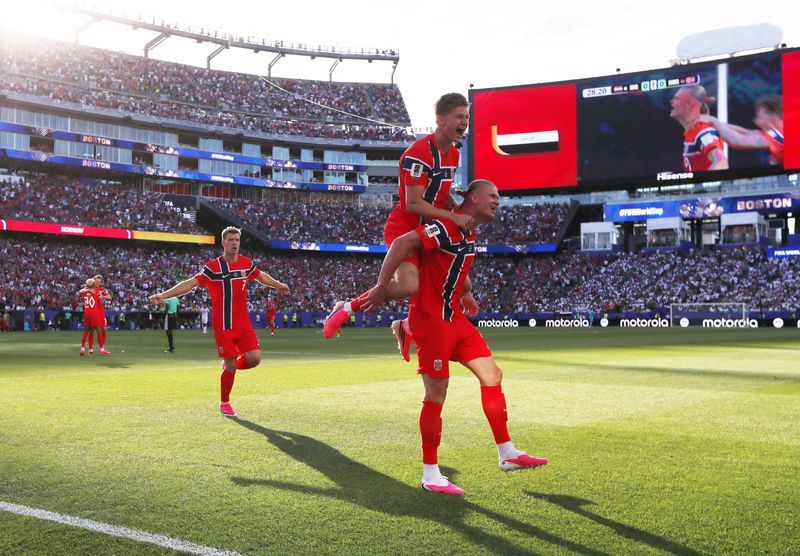
Erling Haaland announced his arrival on football's grandest stage with characteristic ruthlessness, netting twice in a commanding first-half display as Norway demolished Iraq 4-1 in their opening World Cup fixture on Tuesday. The strike by the talismanic forward represents yet another milestone in an extraordinary career arc, adding the World Cup finals to an already remarkable collection of competition debuts where he has proven prolific, having previously scored on his initial appearances in the Bundesliga, Premier League and Champions League.
Haaland's opening goal exemplified his predatory instincts—a clinical finish from close range after David Moller Wolfe's pinpoint cross found him unmarked in the box. His second arrived through a combination of aggressive pressing and opportunism, forcing an erratic back-pass from Iraq's defence before blocking the goalkeeper's desperate clearance attempt. The two-goal haul underscored the strategic clarity of Stale Solbakken's approach: construct the team's offensive framework around enabling Haaland to find space in dangerous areas and capitalise on the chaos that inevitably follows his movement off the ball.
Yet for all the emphatic scoreline, Norway's performance contained significant flaws that offered Iraq genuine moments of resistance. The Scandinavian team struggled to maintain possession fluency, with careless turnovers and misplaced passing regularly disrupting their rhythm. Captain Martin Odegaard, the creative fulcrum from midfield, delivered an unusually subdued display, failing to orchestrate play with the precision typically expected from the Arsenal playmaker. Defensively, Norway appeared susceptible to Iraq's counter-attacking ventures, most notably when Aymen Hussein punished momentary inattention to level the score temporarily and demonstrate that the European side remained vulnerable to organised pressure.
This World Cup represents a significant milestone for Norwegian football. The nation's return to the finals after a 28-year hiatus—their last appearance in 1998—carries substantial expectations both domestically and among regional observers assessing Scandinavian football's competitiveness. Jonas Gahr Stoere, Norway's Prime Minister, underscored this national importance in comments preceding the match, emphasising that despite individual brilliance, tournament success ultimately hinges on collective cohesion and shared attacking purpose. The reminder proved prescient; while Haaland's personal brilliance secured three points, the team's inconsistency suggests unfinished development before encounters against stronger opposition.
Haaland's reluctance to engage extensively with media personnel has become well-documented throughout his career, a preference for letting goal-scoring performances speak with greater eloquence than words. This reticence remains evident in the World Cup environment, where he continues deflecting attention from himself toward team dynamics. However, his post-match comments reflected cautious optimism mixed with tactical clarity regarding the improvements necessary. He acknowledged that Norway had achieved their immediate objective without committing defensive errors that might have proved costly against more clinical opponents, whilst recognising that the group stage demands substantially elevated performance standards against stronger nations.
The result positions Norway atop their World Cup group with three points, marginally ahead of France on goal difference after the French side's 3-1 victory over Senegal earlier that day. This standing places Haaland and his teammates in an advantageous position entering subsequent fixtures, though the competitive reality remains that progression will require either sustained excellence or crucial results elsewhere in the group. The 28-year absence from World Cup football means Norwegian supporters harbour genuine enthusiasm for their team's prospects, an emotional investment evident in Haaland's reference to celebrations back home regardless of the local time.
For Southeast Asian observers tracking European football trends, Haaland's World Cup emergence carries broader significance. His trajectory from Manchester City represents a benchmark for elite athlete development and integration into different competitive environments. The Norwegian's consistent goal-scoring across multiple leagues and competitions demonstrates the sustainability of exceptional talent when matched with intelligent tactical deployment. His performance against Iraq, whilst against inferior opposition, reinforced his status as a generational talent capable of influencing tournament outcomes through individual excellence.
The emphatic victory masked certain vulnerabilities that stronger opponents will systematically expose. Iraq, despite their geographical disadvantage and competitive limitations, created reasonable opportunities through direct play and rapid transitions. This suggests Solbakken's tactical system, whilst functionally effective at containing weaker sides, may require defensive reinforcement when confronting nations with superior technical capability and spatial awareness. The midfield particularly requires stabilisation, as Odegaard's subdued contribution cannot become recurring without compromising team organisation.
Looking forward, Norway faces the immediate challenge of sustaining momentum whilst refining defensive solidity. Haaland's World Cup announcement has delivered the primary objective—a victorious debut establishing psychological confidence—but the tournament's progression demands evidence that the team transcends reliance upon individual brilliance. The 28-year wait for World Cup football intensifies pressure for extended participation, making subsequent group fixtures against France and Senegal critical in determining whether this represents merely a celebratory return or the beginning of sustained competitive relevance on the international stage.