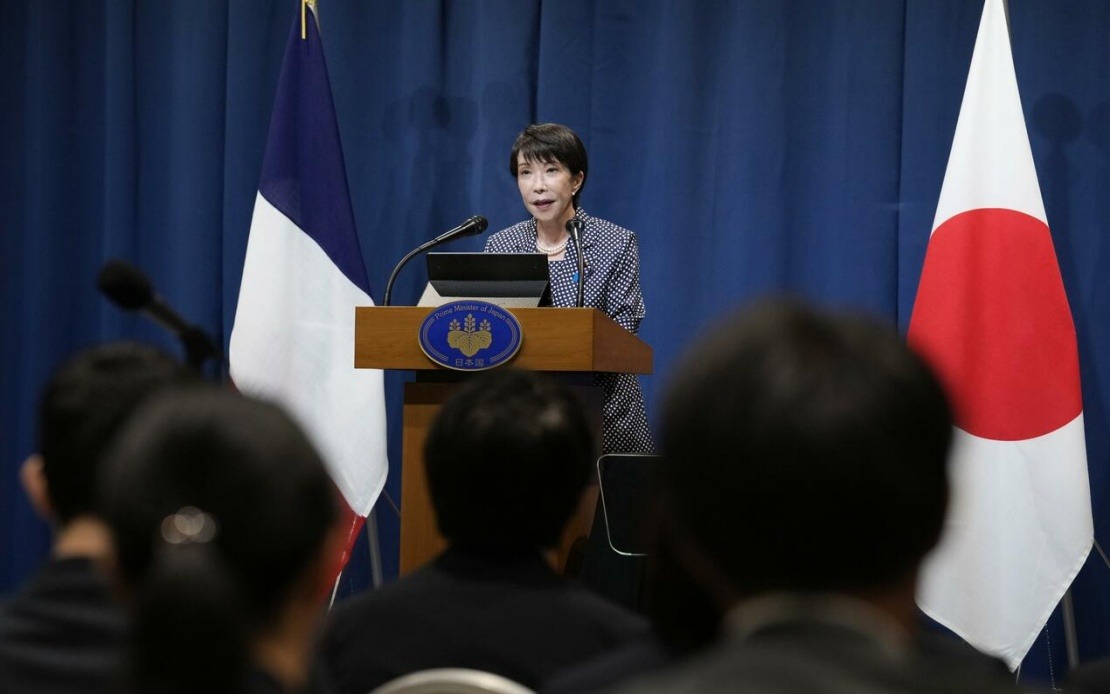
Prime Minister Sanae Takaichi's government faces mounting political headwinds as public confidence erodes to its lowest ebb since she assumed office eight months ago. A Kyodo News survey released Sunday revealed that cabinet approval has dropped to 55.8 per cent, signalling a notable shift in public sentiment at a critical juncture for Japan's economic recovery and regional security strategy. The decline reflects broader anxieties gripping the nation as households continue grappling with stubbornly high inflation and officials navigate increasingly complex international relations in an unstable geopolitical landscape.
Japan's acute vulnerability to external economic shocks has become a defining challenge for the Takaichi administration. As a resource-poor island nation heavily dependent on global trade and energy imports, Japan remains acutely sensitive to disruptions emanating from the West Asia region, where tensions have repeatedly threatened to destabilise critical shipping lanes and energy supplies. Recent developments, including preliminary peace negotiations between the United States and Iran that include provisions for reopening the Strait of Hormuz, have temporarily eased immediate concerns about potential supply disruptions. However, the underlying anxiety persists among policymakers and citizens alike, who recognise that geopolitical volatility in this strategically vital region could quickly reverse gains and impose fresh economic penalties on Tokyo.
The question of Japan's military posture in regional waters has emerged as a particularly sensitive issue, with public opinion decidedly against deeper involvement. According to the same Kyodo survey, 54.7 per cent of respondents explicitly opposed dispatching Japan Self-Defence Forces to secure commercial shipping through contested waterways, while only 36.6 per cent endorsed such action. This substantial majority opposition reveals deep public reluctance to expand Japan's military footprint overseas, reflecting persistent pacifist sentiments embedded in post-war Japanese political culture and constitutional constraints on military operations. For the Takaichi administration, this represents a significant constraint on its ability to project regional influence or respond to allied security requests without risking further erosion of domestic support.
Domestic economic grievances have crystallised around the issue of consumption tax, which has become a lightning rod for public dissatisfaction with cost-of-living pressures. The government's existing 8.0 per cent consumption tax on food and beverages—already elevated compared to international standards—continues to weigh heavily on household budgets as citizens struggle with broader inflationary pressures affecting everything from energy costs to basic groceries. The Kyodo poll demonstrates that 43.9 per cent of respondents find acceptable the proposal to reduce this rate to 1.0 per cent, provided implementation can occur swiftly, while an additional 22.6 per cent advocate for complete elimination to zero per cent, a pledge made by the ruling coalition parties. Collectively, these figures suggest that nearly two-thirds of surveyed voters consider tax relief on food and beverages a reasonable and necessary policy response to current economic conditions.
The gap between public expectations and government policy execution on taxation represents a critical vulnerability for Takaichi's political standing. The ruling parties have staked considerable political capital on promised tax cuts, yet implementation has proceeded more gradually than public sentiment demands. This disconnect between campaign promises and tangible results has likely contributed to the steady decline in cabinet approval ratings over recent months. For Malaysian observers, the situation illustrates how rapidly governments can lose public confidence when economic hardship persists despite pledges of relief, a cautionary tale relevant to policymakers across the region.
Japan's experience also underscores the interconnected nature of modern economic challenges in Southeast Asia's neighbourhood. The geopolitical tensions affecting Japan's inflation concerns—particularly regarding energy security and shipping routes through contested waters—also present significant implications for Malaysia and other regional economies dependent on stable energy supplies and predictable trade corridors. Should West Asia instability reignite, Malaysian ports and shipping interests could face similar disruptions and cost pressures, making Tokyo's policy responses relevant to regional economic stability.
The Takaichi cabinet's declining approval rating, now at its lowest point since her October 2023 inauguration, suggests that public tolerance for continued economic hardship has reached a critical threshold. Japanese voters appear to be signalling that symbolic gestures and incremental policy adjustments no longer suffice; they demand concrete, substantial relief from inflation and related pressures. The eight-month trajectory from her political honeymoon to present circumstances demonstrates how quickly initial goodwill can dissipate when economic conditions fail to improve markedly.
Looking forward, the Takaichi administration faces mounting pressure to accelerate tax relief implementation and demonstrate tangible progress on inflation control, or risk further erosion of public support. The political window for corrective action remains open, but margins for error appear to be narrowing. For the region's broader economic outlook, Japan's internal political dynamics carry weight given Tokyo's status as a major trading partner and technological innovator whose policy choices influence regional growth trajectories and investment patterns.
The survey results also highlight a fundamental challenge confronting policymakers throughout developed economies: balancing fiscal sustainability with immediate public pressure for relief. Japan's experience suggests that when inflation persistently erodes household purchasing power, even relatively robust initial approval ratings can deteriorate rapidly if citizens perceive government action as insufficient or too delayed. This dynamic carries implications for how Southeast Asian governments might anticipate and manage public expectations during periods of economic stress, particularly regarding taxation and cost-of-living pressures that directly affect voter satisfaction.
%22%2F%3E%3C%2Fpattern%3E%3C%2Fdefs%3E%3Crect%20width%3D%22100%25%22%20height%3D%22100%25%22%20fill%3D%22url(%23ph5iv51g)%22%2F%3E%3Crect%20width%3D%22100%25%22%20height%3D%22100%25%22%20fill%3D%22url(%23ph5iv51p)%22%2F%3E%3Ctext%20x%3D%2250%25%22%20y%3D%2250%25%22%20text-anchor%3D%22middle%22%20dominant-baseline%3D%22central%22%20fill%3D%22rgba(255%2C255%2C255%2C0.95)%22%20font-family%3D%22Georgia%2C%20'Times%20New%20Roman'%2C%20serif%22%20font-weight%3D%22700%22%20font-size%3D%22320%22%20letter-spacing%3D%22-0.02em%22%3E24%3C%2Ftext%3E%3C%2Fsvg%3E)
%22%2F%3E%3C%2Fpattern%3E%3C%2Fdefs%3E%3Crect%20width%3D%22100%25%22%20height%3D%22100%25%22%20fill%3D%22url(%23ph2s5vng)%22%2F%3E%3Crect%20width%3D%22100%25%22%20height%3D%22100%25%22%20fill%3D%22url(%23ph2s5vnp)%22%2F%3E%3Ctext%20x%3D%2250%25%22%20y%3D%2250%25%22%20text-anchor%3D%22middle%22%20dominant-baseline%3D%22central%22%20fill%3D%22rgba(255%2C255%2C255%2C0.95)%22%20font-family%3D%22Georgia%2C%20'Times%20New%20Roman'%2C%20serif%22%20font-weight%3D%22700%22%20font-size%3D%22320%22%20letter-spacing%3D%22-0.02em%22%3EData%3C%2Ftext%3E%3C%2Fsvg%3E)