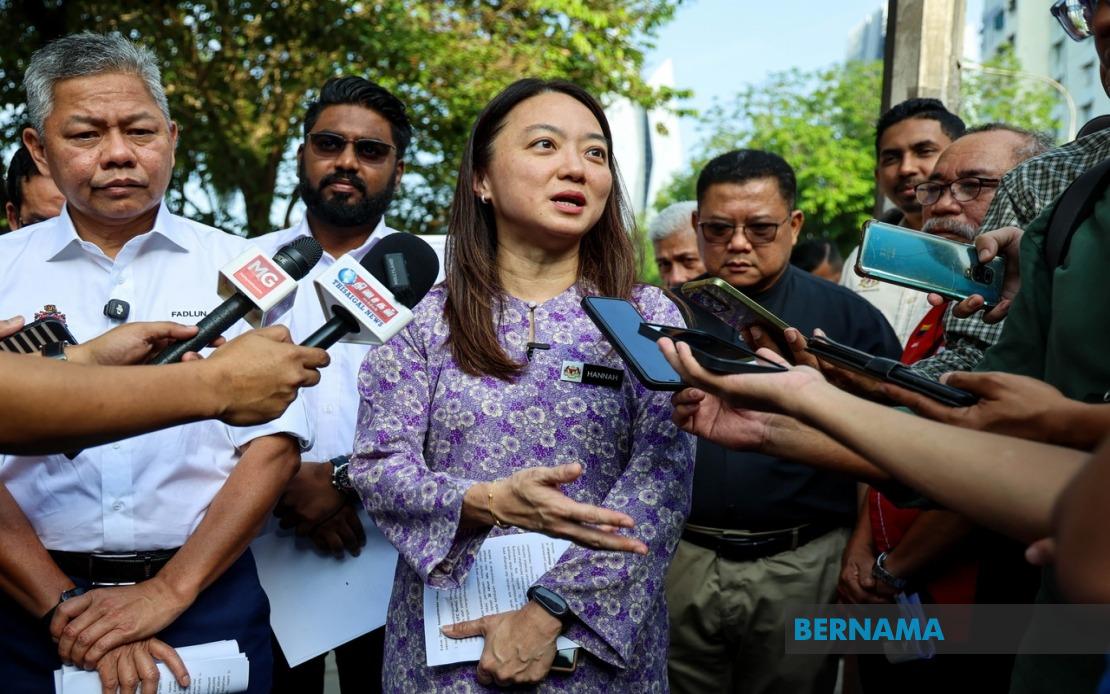
Malaysia's Minister in the Prime Minister's Department (Federal Territories) Hannah Yeoh has issued a pointed reminder that local authorities nationwide must adopt a more proactive stance towards maintaining public infrastructure, emphasising that operational maintenance cannot be deferred until complaints surface on social media platforms. Speaking after inspecting a hawker facilities upgrading initiative near the Urban Transformation Centre in Sentul, Yeoh underscored that basic housekeeping duties fall squarely within the obligations of municipal corporations and local government bodies, regardless of whether budget constraints exist for more substantial capital projects.
The minister's comments emerge against the backdrop of recent online complaints highlighting deteriorating conditions at public facilities throughout Putrajaya, particularly incidents involving non-functional lifts and escalators that drew widespread criticism from residents and visitors. These incidents, shared across digital networks and generating considerable public attention, prompted intervention from Yeoh's ministry, which subsequently coordinated with Putrajaya Corporation management to initiate necessary repairs. The situation exemplifies a broader pattern affecting Malaysian urban centres, where social media amplification has become the default mechanism for triggering bureaucratic response to infrastructure deficiencies that arguably should have been identified and addressed through routine maintenance protocols.
Yeoh's statement reflects growing governmental concern about the reactive rather than anticipatory nature of municipal service delivery across the country's local authorities. She stressed that while major infrastructure upgrades may legitimately require budgetary approvals and extended planning timelines, the fundamental standards of cleanliness and operational safety represent non-negotiable baseline expectations that demand continuous attention. The distinction between these categories proves crucial for understanding resource allocation within local government frameworks, where managers must balance competing demands against fixed budgets. However, the minister's framing suggests that operational maintenance should not compete with other priorities but rather constitute an unavoidable foundational commitment.
In the context of Putrajaya specifically, the minister acknowledged that the administrative capital's leadership has mobilised teams to undertake repair work, yet she cautioned against treating such reactive interventions as adequate substitutes for systematic preventive maintenance. As a premier tourism destination attracting both domestic visitors and international guests, Putrajaya carries particular significance for Malaysia's national image abroad. The deterioration of public amenities in such high-profile locations sends unintended signals about governmental efficiency and administrative capacity that extend beyond the immediate inconvenience to users. Tourism authorities and city planners across Southeast Asia increasingly recognise that infrastructure quality functions as a competitive differentiator, influencing visitor satisfaction and repeat patronage.
Yeoh called specifically for intensified site inspection regimens, urging local authority personnel to conduct more frequent ground-level assessments rather than relying on complaint-driven identification of problems. This prescriptive guidance reflects best practices in municipal management, where preventive site audits consistently outperform reactive repair cycles in terms of both cost-effectiveness and service quality. Regular inspections enable identification of incipient problems before they deteriorate into serious safety hazards or substantial user inconvenience. The resource implications of such a shift towards preventive governance merit consideration, as additional inspection staff or extended maintenance team hours would require budgetary accommodation within existing municipal structures.
Simultaneously, the minister addressed the information ecosystem surrounding public infrastructure issues, offering nuanced commentary on social media's role in municipal accountability. Yeoh cautioned digital users against accepting individual videos or anecdotal reports as comprehensive representations of complex situations, noting that single-perspective documentation frequently omits crucial contextual details. She observed that contemporary digital platforms democratise the capacity to broadcast information yet simultaneously introduce substantial risks of partial or misleading representation. This observation carries particular relevance across Malaysia and Southeast Asia, where rapid smartphone adoption and social media penetration have accelerated the velocity with which localised incidents can achieve viral status without proportional investigation or fact-checking.
However, the minister's emphasis on media literacy and multifaceted analysis should not obscure the underlying governance challenge that social media visibility has helpfully illuminated. The reality remains that public facility maintenance failures occurred in Putrajaya, that these failures affected user experience, and that external pressure proved necessary to mobilise corrective action. While individual social media posts may indeed present incomplete pictures, the aggregate evidence of deteriorating infrastructure across multiple sites suggests systemic rather than isolated deficiencies. Malaysian local authorities would benefit from recognising social media feedback as valuable early warning systems rather than dismissing such signals as inherently unreliable.
The broader implications for Malaysian municipalities extend beyond Putrajaya's particular circumstances. Throughout urban centres from Kuala Lumpur to Penang, Johor Bahru to Kota Kinabalu, local governments struggle with maintenance backlogs resulting from inadequate budgets, competing priorities, and capacity constraints. The tension between capital projects and operational maintenance reflects a persistent challenge in municipal governance worldwide, yet particularly acute in developing economies managing rapid urbanisation. Malaysian local authorities might consider Yeoh's statement as impetus for reassessing internal resource allocation, potentially shifting emphasis towards preventive maintenance frameworks that reduce emergency repair expenses over medium-term horizons.
The minister's framing of maintenance as a non-negotiable baseline expectation, independent of budgetary availability, implicitly acknowledges that current arrangements may prove inadequate. If local authorities genuinely cannot fund basic operational maintenance from existing allocations, then the structural problem lies not with municipal management but with state and federal funding mechanisms. This interpretation suggests potential necessity for recalibrating fiscal transfer formulas to local governments or expanding revenue-raising authority at municipal levels. Malaysian policymakers should examine whether local authority funding structures genuinely enable the maintenance standards that state and federal officials now demand.
Looking forward, Yeoh's intervention signals heightened ministerial attention to municipal service delivery standards. This increased scrutiny may incentivise local authorities to strengthen internal monitoring systems and accelerate resolution of deferred maintenance issues. However, sustained improvement requires more than episodic political pressure. Systematic change demands institutionalised maintenance protocols, adequate funding streams, and accountability mechanisms that reward proactive rather than reactive governance. The evolution from social media-triggered intervention to predictable, continuous maintenance represents an organisational challenge requiring structural adjustment across Malaysia's municipal system.
For Southeast Asian readers observing Malaysian municipal governance patterns, Yeoh's remarks underscore the region-wide challenge of reconciling rapid urbanisation with adequate infrastructure maintenance. Across the region, cities struggle with similar dynamics where visible infrastructure projects generate political attention while invisible maintenance languishes. Malaysia's explicit ministerial acknowledgment of these tensions, coupled with calls for systemic change, offers useful perspective for neighbouring countries grappling with analogous governance questions. The extent to which Malaysian local authorities translate such exhortations into sustained operational improvements will likely influence neighbouring jurisdictions' approaches to municipal accountability and service delivery standards.