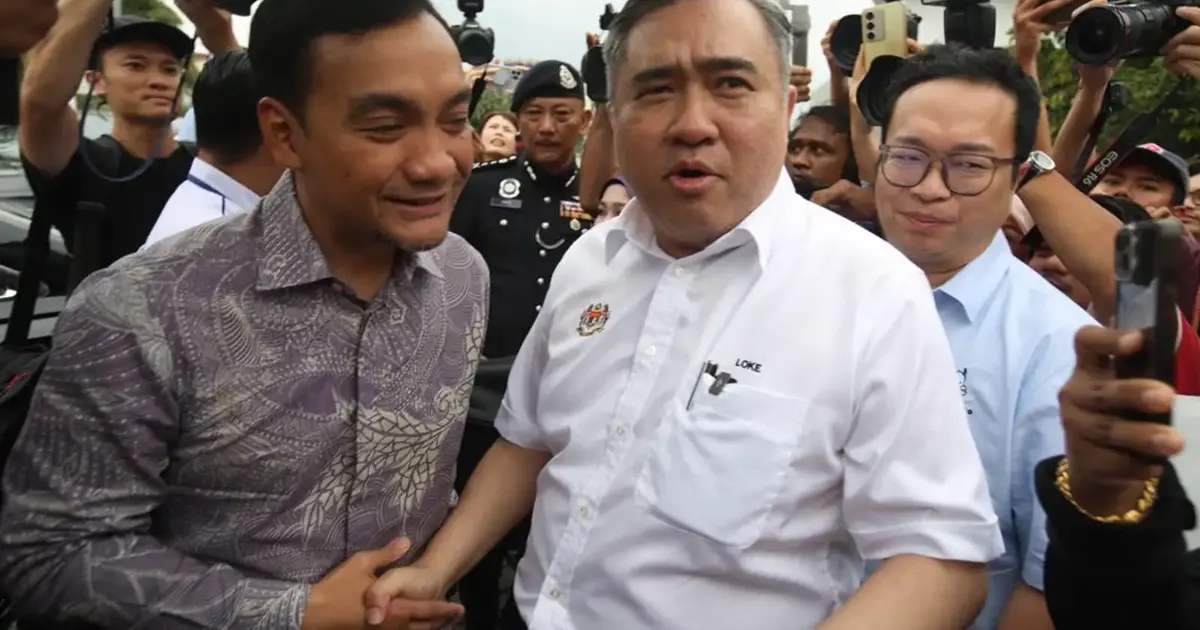
Anthony Loke and Onn Hafiz Openg managed to maintain decorum at their first face-to-face meeting since trading remarks online, underlining the delicate equilibrium required when senior figures from different political coalitions must work together at the federal and state levels. The gathering at a transport ministry event served as a test of whether the two leaders could compartmentalise their public disagreements and function effectively in an official capacity, a dynamic that carries significance for Malaysia's broader coalition politics.
The Johor Menteri Besar did not entirely sidestep the tension, however, offering what observers interpreted as a pointed commentary during his address. Onn Hafiz referenced the compressed timeline for his participation, noting that his schedule had required rearrangement following last-minute notification from the transport ministry about the event. The remark appeared to contain an oblique criticism of the DAP leader's stewardship of his portfolio, suggesting either inefficient advance planning or deliberate scheduling tactics. Such subtle jabs remain within acceptable bounds of political theatre—no explicit accusations or confrontations—yet they signal underlying friction that politeness cannot entirely mask.
The exchange reflects broader tensions within Malaysia's coalition government, where parties from Pakatan Harapan and Barisan Nasional maintain an uncomfortable partnership that frequently produces public disagreements. The cordial exterior masks divergent interests and competing narratives, particularly between the DAP's secular, urban-focused agenda and the Umno-aligned Johor establishment's more conservative posture. When federal ministers and state leaders clash online, it raises questions about governmental coherence and the capacity of coalition members to present a unified vision to the public.
Onn Hafiz's subtle swipe serves multiple audiences. For his Johor base and Umno supporters, it demonstrates that he will not be steamrolled by federal counterparts or DAP officials, even in formal settings. For observers watching coalition dynamics, it signals that professional courtesy does not equate to political alignment or acquiescence. For Loke, the veiled criticism likely registers as a reminder that state-level cooperation cannot be assumed and that transport initiatives requiring state participation may face resistance if handled insensitively.
The original online disagreement between the two figures has not been fully detailed in this account, but such spats typically emerge from policy differences, resource allocation disputes, or broader coalition fault lines. Transport matters often become flashpoints because infrastructure development intersects with land rights, environmental concerns, and state prerogatives. A federal minister might propose initiatives that state governments perceive as overreach or insufficiently consultative, triggering defensive responses that cascade into public view.
For Malaysian readers, the significance of this interaction extends beyond personality politics. The capability of federal and state authorities to collaborate effectively determines whether infrastructure projects, regulatory frameworks, and public services function smoothly. Johor's status as Southeast Asia's second-largest economy and a crucial logistics hub means that transport policy coordination affects not just the state but regional commerce and Malaysia's competitiveness internationally. Breakdowns in inter-governmental cooperation create inefficiencies, missed opportunities, and occasionally failed investments.
The DAP's presence in transport matters through Loke's ministry represents a shift in Malaysian politics, where the party has leveraged urban electoral success into ministerial portfolios that affect the entire nation. This reality has not fully settled into acceptance among traditional power structures, particularly in states where Barisan Nasional retains control. Onn Hafiz, as Johor's chief executive and a prominent Umno figure, occupies a position of considerable authority and prestige, and any federal encroachment on state prerogatives is likely to provoke reaction.
The maintenance of civility despite underlying tension demonstrates that Malaysian politics, while fractious, has not descended into personal animosity that precludes professional interaction. Both leaders recognised that an uncordial meeting would have generated negative headlines and suggested governmental dysfunction at a moment when Malaysia's economic situation demands confidence in institutional stability. The performance of goodwill, even if incomplete, serves national interests by maintaining the appearance of a functioning coalition.
The slight jab about scheduling, however, should not be dismissed as mere theatre. It communicates boundaries and signals that state governments retain agency and will not be treated as subordinate administrative units. For transport ministry initiatives requiring state cooperation, the message is clear: advance notice and proper consultation matter, and shortcuts will be noted and gently but publicly criticised. This dynamic, while sometimes frustrating for federal policymakers, reflects the federal structure of Malaysian governance and the legitimate interests of state governments in protecting their authority.
Looking ahead, the relationship between Loke and Onn Hafiz will likely evolve based on practical outcomes rather than personal affinity. Transport projects that proceed smoothly and benefit both Johor and the nation may improve the dynamic, while contested initiatives or perceived slights could reignite tensions. The coalition government's stability depends partly on whether such figures can manage their differences through this diplomatic dance, neither fully embracing nor openly rejecting one another, maintaining sufficient civility to govern while preserving distinct political identities and interests.