Malaysia's nationwide Maal Hijrah celebrations on June 17 resonated with a unifying message: that the concept of hijrah—spiritual migration and positive transformation—remains central to building stronger communities and more effective governance. Across the country, religious programmes, Quranic recitations, and formal award ceremonies reflected a broader national conversation about what it means to undergo meaningful change in contemporary times, particularly through the lens of exemplary leadership and collective Islamic identity.
The observance of Maal Hijrah, marking the Islamic calendar's transition to year 1448H, traditionally invites reflection on personal and communal renewal. This year's national celebration, organised under the theme "MADANI Dihayati, Ummah Diberkati" (MADANI Lived, Ummah Blessed), explicitly connected these spiritual ideals to governance and social well-being. The emphasis on quality leadership emerged as the dominant thread throughout proceedings, suggesting official recognition that systemic change and community progress depend fundamentally on principled decision-making at all levels of society.
The primary national ceremony drew approximately 5,000 attendees and featured prominent government representation. Deputy Prime Minister Datuk Seri Fadillah Yusof and Minister in the Prime Minister's Department (Religious Affairs) Dr Zulkifli Hasan attended, signalling the government's commitment to integrating Islamic values into national development frameworks. Their presence underscored how religious observances in Malaysia increasingly intersect with policy discussions and nation-building narratives, reflecting the country's constitutional role as protector of Islam and its diverse religious landscape.
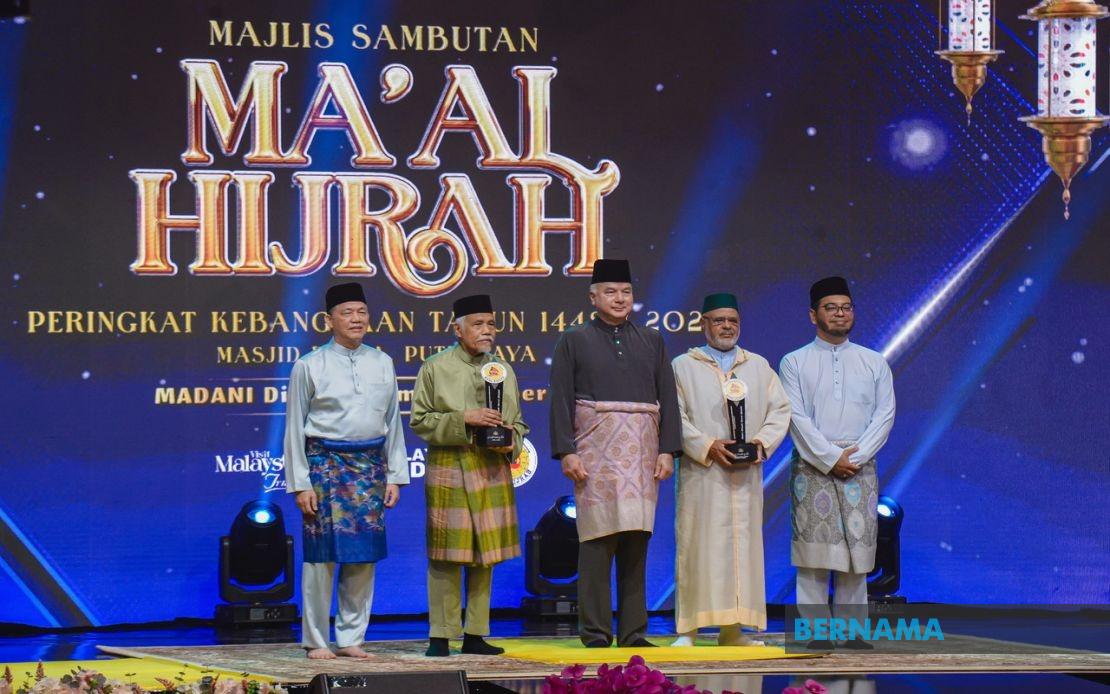
Sultan Nazrin, ruler of Perak, conferred the National Tokoh Maal Hijrah Award upon Prof Emeritus Datuk Dr Osman Bakar, rector of the International Islamic University Malaysia (IIUM). The recognition of IIUM's leadership carries particular significance given the institution's role in producing Islamic scholars and leaders who shape intellectual and religious discourse across Southeast Asia. Bakar's honour reflects ongoing efforts to acknowledge individuals advancing Islamic scholarship and education within contemporary frameworks, bridging traditional learning with modern institutional structures.
International recognition formed another dimension of the celebration. Dr Ahmad Al-Raysuni, a prominent Moroccan Islamic jurisprudence scholar, received the International Tokoh Maal Hijrah Award. This cross-border recognition highlights Malaysia's engagement with the broader Islamic world and its aspirations to position itself as a centre of Islamic learning and dialogue. Such awards facilitate intellectual exchange and validate Malaysia's contribution to contemporary Islamic thought within a globalised context.
Regional celebrations extended the commemoration beyond the capital. In Sabah, a separate ceremony attended by approximately 1,000 people honoured individuals demonstrating exceptional service to their communities. Tun Musa and his wife Toh Puan Faridah Tussin were welcomed by Chief Minister Datuk Seri Hajiji Noor and organising committee chairman Datuk Dr Mohd Arifin Mohd Arif, reflecting how state-level leadership actively participates in religious and cultural observances that strengthen social cohesion.
Community and religious leaders received recognition across multiple categories. Datuk Ag Sharin Alimin, a community activist and former director of the Sabah Islamic Religious Affairs Department, was honoured in the male category for the Tokoh Maal Hijrah Award. Datuk Masnah Matsalleh, former Sabah deputy state secretary, received recognition in the female category, demonstrating the inclusive nature of awards acknowledging contribution across gender lines and professional backgrounds. Such recognition validates the varied forms through which individuals advance Islamic values and community welfare.
Among honourees was Jusoh @ Muda Ismail, a 95-year-old Quran teacher, whose recognition carries particular symbolic weight. As a student and adopted son of the late Tuan Guru Haji Mat Lintar—a revered Quranic scholar—Ismail represents continuity in Islamic education and the transmission of religious knowledge across generations. His recognition celebrates the often-unsung contributions of community-level educators who maintain Quranic literacy and Islamic teaching outside formal institutional settings, activities that have historically sustained Islamic learning throughout Southeast Asia.
The Maal Hijrah observance reflects how Malaysia negotiates religious identity within a multicultural context. These celebrations reinforce Islamic principles while occurring within a pluralistic national framework, demonstrating how religious observance can coexist with secular governance and interfaith coexistence. The emphasis on leadership and ummah unity speaks to contemporary challenges: how diverse communities navigate shared citizenship while maintaining distinct religious identities, and how institutional and spiritual leadership can address social fragmentation.
For Malaysian readers and regional observers, these celebrations indicate ongoing efforts to anchor national development in Islamic values without compromising constitutional commitments to religious freedom. The recognition of scholars, activists, and educators reinforces that progress depends on individuals across sectors—government, academia, civil society—internalising principles of integrity, service, and communal responsibility. The international dimension, through recognition of scholars like Al-Raysuni, positions Malaysia as an active participant in global Islamic discourse rather than a passive recipient of external Islamic authority.