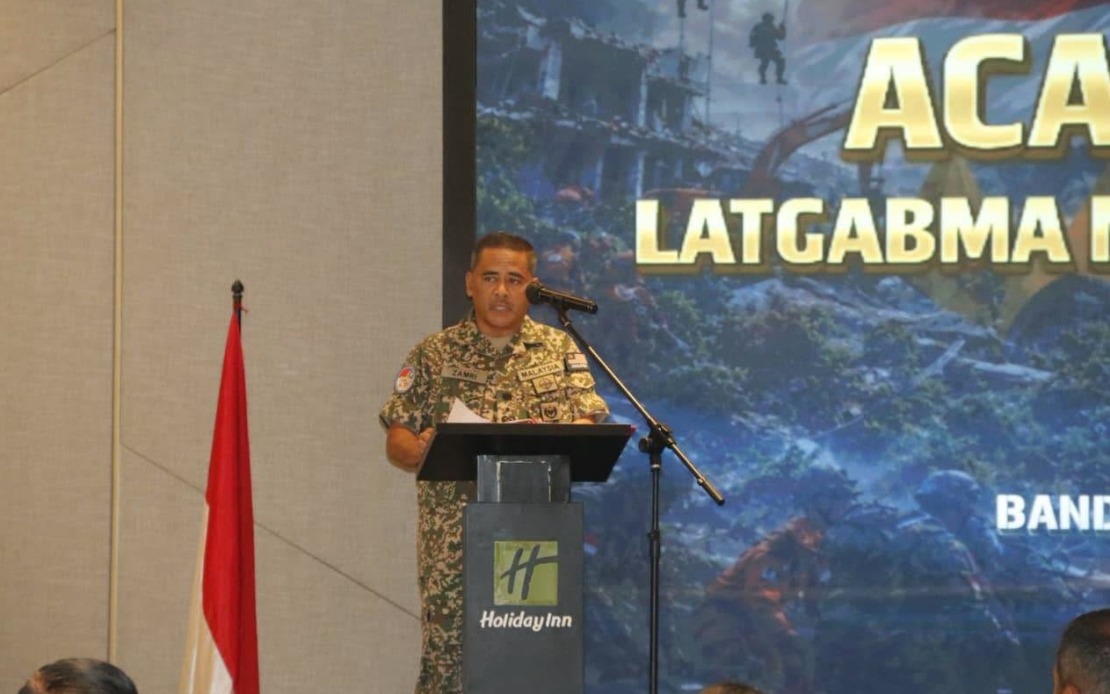
The Malaysian Armed Forces and their Indonesian counterparts have launched a significant trilateral training initiative designed to bolster defence cooperation and operational readiness across land, maritime and aerial domains. Held in Lampung, Sumatra, the 12AB/2026 Malaysia-Indonesia Joint Combined Exercise, formally designated LATGABMA MALINDO DARSASA, brings together 719 service members and civilian personnel from both nations for an intensive 13-day programme spanning multiple operational and humanitarian scenarios.
According to Malaysia's Joint Forces Headquarters at Al-Sultan Abdullah Camp, this exercise transcends routine training protocols and instead reflects the enduring strategic partnership between Kuala Lumpur and Jakarta. Brigadier General Datuk Zamri Othman, Commander of the 1st Infantry Brigade and chief of the MAF Exercise Planning Group, characterised the initiative as a tangible demonstration of fraternal bonds and mutual strategic confidence. The exercise provides a structured platform for armed forces personnel to refine joint operational concepts, standardise procedures across services and build interpersonal confidence among military ranks from both countries.
The geopolitical context for this cooperation has become increasingly urgent. Both nations face proliferating security challenges that transcend conventional military threats, ranging from sophisticated maritime criminal networks and drug trafficking operations to transnational terrorism, advanced cyber intrusions and catastrophic natural disasters. The deteriorating security environment in Southeast Asia necessitates deepened integration between regional militaries, making bilateral and multilateral exercises essential mechanisms for synchronising responses and developing coordinated defence strategies.
This iteration of LATGABMA MALINDO DARSASA represents a continuity of institutional cooperation dating back to 1984. The biennial exercise, rotated between Malaysian and Indonesian territories under the oversight of the General Border Committee and the Malaysia-Indonesia Joint Training Committee, has evolved considerably since its inception. The 2023 edition, held in Pekan, Pahah, focused on counter-terrorism scenarios, reflecting that year's operational priorities. The selection of Lampung Province as the 2026 venue addresses contemporary humanitarian and disaster management imperatives.
Lampung's geographic position at the convergence of three active tectonic plate boundaries makes it an exceptionally realistic training environment for disaster preparedness scenarios. Southern Sumatra has endured multiple seismic and tsunami events in recent decades, providing planners with authentic historical data and experienced local populations who can contribute valuable lessons learned. This setting ensures that exercise participants confront realistic complications and evolving challenges rather than theoretical abstractions divorced from operational reality.
The exercise architecture encompasses three primary components: academic instruction through staff exercises, field training operations, and humanitarian civic engagement. The staff exercise phase focuses on ten integrated scenarios including initial disaster response protocols, mass casualty management, infrastructure damage assessment, medical emergencies, international assistance coordination, cyber attacks, information warfare, mass evacuation procedures, stabilisation operations and transition to normal governance. This comprehensive scenario design ensures participants develop sophisticated understanding of crisis management complexity before attempting practical implementation.
The field training exercise phase emphasises force integration across national boundaries, involving Malaysian personnel, Indonesian military units and civilian agencies including the National Search and Rescue Agency, Disaster Preparedness Cadets, the Indonesian Red Cross and regional disaster management bodies. Practical activities encompass technical rescue skills, emergency medical response protocols and field hospital establishment. This integrated approach breaks down institutional silos and develops familiarity between military and civilian responders who will likely coordinate during genuine disasters.
Beyond traditional military training, the exercise includes substantial humanitarian and civil action components. Engineers from both countries will conduct infrastructure repair and reconstruction activities in Kampung Sukamaju and Kampung Keteguhan, addressing community needs whilst providing personnel with practical experience in civil engineering support operations. A parallel medical civic action programme, conducted at local health facilities, will provide general health screenings, optical assistance and blood donation drives, simultaneously delivering genuine community benefits whilst training medical personnel in field clinic operations and mass health screening procedures.
The cyber security dimension reflects evolving threat landscapes. The cybersecurity exercise segment addresses contemporary attack methodologies including reconnaissance techniques, network enumeration, credential compromise attacks, man-in-the-middle interception, spoofing attacks and data manipulation strategies. Given increasing concerns regarding cyber threats to critical infrastructure across Southeast Asia, this training represents a crucial capability gap that regional militaries have historically neglected. Developing shared cyber defence protocols and familiarising personnel with attack vectors and defensive responses strengthens regional resilience against increasingly sophisticated digital threats.
Participant composition reflects the comprehensive nature of modern security challenges. Beyond the 613 military personnel from both armed forces, the exercise incorporates 79 representatives from diverse Indonesian agencies, two Malaysian civilian representatives, and 25 Indonesian National Police officers. This interagency approach acknowledges that contemporary crises require coordinated responses transcending single organisations and that military personnel must understand civilian agency mandates, capabilities and operational constraints.
For Malaysia specifically, deepening defence cooperation with Indonesia carries strategic significance beyond immediate training benefits. Indonesia represents the region's largest military power by personnel and equipment, and bilateral cooperation enhances Malaysian security through institutional relationships, shared intelligence arrangements and coordinated regional defence postures. Joint exercises reduce misunderstanding, establish professional relationships that facilitate crisis communication and demonstrate commitment to regional stability that reassures other Southeast Asian partners.
The LATGABMA MALINDO DARSASA framework also provides institutional mechanisms for addressing transnational security challenges that individual nations cannot effectively counter alone. Maritime piracy, human trafficking, illegal fishing and drug smuggling operations span territorial waters of multiple nations, requiring coordinated surveillance, interdiction and prosecution efforts. Joint exercises, whilst focused on disaster response, simultaneously build the operational interoperability and institutional trust necessary for addressing these persistent transnational threats.
Looking forward, the success of this 2026 exercise will likely influence future iterations and could establish templates for expanding participation to other Southeast Asian nations. As regional security challenges intensify and institutional cooperation deepens, Malaysia and Indonesia face opportunities to leverage their comprehensive defence relationship as a stabilising force throughout the broader region.