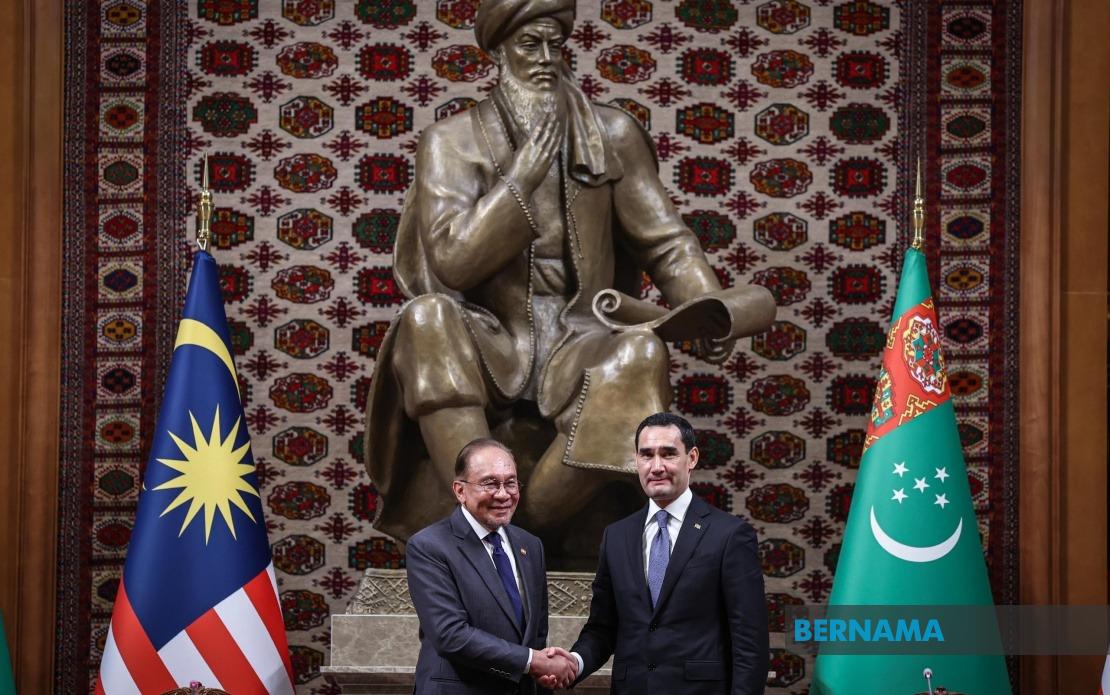
Prime Minister Datuk Seri Anwar Ibrahim and Turkmenistan President Serdar Berdimuhamedov have committed to elevating bilateral relations between Malaysia and Turkmenistan into a more structured, progressive partnership that serves the long-term strategic interests of both nations. The pledge emerged from their bilateral meeting at the Presidential Palace in Ashgabat on Friday, June 19, with both leaders emphasizing that the relationship will be built on mutual respect, trust, and a shared vision for tangible benefits to their respective populations.
The partnership framework materialized through the signing of four formal instruments, marking a significant milestone in Malaysia-Turkmenistan diplomatic engagement. The countries exchanged an Air Services Agreement, which is expected to facilitate enhanced aviation connectivity between Kuala Lumpur and Ashgabat, alongside three memoranda of understanding covering institutional cooperation. These documents represent deliberate steps toward institutionalizing cooperation mechanisms that will outlast political transitions and provide continuity in bilateral initiatives. The tangible nature of these agreements distinguishes the Malaysia-Turkmenistan relationship from purely rhetorical engagements, positioning both nations to move from aspirational statements into concrete implementation.
Anwar underscored that Malaysia and Turkmenistan have reaffirmed their determination to execute all cooperative initiatives with discipline, transparency, and measurable effectiveness. This commitment to accountability signals a departure from the bureaucratic inertia that sometimes undermines bilateral agreements in the region. For Malaysian observers, the emphasis on transparent implementation reflects Anwar's administration's broader governance agenda and suggests that any joint ventures or institutional exchanges will be subject to clear performance metrics and oversight mechanisms.
The sectoral scope of bilateral cooperation is notably comprehensive, encompassing domains critical to both nations' development trajectories. Energy cooperation stands as a natural priority, given Turkmenistan's substantial natural gas reserves and Malaysia's position as a regional energy hub with expertise in liquefied natural gas production and petrochemical downstream operations. Trade and investment discussions promise to unlock commercial opportunities for Malaysian businesses seeking Central Asian markets, while Turkmenistan gains access to Malaysia's established supply chains and technological capabilities. The inclusion of halal industry cooperation is particularly strategic, as Malaysia can leverage its position as a global halal standard-setter to help Turkmenistan, a Muslim-majority nation, develop and certify halal products for international markets, a sector experiencing rapid growth across Southeast Asia and the Islamic world.
The agreements also emphasize Islamic banking and financial services, an area where Malaysia possesses substantial competitive advantages. Malaysian Islamic financial institutions have developed sophisticated sharia-compliant instruments and operational frameworks that could be adapted for Turkmenistan's growing interest in Islamic finance. This cooperation would position Malaysian banks and takaful providers as partners in Turkmenistan's financial sector modernization, creating commercial pathways for Malaysian financial services exports while strengthening the broader Islamic financial ecosystem across Central Asia.
Education, research, and scientific collaboration feature prominently in the partnership design, reflecting the understanding that knowledge transfer and institutional capacity-building generate enduring developmental benefits. The Academy of Sciences Malaysia and the Academy of Sciences of Turkmenistan will collaborate on research initiatives, potentially opening avenues for Malaysian doctoral students and researchers to access Central Asian research networks, while Turkmen scholars gain exposure to Southeast Asian research methodologies and technological advancement. Tourism promotion between the two countries also holds potential, as Malaysia's established tourism infrastructure and marketing expertise could help Turkmenistan develop its tourism sector, while Malaysian travelers gain access to the Caspian region's unique cultural heritage.
The institutional architecture supporting these initiatives reveals sophisticated diplomatic planning. Beyond bilateral government coordination, the exchange of memoranda between Malaysia's Institute of Diplomacy and Foreign Relations and Turkmenistan's Institute of International Relations establishes direct dialogue channels between specialized diplomatic training and policy research institutions. Similarly, the agreement between Malaysia's Ministry of Transport and Turkmenistan's State Service creates a dedicated mechanism for resolving transportation and logistics coordination matters. These layered institutional frameworks ensure that cooperation functions simultaneously at multiple governance levels, reducing the likelihood of initiatives stalling due to bureaucratic bottlenecks or communication breakdowns.
Anwar's visit, undertaken at Berdimuhamedov's invitation and spanning June 18-19, represents his first official journey to Turkmenistan since assuming office as Malaysia's 10th Prime Minister in November 2022. The timing and inaugural nature of this visit underscore the importance Anwar's administration assigns to Central Asian engagement, signaling a deliberate geographical reorientation of Malaysia's diplomatic priorities. Accompanying the prime minister were Minister of Investment, Trade and Industry Datuk Seri Johari Abdul Ghani and Minister of Economy Akmal Nasrullah Mohd Nasir, a delegation composition that prioritizes commercial and economic dimensions alongside diplomatic protocol.
The strategic implications of this partnership extend beyond bilateral considerations into broader regional geopolitics. Central Asia remains relatively underexploited in Malaysia's strategic engagement calculus, despite the region's significance for energy security, trade route diversification, and Islamic civilization dialogue. By establishing structured institutional frameworks now, Malaysia positions itself as a preferred Southeast Asian partner for Turkmenistan and other Central Asian states, potentially gaining influence in a geopolitically significant region where competition from China, Russia, and Europe intensifies. For Malaysian enterprises, this partnership unlocks access to Central Asian markets currently dominated by competitors with stronger historical connections.
For investors and business observers in Malaysia, the air services agreement assumes particular commercial importance, as direct aviation connectivity typically precedes trade expansion and tourism growth. The agreement facilitates easier movement of business delegations, reduces transaction costs for companies pursuing investment opportunities, and can catalyze supply chain integration between Malaysian manufacturers and Turkmen resources. Similarly, the halal industry cooperation dimension offers significant potential given Malaysia's established halal certification ecosystem and Turkmenistan's untapped opportunities in halal food production, cosmetics, and pharmaceuticals destined for Islamic markets across the Middle East, Africa, and Asia.
The partnership also reflects Malaysia's broader effort to diversify its foreign policy orientation and reduce over-dependence on traditional bilateral relationships. By cultivating substantive engagement with Central Asian nations, Malaysia expands its diplomatic portfolio and creates multiple centers of influence that enhance national standing in multilateral forums. Turkmenistan's strategic location between the Caspian and Hindu Kush regions positions it as a gateway for Malaysian diplomatic reach into an otherwise distant geopolitical sphere, potentially facilitating future Malaysian involvement in regional cooperation mechanisms and development initiatives spanning from the Black Sea to the South China Sea.
Looking forward, the practical success of this partnership will depend on implementation velocity and institutional commitment from both governments. The exchange of agreements represents the easy phase; translating memoranda into functioning collaborative programs, completed research projects, and active commercial flows requires sustained bureaucratic effort, adequate resource allocation, and political will. For Malaysian stakeholders, monitoring the progress of these initiatives over the coming 12-24 months will provide early indicators of whether this structured partnership represents a genuine strategic recalibration or follows the familiar pattern of diplomatic declarations that generate limited tangible outcomes. The emphasis on transparent, disciplined implementation suggests the current Malaysian leadership takes such commitments seriously, but historical patterns in bilateral cooperation often reveal gaps between diplomatic ambition and administrative capacity.