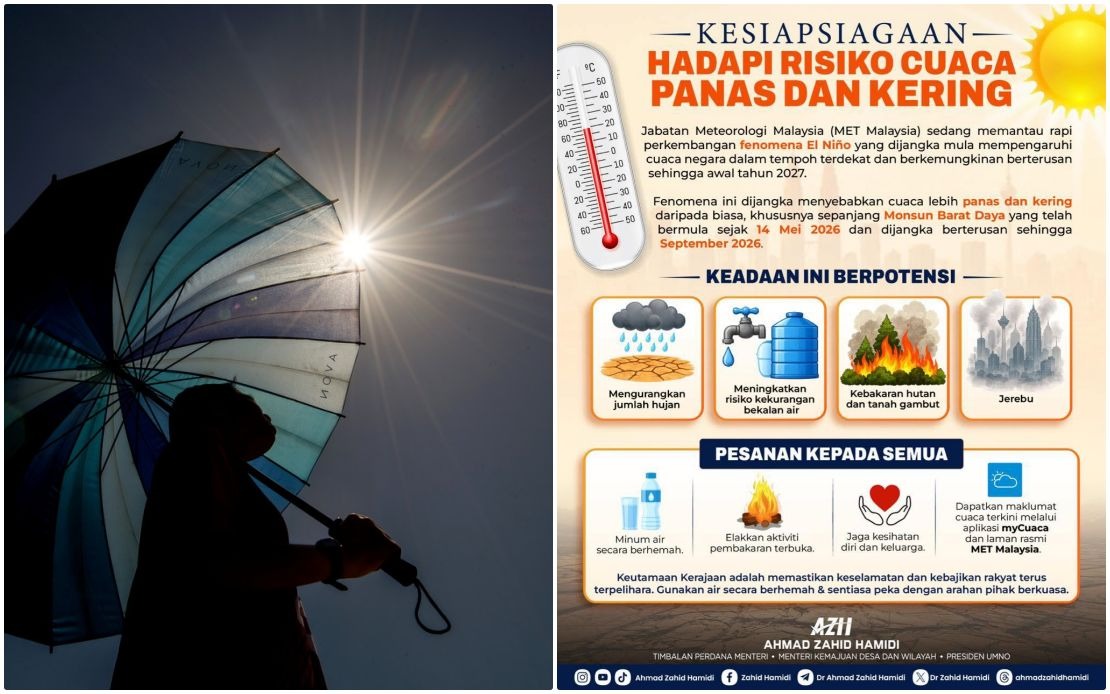
The Malaysian government has sounded a formal alert regarding the anticipated arrival of El Niño conditions that could reshape the nation's weather patterns for the next two years. Deputy Prime Minister Datuk Seri Dr Ahmad Zahid Hamidi, speaking through an official statement on June 15, warned that the climatic phenomenon is poised to take hold of the country in the immediate term and could maintain its grip until the early months of 2027. As chairman of the Central Disaster Management Committee, Ahmad Zahid's cautionary remarks carry significant institutional weight, signalling that federal authorities are preparing contingency measures for what meteorologists describe as a prolonged period of atmospheric disruption.
The El Niño effect, a naturally occurring climate pattern characterised by warmer-than-normal ocean temperatures in the central and eastern Pacific, typically generates measurable consequences across Southeast Asia. In Malaysia's context, the phenomenon manifests most acutely during the Southwest Monsoon season, which commenced on May 14 and is scheduled to conclude by September of the current year. During this period, the typical wind patterns that bring moisture-laden air from the Indian Ocean weaken, allowing high-pressure systems to dominate and suppress rainfall across much of the peninsula and East Malaysia. The result is a compound crisis of escalating temperatures coupled with significant precipitation deficits, a combination that creates cascading environmental and social pressures.
One of the most immediate concerns centres on water availability across the country's urban and rural communities. Reduced rainfall during the Southwest Monsoon means that reservoirs, rivers, and groundwater sources will experience lower replenishment rates, potentially pushing water security into precarious territory, particularly for densely populated areas dependent on reliable supply chains. Ahmad Zahid explicitly flagged the risk of water shortages, acknowledging that certain localities may face acute scarcity if consumption patterns remain uncalibrated to the diminished availability. This underscores a broader challenge facing Malaysian water authorities: the need to balance competing demands from domestic consumption, agricultural irrigation, and industrial processes while maintaining strategic reserves.
The fire risk dimension of El Niño-induced drought conditions poses perhaps the most visible public health and environmental hazard. Extended periods without significant rainfall create ideal conditions for forest fires and peatland combustion, phenomena that have devastated large swathes of Indonesia and Malaysia in previous El Niño cycles. Peatlands, which store immense quantities of organic matter accumulated over millennia, release prodigious amounts of carbon dioxide and other pollutants when burning. These fires generate transboundary haze that blankets neighbouring countries, degrading air quality and triggering respiratory health crises. The 2015 El Niño episode remains a sobering reference point, when uncontrolled peatland fires across the region created hazardous air quality conditions that affected hundreds of millions of people across Southeast Asia.
Recognising these multifaceted threats, Ahmad Zahid articulated a comprehensive public advisory that extends beyond mere weather awareness. He enjoined all Malaysians to exercise heightened vigilance regarding meteorological developments, adopt prudent water consumption practices, and abstain from open burning activities that could accelerate fire spread. The emphasis on vulnerable populations—children, the elderly, and those with pre-existing respiratory or cardiovascular conditions—reflects a targeted approach to mitigating heat-related health impacts. Heat waves exacerbate dehydration, heat exhaustion, and heat stroke, conditions that disproportionately affect populations with limited adaptive capacity.
The Malaysian Meteorological Department (MetMalaysia) has emerged as the primary institutional repository of climate intelligence for public guidance. Director-general Dr Mohd Hisham Mohd Anip corroborated Ahmad Zahid's assessment, confirming that meteorological models indicate hotter and drier conditions will characterise the Southwest Monsoon phase extending through September. MetMalaysia's myCuaca application, a digital platform providing real-time weather updates and forecasting information, has been positioned as the authoritative information source for citizens seeking current meteorological data. The promotion of digital tools reflects an understanding that environmental risks are best managed when the public possesses timely, accurate information.
From a governance perspective, Ahmad Zahid's statement represents the federal government's acknowledgement that El Niño poses a systemic challenge requiring coordinated multi-agency response. The Central Disaster Management Committee, which he chairs, coordinates responses across various government entities, including water authorities, fire and rescue services, health ministries, and agricultural departments. Early preparation, as emphasised in the official statement, involves stockpiling emergency water supplies, conducting controlled burns to reduce fuel loads before the dry season intensifies, strengthening health system capacity, and establishing communication protocols for rapid public alerts should critical thresholds be breached.
The projection that El Niño could persist until early 2027 carries particular significance for long-term planning. An extended two-year period of suppressed rainfall would strain Malaysia's freshwater management infrastructure, potentially necessitating restrictions on non-essential water consumption, increased reliance on desalination facilities, or emergency water transport from neighbouring jurisdictions. Agricultural sectors dependent on monsoon rains would face reduced yields, potentially elevating food prices and triggering import dependencies. The tourism industry, particularly nature-based tourism reliant on healthy forests and clear skies, would face operational challenges should haze episodes materialise.
For Southeast Asian observers, Malaysia's formal articulation of El Niño preparedness carries regional implications. The region's interconnected water systems, shared forest ecosystems, and transboundary air currents mean that El Niño impacts transcend national boundaries. Indonesia's fire management practices directly affect Malaysian air quality; Malaysia's water policies influence downstream riparian nations. Coordinated regional responses, underpinned by shared meteorological intelligence and harmonised mitigation strategies, prove more effective than fragmented national efforts. Malaysia's public advisory potentially catalyses similar preparatory initiatives across the Association of Southeast Asian Nations.
The government's commitment to continued monitoring and adaptive management, as restated in Ahmad Zahid's concluding remarks, suggests that this initial advisory represents merely the opening phase of a sustained institutional response. As the Southwest Monsoon progresses and meteorological models refine their projections, additional guidance will likely be issued, potentially including water usage restrictions, fire prevention mandates, or public health advisories tailored to observed conditions. The integration of traditional meteorological expertise with modern forecasting technology positions Malaysian authorities to detect early warning signals and adjust response measures accordingly.
Ultimately, the success of Malaysia's El Niño response depends on translating governmental warnings into household behaviour change and institutional adaptation. Water conservation requires individual discipline and community accountability; fire prevention demands compliance with regulations across both urban and rural areas; heat resilience depends on informed personal health choices. The framing of El Niño preparedness as a shared responsibility—one demanding simultaneous action from government agencies, private enterprises, and individual citizens—reflects an understanding that climatic challenges of this magnitude admit no purely top-down solutions.