Government leaders across multiple portfolios have rallied Malaysians to harness the philosophical and practical dimensions of Maal Hijrah as the Islamic calendar transitions to 1448H, framing the occasion as more than ceremonial observance but rather a moment for substantive national reflection and recommitment to shared values. The coordinated messaging from the Deputy Prime Ministers and Cabinet ministers underscores how the arrival of Awal Muharram serves as an anchor point for the administration's broader agenda around institutional reform, fiscal discipline and social cohesion during a period of pronounced global economic volatility.
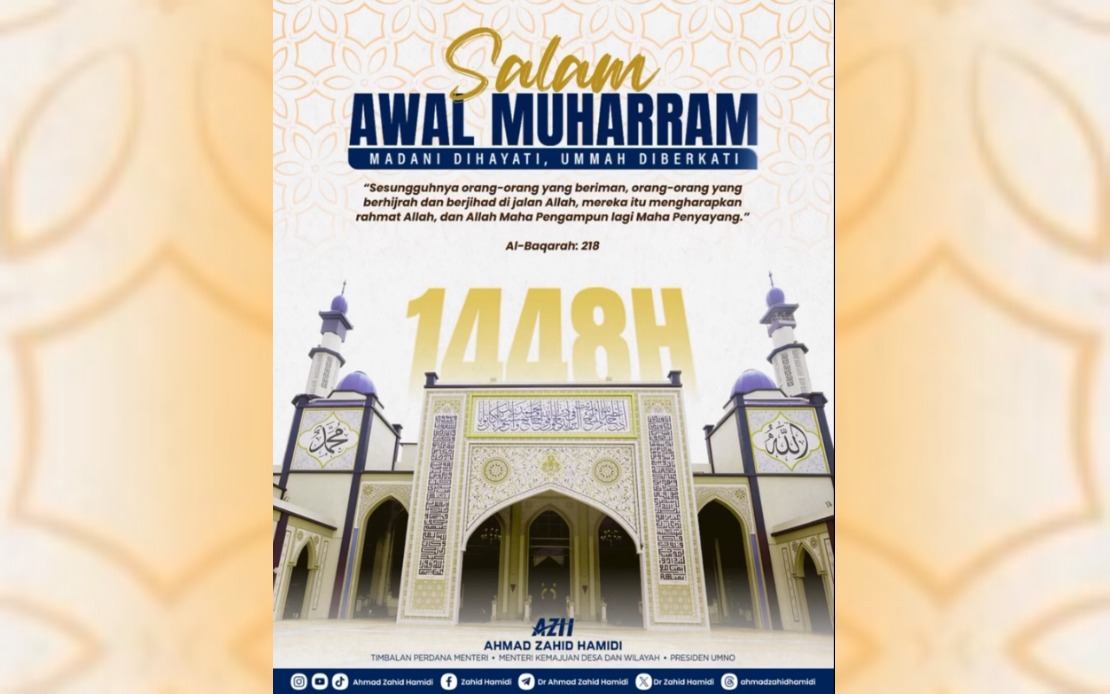
Deputy Prime Minister Datuk Seri Dr Ahmad Zahid Hamidi positioned Maal Hijrah as a philosophical template for genuine transformation, arguing that meaningful progress demands more than rhetorical commitment and instead requires sustained effort, structured discipline and unwavering determination to exceed previous standards. His articulation emphasizes that the concept of Hijrah—rooted in the Prophet Muhammad's migration to Medina—encapsulates timeless principles around personal sacrifice and perseverance that remain applicable to contemporary Malaysian challenges. By drawing these parallels, Zahid implicitly invokes a framework where institutional and societal improvement becomes a religious and moral imperative rather than merely a technocratic exercise.
The Deputy Prime Minister's framing extends to positioning Malaysia's reform agenda within a narrative of global competitiveness and national advancement. His call for courage in embracing structural reforms and confronting institutional weaknesses signals an administration conscious of competitive pressures facing the nation in an increasingly dynamic regional and global economic environment. This rhetorical move strategically connects religious observance to policy priorities, suggesting that citizens' spiritual commitments and their obligations to national progress are fundamentally aligned rather than competing demands.
Deputy Prime Minister Datuk Seri Fadillah Yusof offered a complementary perspective by recalibrating Maal Hijrah from a calendar marker into a mandate for self-improvement and intensified collective responsibility toward religious, familial and national institutions. His emphasis on drawing lessons from Hijrah in response to concrete economic pressures—including global supply chain disruptions and economic uncertainties—demonstrates how senior government figures are operationalizing religious and cultural symbolism to address pragmatic policy challenges. By explicitly linking the Islamic New Year to Malaysia's navigation of supply chain crises and economic headwinds, Fadillah reframes what might otherwise appear as purely external shocks into opportunities for demonstrating resilience rooted in Islamic principles of prudence and moderation.
Fadillah's extended commentary on resource stewardship articulates a vision of collective discipline extending across household spending, energy consumption, food and water usage patterns. This granular enumeration of resource management behaviors positions ordinary Malaysians as active participants in addressing national economic challenges rather than passive recipients of government policy. The rhetorical strategy here—that accumulated individual choices yield aggregate national impact—distributes responsibility for national wellbeing across the entire population while implying that government leadership provides the motivational and spiritual framework for such collective action.
A persistent theme uniting statements from multiple Cabinet ministers addresses the relationship between national strength and societal unity. Communications Minister Datuk Fahmi Fadzil invoked Hijrah's teachings around personal transformation and patient perseverance, while Minister in the Prime Minister's Department (Religious Affairs) Zulkifli Hasan reframed Awal Muharram as a structured moment for spiritual accounting and self-reformation. These complementary messages across government reinforce a narrative positioning Malaysia's stability and prosperity as contingent upon citizens' willingness to embrace internal improvement and to subordinate divisive differences to aspirations for collective progress.
The breadth of ministerial participation in these Maal Hijrah observances—spanning portfolios from agriculture and science through education, health and youth affairs—signals that Malaysia's government infrastructure is being mobilized around this observance as a nation-unifying moment. This comprehensive engagement across ministerial lines suggests deliberate strategic coordination to maximize the resonance of messages around reform, unity and economic prudence throughout the bureaucratic apparatus and public consciousness.
For Malaysian readers, these statements carry significance extending beyond routine holiday observances. The government's explicit connection between Hijrah observance and navigation of contemporary economic challenges—including supply disruptions and global uncertainty—speaks to administrative concerns about Malaysians' purchasing power and household economic resilience during periods of inflation and cost-of-living pressure. The repeated emphasis on fiscal discipline, resource conservation and moderation implicitly acknowledges that many households face constrained circumstances requiring careful financial management.
The unity messaging also carries political resonance in Malaysia's context of persistent religious, ethnic and partisan divisions. By anchoring appeals for societal cohesion in Islamic theological and historical foundations, government leaders access a value system with broad legitimacy among the Muslim majority while carefully framing such appeals in inclusive national rather than narrowly sectarian language. This communicative strategy attempts to transform religious observance into an instrument of national integration.
Regionally, Malaysia's government narrative around Hijrah reflects broader Muslim-majority Southeast Asian patterns of harnessing religious and cultural frameworks to address governance challenges and mobilize populations toward state-defined priorities. The explicit elevation of Maal Hijrah from personal religious obligation into a framework for national economic management and social cohesion illustrates how governments in the region increasingly articulate secular policy objectives through religious and cultural vocabularies that resonate more powerfully with populations than would purely technocratic messaging.
For international observers and regional analysts, the coordinated emphasis from Malaysia's Cabinet on economic resilience, institutional reform and societal unity during an Islamic calendar transition provides insight into how the administration perceives current vulnerabilities and priorities. The extraordinary attention to fiscal discipline and resource management suggests official concern about inflation, supply chain risks and household economic stress affecting citizen purchasing power and sentiment.