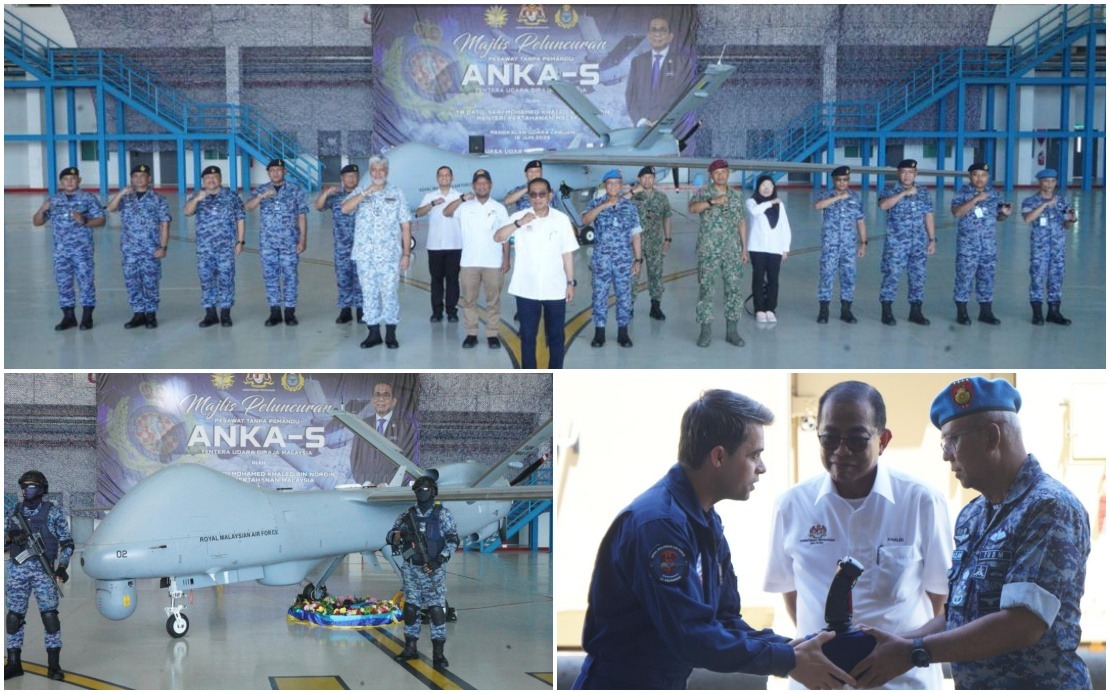
Malaysia has taken a significant step in modernising its defence infrastructure with the operational deployment of the ANKA-S Unmanned Aircraft System at the Royal Malaysian Air Force's Labuan Air Base. Defence Minister Datuk Seri Mohamed Khaled Nordin described the move as a strategic milestone that addresses a longstanding gap in the nation's maritime surveillance capabilities, particularly across the strategically vital South China Sea. The system represents the first time Malaysia possesses indigenous medium-altitude, long-endurance unmanned platforms capable of providing continuous operational coverage across its maritime zones.
The acquisition of three ANKA-S aircraft, procured at a total investment of RM423.8 million inclusive of ground control stations and two years of comprehensive personnel training, reflects the government's commitment to strengthening national security infrastructure. These aircraft are engineered to operate continuously for more than 24 hours at altitudes reaching 30,000 feet, enabling them to maintain persistent surveillance over vast maritime areas without the operational constraints that conventional aircraft face. The Labuan Air Base location was selected deliberately to optimise coverage of the South China Sea, one of the world's most strategically contested waterways and a region where Malaysia maintains significant maritime interests through its territorial waters and exclusive economic zones.
The operational advantages of the ANKA-S system extend beyond simple surveillance capability. The aircraft can accurately identify and track vessel profiles with sufficient precision to enable the Royal Malaysian Air Force to conduct targeted asset deployment to specific intrusion locations, eliminating the inefficiency of unfocused patrols that characterise traditional maritime security operations. This represents a substantial shift in how Malaysia approaches maritime domain awareness, transforming reactive patrolling into intelligence-driven, purposeful deployment. The system's ability to operate effectively across varying weather conditions and in positions difficult to detect provides Malaysia with a critical information advantage when formulating and implementing national security policies.
Cost efficiency considerations were central to the Defence Ministry's advocacy for the system. The ANKA-S offers substantial savings compared to deploying fighter aircraft or large maritime patrol vessels for surveillance purposes alone. Traditional maritime patrol operations consume enormous resources in fuel and maintenance, particularly when vessels must conduct extensive patrols across Malaysia's vast maritime territory. By contrast, unmanned systems can maintain surveillance positions for extended periods while consuming considerably less resources, allowing Malaysia to stretch its defence budget further across multiple strategic priorities. This financial advantage becomes particularly significant for a Southeast Asian nation managing surveillance responsibilities across one of the world's busiest and most contested shipping lanes.
A noteworthy aspect of Malaysia's approach involves the deliberate decision not to arm the ANKA-S aircraft despite their technical capability to carry weapons systems. Defence Minister Mohamed Khaled explicitly stated this decision represents a deliberate signal regarding Malaysia's defence posture, emphasising that the nation's security strategy remains fundamentally defensive rather than offensive in character. This choice carries diplomatic weight in the South China Sea context, where military buildups and weapons acquisitions frequently trigger regional tensions and reciprocal arms escalation. By deploying unarmed surveillance systems, Malaysia demonstrates restraint while simultaneously bolstering its capacity to monitor threats and protect sovereign interests.
The technical specifications of the ANKA-S make it particularly suitable for Malaysia's geographical and operational requirements. Flying at altitudes where conventional aircraft cannot operate economically, the unmanned system can maintain surveillance over extended periods without requiring pilots to endure fatigue-related constraints. The aircraft's medium-altitude characteristics position it above conventional anti-aircraft threats while remaining below the altitude band where civilian aviation operates, creating a distinct operational niche. The integration of Intelligence, Surveillance and Reconnaissance capabilities demonstrates that the system extends beyond simple observation, providing actionable intelligence that can inform strategic decision-making across multiple government agencies responsible for maritime security.
The launch of the ANKA-S at Labuan included a live demonstration of the Intelligence, Surveillance and Reconnaissance mission capabilities, allowing senior defence officials including Chief of Navy Admiral Tan Sri Dr Zulhelmy Ithnain and Chief of Air Force Gen Tan Sri Muhamad Norazlan Aris to observe the system's operational performance firsthand. The Data Exploitation Centre established at the base represents the infrastructure backbone supporting the system's deployment, where raw surveillance data is processed, analysed and converted into intelligence products for distribution to relevant agencies. This institutional development ensures that the ANKA-S investment translates into actionable security outcomes rather than merely technological possession.
The Defence Ministry's consideration of acquiring three additional ANKA-S aircraft in a second phase indicates confidence in the initial system's performance and recognition that expanded capacity would provide more comprehensive maritime coverage. Submission of this proposal through the national development planning framework signals the government's intention to integrate unmanned systems as permanent components of Malaysia's defence architecture rather than treating them as temporary acquisitions. Expanding the fleet would enable simultaneous operations across multiple maritime zones and provide redundancy that ensures continuous coverage even during maintenance periods.
For Southeast Asian observers, Malaysia's ANKA-S deployment carries broader implications regarding the region's evolving security infrastructure. The system represents the type of advanced surveillance technology that smaller and medium-sized nations increasingly view as essential to protecting their maritime interests against both state and non-state actors. Malaysia's experience with the ANKA-S may influence acquisition decisions by other Southeast Asian neighbours seeking to enhance their own maritime domain awareness capabilities. The system's focus on surveillance rather than weapons delivery also offers a model for how nations can strengthen security posture while maintaining regional stability and minimising escalatory dynamics.
The integration of the ANKA-S into operational units at Labuan Air Base marks the completion of one phase in Malaysia's defence modernisation process, but it also initiates the practical operational phase where the system's real-world effectiveness against emerging maritime security challenges will be tested and evaluated. Personnel training programmes encompassed in the original acquisition will determine whether Malaysia successfully develops domestic expertise in operating and maintaining these complex systems or remains dependent on contractor support. The success of this initiative may determine whether Malaysia pursues additional unmanned system acquisitions across other domains including coastal surveillance and maritime interdiction operations.