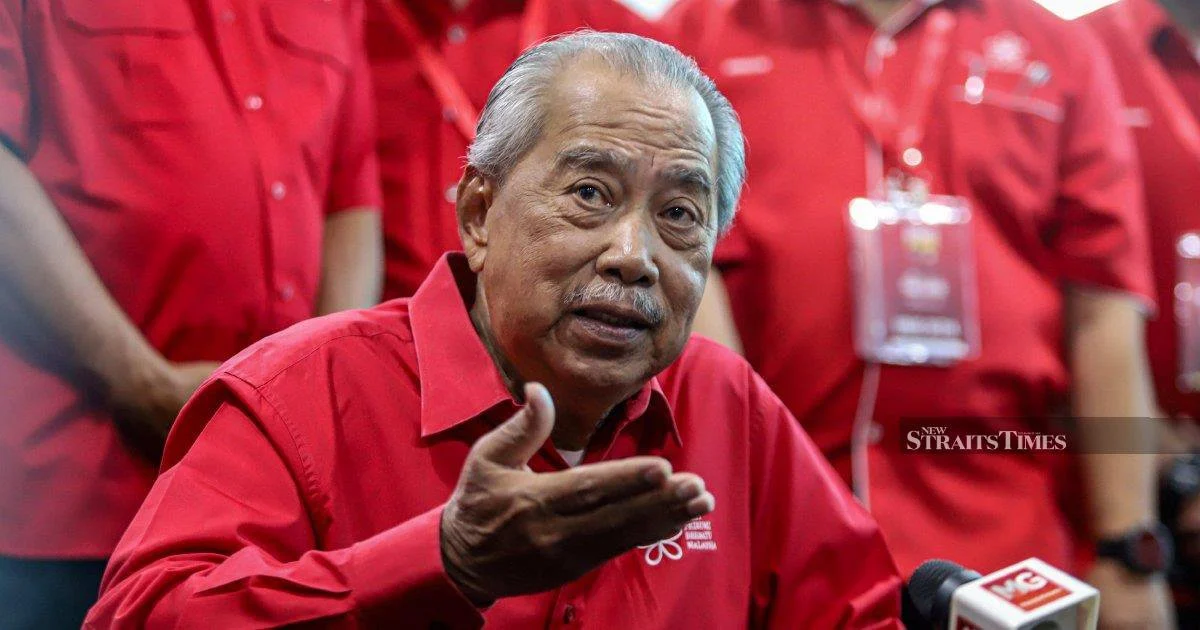
Tan Sri Muhyiddin Yassin, the president of Bersatu, has moved to quell mounting concerns about his party's continued participation in Perikatan Nasional (PN), declaring in emphatic terms that the coalition remains his party's permanent political home. The statement represents an attempt to stabilise the opposition alliance amid recurring questions about whether Bersatu might eventually shift its allegiances or pursue a separate path.
Muhyiddin's reaffirmation of Bersatu's commitment to PN carries particular weight given the fraught history of Malaysian coalition politics, where parties frequently realign in response to electoral calculations, internal disputes, or shifting power dynamics. Perikatan Nasional itself emerged from the ashes of earlier political restructuring, and its component parties have faced considerable pressure from rival coalitions seeking to poach influential members. The declaration thus serves as an important anchor for a coalition that has struggled to establish itself as a credible alternative government following its electoral setbacks in recent years.
The statement also reflects the complex position that Bersatu occupies within Malaysia's fractious political landscape. As a relatively younger party that gained prominence only in recent years, Bersatu lacks the deep organisational roots of older established parties, making it potentially vulnerable to defections or strategic repositioning. By publicly committing to PN indefinitely, Muhyiddin appears to be signalling to both party members and coalition partners that Bersatu will not opportunistically abandon the alliance, a concern that has likely weighed on other PN members.
For Malaysian readers, Muhyiddin's remarks underscore the ongoing volatility of the nation's opposition politics. Since the 2023 general election, opposition coalitions have struggled to maintain unity and coherence, with PN itself emerging as a significant force despite never holding federal power. The stability of PN carries implications for the trajectory of Malaysian democracy, as a functional opposition is essential for democratic accountability and political competition at the national level.
The timing of this declaration is instructive. Political observers have periodically speculated that deteriorating relations within PN, disagreements over electoral strategy, or attractive overtures from the ruling coalition might eventually lure Bersatu away. Such speculation has a basis in reality, as Malaysian politics has witnessed numerous party defections and coalitional realignments over the past decade. Muhyiddin's emphatic language—using the word "forever"—suggests an attempt to foreclose such possibilities and stabilise expectations among both party supporters and coalition partners.
Understanding the dynamics within PN is crucial for Southeast Asian political observers, as Malaysia's coalition politics influence the broader regional landscape. The stability or instability of Malaysia's opposition alliances can affect economic policy, foreign relations, and the institutional health of Malaysian democracy. A fragmented opposition could enable the ruling coalition to govern without meaningful checks, whereas a stable, credible alternative could enhance competitive democratic governance.
Bersatu's role within PN differs markedly from its position when it briefly flirted with government between 2020 and 2021. That experience, culminating in the party's return to opposition, likely shaped its perspective on coalition loyalty. Having experienced both government and opposition, Bersatu leadership may recognise the value of maintaining a stable platform from which to mount electoral challenges, rather than engaging in disruptive manoeuvres that ultimately proved counterproductive.
The explicit nature of Muhyiddin's commitment also reflects broader anxieties within PN about the durability of the coalition itself. Unlike BN, which maintained structural continuity despite periodic crises, or PKR-led Pakatan Harapan, which benefited from a specific historical moment of anti-establishment sentiment, PN remains a coalition of convenience anchored primarily by opposition to incumbent governance. Such coalitions require consistent reinforcement of commitment from component parties, as they lack the institutional ossification that supports longer-established alliances.
Looking forward, Muhyiddin's statement will likely serve as a reference point in future discussions about PN's trajectory. Should internal disputes emerge or electoral prospects deteriorate further, both supporters and critics of the coalition will cite this declaration as evidence of either steadfast commitment or, should circumstances change, opportunistic reversal. The statement thus functions simultaneously as a binding commitment and as a political document that shapes how future decisions will be interpreted.
For Malaysians considering the nation's political direction, Bersatu's role within PN remains significant despite the party's secondary status compared to some coalition partners. The party holds representation across multiple states and possesses sufficient legislative numbers to influence national outcomes. Muhyiddin's assertion of permanence attempts to ensure that these votes and state-level positions remain mobilised within a coherent coalition framework rather than fragmented through defection or independent action.
%22%2F%3E%3C%2Fpattern%3E%3C%2Fdefs%3E%3Crect%20width%3D%22100%25%22%20height%3D%22100%25%22%20fill%3D%22url(%23ph3iugkg)%22%2F%3E%3Crect%20width%3D%22100%25%22%20height%3D%22100%25%22%20fill%3D%22url(%23ph3iugkp)%22%2F%3E%3Ctext%20x%3D%2250%25%22%20y%3D%2250%25%22%20text-anchor%3D%22middle%22%20dominant-baseline%3D%22central%22%20fill%3D%22rgba(255%2C255%2C255%2C0.95)%22%20font-family%3D%22Georgia%2C%20'Times%20New%20Roman'%2C%20serif%22%20font-weight%3D%22700%22%20font-size%3D%22151%22%20letter-spacing%3D%22-0.02em%22%3EBezzecchi%3C%2Ftext%3E%3C%2Fsvg%3E)