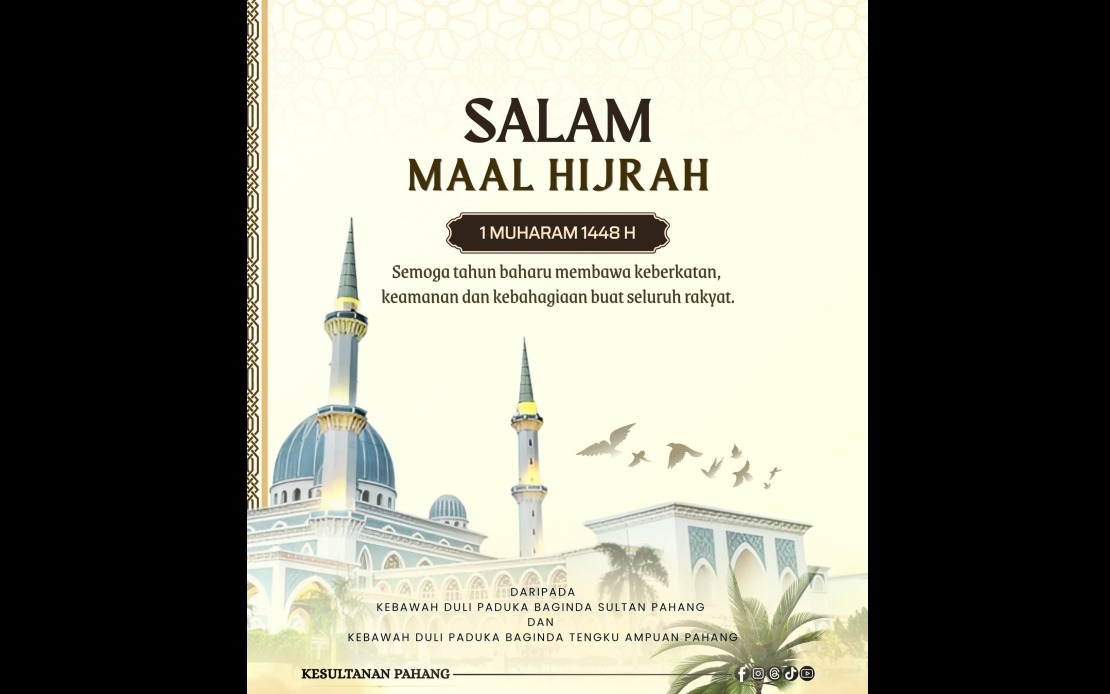
The Sultan of Pahang, Al-Sultan Abdullah Ri'ayatuddin Al-Mustafa Billah Shah, and the Tengku Ampuan of Pahang, Tunku Azizah Aminah Maimunah Iskandariah, have issued greetings to the Muslim community across the state as they commemorate the Maal Hijrah 1448H, the Islamic calendar's new year. The royal address, shared through official channels, underscores the significance of this annual observance for the predominantly Muslim population of Pahang and the broader Islamic community.
The timing of this announcement carries cultural importance beyond mere ceremonial observance. Maal Hijrah commemorates Prophet Muhammad's migration from Mecca to Medina in 622 CE, marking the establishment of the first Islamic state. For Malaysian Muslims, this occasion serves as both a spiritual milestone and a moment for collective introspection about community values and progress. The Sultan and Tengku Ampuan's public acknowledgment reflects the traditional role of royal institutions in maintaining Islamic traditions within Pahang's governance framework.
Through their statement, the royal pair articulated hope that the incoming Islamic year would usher in blessings, tranquility, and contentment for all residents of the state, regardless of faith background. This inclusive framing demonstrates how Pahang's leadership positions Islamic observances within a pluralistic context, emphasizing universal values of peace and prosperity rather than divisive messaging. Such articulation matters in Malaysia's multicommunal society, where state-level religious leadership must balance spiritual significance with broader social cohesion.
Pahang Menteri Besar Datuk Seri Wan Rosdy Wan Ismail expanded upon the royal sentiment by framing the new Islamic year as a pivotal moment for Muslims to reassess their spiritual commitments and ethical obligations. His contribution to the observance positioned Maal Hijrah as more than historical commemoration, transforming it into a framework for personal accountability and institutional improvement. The Menteri Besar's emphasis on renewal speaks to contemporary challenges facing Malaysian society, from economic pressures to social fragmentation.
The Menteri Besar's remarks drew an explicit connection between Prophet Muhammad's Hijrah and modern ethical imperatives. By invoking the historical migration as a model for positive transformation, he encouraged the Muslim population to view this new year as an opportunity to strengthen communal bonds, uphold integrity in public and private conduct, and reinvigorate commitment to Pahang's development trajectory. This rhetorical strategy ties religious observance to tangible governance outcomes, suggesting that spiritual renewal and material progress are interconnected rather than separate domains.
Among the specific virtues the Menteri Besar highlighted were unity, integrity, and charitable action. In the Malaysian context, where communal tensions occasionally surface around religious and ethnic lines, an official call for strengthened unity carries operational significance. Similarly, the emphasis on integrity addresses longstanding concerns about accountability in governance and business, areas where Malaysia has faced international scrutiny in recent years. These references suggest an understanding that religious observances must speak to contemporary institutional challenges.
The invocation of divine blessing in the Menteri Besar's message reflects the theological foundation underlying Islamic governance in Malaysian states. Pahang, like other Malay-majority states, maintains formal structures linking Islam to state administration, including the position of the Sultan as guardian of Islamic affairs. This institutional linkage means that even ceremonial statements carry weight in shaping public expectations about how religious values should inform policy and administrative conduct.
For the broader Malaysian readership, these statements from Pahang's leadership illustrate how state governments engage with religious observances. Unlike federal-level announcements that must navigate greater diversity, state-level religious messaging can reflect the predominant faith community more directly. Yet the consistent emphasis on inclusivity and universal values suggests that even state-specific Islamic observances operate within Malaysia's constitutional framework of religious pluralism and non-establishment of any single faith at the federal level.
The Maal Hijrah observance also carries implications for understanding Malaysia's ongoing discourse about Islamic modernization. By framing spiritual renewal alongside development and integrity, Pahang's leadership positions Islam as compatible with contemporary governance challenges rather than isolating religious practice from practical concerns. This approach reflects a pragmatic interpretation of Islamic teaching popular among Southeast Asian Muslim-majority societies, contrasting with more puritanical or literalist interpretations that might resist engagement with modern institutions.
For Malaysian readers following developments in Pahang specifically, these greetings signal continuity in the state's approach to religious leadership and public messaging. Al-Sultan Abdullah and the Tengku Ampuan have, since assuming their positions, maintained active engagement with significant Islamic occasions through official statements and participatory events. This consistency demonstrates institutional commitment to visible religious leadership, an aspect of governance that resonates with Pahang's Muslim population.
The broader Southeast Asian dimension of this observance reflects Islam's deep historical roots in the region. Malaysia, Indonesia, Brunei, and other Muslim-majority Southeast Asian nations mark Maal Hijrah as an important calendar milestone, though specific observance practices vary. By publicizing their Maal Hijrah greetings, Pahang's leaders participate in this region-wide religious practice while affirming their own state's position within both Malaysian federalism and the global Islamic community.
Looking forward, such annual statements establish an expected rhythm of official engagement with Islamic observances. Citizens and observers can anticipate that significant Islamic occasions will prompt leadership responses, creating opportunities for state officials to communicate values and policy priorities through religious frameworks. This pattern suggests how state-level Islam in Malaysia continues to evolve as an administrative and communicative tool, bridging traditional religious authority with contemporary governance demands. The emphasis on renewal, unity, and integrity will likely recur in future official statements, reflecting consistent thematic priorities among Pahang's leadership.