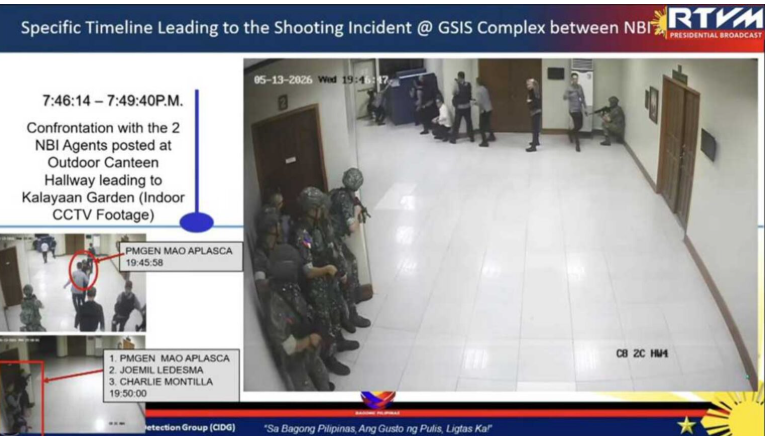
The Philippine Department of Justice has initiated a formal inquiry into the circumstances surrounding a shooting incident at the Senate building on May 13 and the subsequent escape of Senator Ronald dela Rosa from protective custody in the early hours of May 14, with investigators now examining whether public officials bore responsibility for either event. Justice Secretary Fredderick Vida confirmed that prosecutors are actively reviewing evidence collected from multiple sources as they work to establish connections between the two incidents, which unfolded within hours of each other in Manila.
According to Vida's account of preliminary findings, investigators have obtained statements from National Bureau of Investigation personnel and media representatives, along with closed-circuit television recordings, that allegedly document sniper fire originating from the fifth floor of the Senate building. The shots appeared to be directed toward an identifiable NBI vehicle stationed at the GSIS premises, suggesting a deliberate and targeted operation rather than an incident of random violence. The specificity of this account—including the precise floor of origin and the identified target vehicle—indicates that investigators have already gathered substantial physical and testimonial evidence in the opening phase of their inquiry.
Vida's characterization of the investigation as "active and ongoing" signals that authorities have not yet consolidated their findings into formal charges, though the groundwork for potential prosecutions appears to be advancing. When questioned directly about whether specific individuals had been identified as subjects of investigation, Vida responded cautiously in Filipino, acknowledging that no formal designations had been made at that preliminary stage. However, he noted that based on the initial data emerging from the investigation, many of the personalities implicated in the events appear to hold positions within government, a disclosure that raises the prospect of high-level involvement.
The involvement of public officials in either planning, executing, or facilitating the shooting or the escape would represent a significant scandal in Philippine governance, potentially extending beyond individual criminal liability to questions about institutional accountability and the integrity of security protocols. The fact that protective custody could be circumvented so readily, assuming the allegations prove accurate, suggests either systemic failures in the mechanisms designed to safeguard individuals under state protection or deliberate breaches by officials entrusted with those responsibilities. For observers of Philippine politics and governance, this dimension of the inquiry carries implications that transcend the facts of the immediate incident.
Vida's public statements emphasize the DOJ's commitment to proceeding with investigative rigor and impartiality, a reassurance that appears designed to counter any perception that the inquiry might be compromised by political considerations or institutional pressures. His invocation of the principle that "no individual is above the law" directly engages with longstanding concerns in Philippine governance about whether the legal system applies equally across hierarchical divides or tends to insulate powerful figures from accountability. The simultaneous reminder that "no person should be judged before the evidence has been fully examined" appears calibrated to preempt accusations of predetermined conclusions or rushed prosecution.
The timeline of the events—with the Senate shooting occurring on May 13 and dela Rosa's escape happening early on May 14—suggests that the two occurrences may have been coordinated or that the latter was facilitated in the chaos or confusion potentially created by the former. Alternatively, investigators may be examining whether the shooting was staged to provide cover for the escape, or whether officials who orchestrated one event were also responsible for the other. The proximity of these events in time and space naturally invites speculation about intentional linkage, though the investigation must establish such connections through evidence rather than temporal coincidence.
Dela Rosa's status as a sitting senator amplifies the gravity of the case, as it implicates questions about the security and liberty of members of the legislative branch and raises concerns about the integrity of the institutions responsible for protecting them. The fact that a senator could escape from protective custody—or that someone arranged for him to do so—undermines confidence in the ability of state security mechanisms to function as intended. This dimension of the case likely commands significant political attention beyond the DOJ's prosecutorial mandate.
The DOJ's decision to make public statements about the investigation's progress, even while emphasizing its ongoing nature and the absence of formal charges, suggests that authorities believe transparency serves both institutional credibility and public confidence. Alternatively, such announcements may serve to signal to potential subjects of investigation that the inquiry is serious and expanding, thereby encouraging cooperation or discouraging obstruction. The balance between transparency and operational discretion in sensitive investigations of this type remains delicate.
For observers in Malaysia and across Southeast Asia, the case offers a window into the challenges that democracies in the region face in maintaining the rule of law while contending with political pressures and institutional weaknesses. The willingness of the Philippine DOJ to pursue an investigation that may implicate high-ranking officials demonstrates both the necessity of and the difficulty involved in subjecting power to legal accountability. The outcome of the inquiry will likely serve as a test case for the durability of institutional checks on executive and governmental authority in the Philippines, with implications extending to broader questions about democratic governance and judicial independence in Southeast Asia.