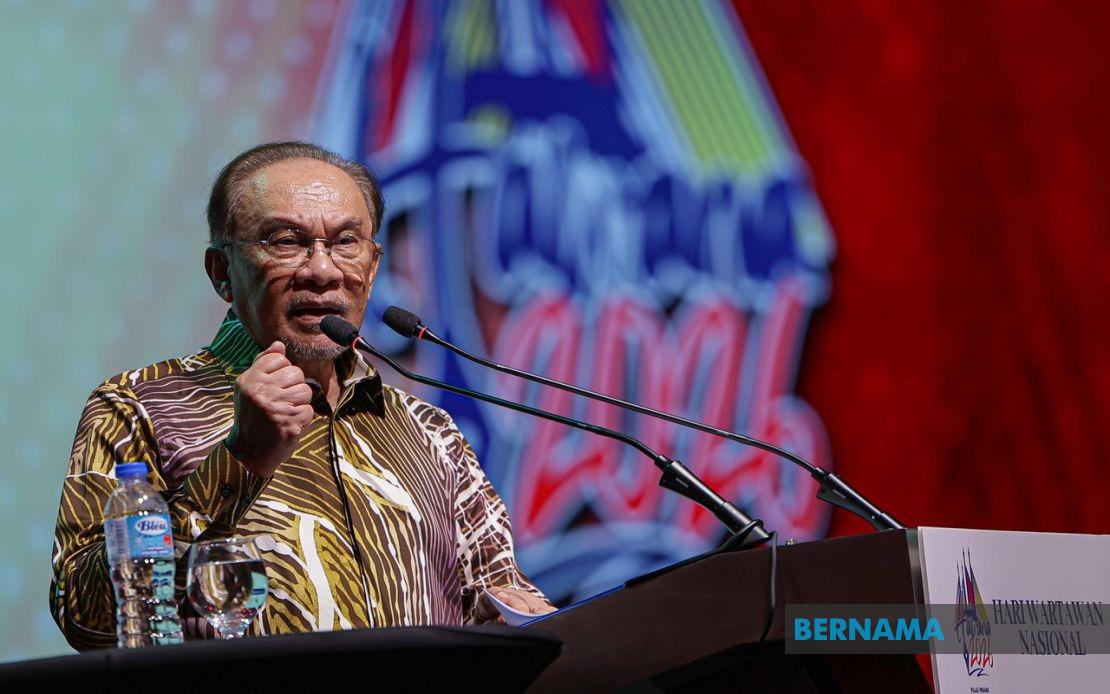
Prime Minister Datuk Seri Anwar Ibrahim has thrown his weight behind the recent appointment of Tan Sri Nallini Pathmanathan as chairman of the Malaysian Media Council, viewing her judicial credentials as a crucial step toward restoring public faith in the media watchdog. Speaking at the National Journalists' Day celebration in Butterworth on June 20, Anwar emphasised that Nallini's distinguished background would help reshape the council's reputation during a period when media institutions face heightened scrutiny across Southeast Asia.
The appointment follows careful deliberation by MMC board members, who unanimously endorsed Nallini during a board meeting on May 26. Anwar highlighted that her selection reflected not merely procedural necessity but a deliberate strategic choice grounded in her proven judicial experience, professional standing and personal integrity. The Prime Minister's public endorsement carries particular weight given the Malaysian Media Council's nascent status, as the body was formally established only recently under the Malaysian Media Council Act 2025.
Nallini's elevation to the chairmanship represents a significant moment for Malaysia's media governance architecture. Her transition from the Federal Court bench brings judicial gravitas to a self-regulatory entity that must balance competing interests: protecting journalistic freedom while establishing credible standards and managing public complaints about media conduct. This appointment signals that the government intends to position the MMC as an independent arbiter with legitimacy derived from its leadership's standing rather than state apparatus affiliation.
The timing of this appointment reflects broader regional conversations about media standards and public confidence. Across Southeast Asia, media councils and self-regulatory bodies have struggled to maintain perceived neutrality amid polarised political landscapes and declining trust in traditional journalism. By appointing someone from the judiciary, Malaysian authorities hope to insulate the MMC from accusations of political interference or partisan decision-making. Nallini's judicial background suggests that the council will adopt a legally rigorous approach to adjudication rather than relying on opaque editorial judgement.
The Malaysian Media Council's mandate encompasses several critical functions within Malaysia's media ecosystem. As a self-regulatory mechanism, it aims to elevate journalistic standards, establish frameworks for handling public complaints about media coverage, promote ethical practices among news organisations, and—perhaps most significantly—protect media freedom as a foundational democratic principle. These responsibilities carry enormous implications for how Malaysia's news industry evolves. Unlike government-imposed regulations, self-regulation theoretically preserves editorial independence while creating accountability structures that satisfy public expectations for responsible journalism.
Anwar's remarks at the HAWANA 2026 event underscored the government's broader commitment to professionalising Malaysia's media landscape. Alongside him were key figures including Communications Minister Datuk Fahmi Fadzil and Penang Chief Minister Chow Kon Yeow, indicating that the appointment carries support across multiple tiers of government. The presence of high-ranking officials from the Communications Ministry and prominent media personalities—including Bernama leadership—demonstrated an institutional consensus regarding the appointment's importance.
For Malaysian journalists and news organisations, Nallini's chairmanship signals expectations of substantive engagement with media governance issues. Her judicial background means she will likely approach council decisions with formal reasoning and written decisions—a departure from less transparent processes common in some self-regulatory bodies regionally. News organisations may experience more formalised complaint procedures and potentially more demanding evidentiary standards when disputes arise, though this should theoretically enhance rather than undermine press freedom by creating predictable rules of engagement.
The Malaysian Media Council's role as the cornerstone of media self-regulation comes at a moment when governments throughout Southeast Asia are wrestling with how to address journalistic accountability without eroding the independence essential to democratic oversight functions. By appointing an external figure with judicial credibility, Malaysia is attempting to resolve a persistent tension: creating meaningful accountability mechanisms while maintaining sufficient distance from political pressure. Nallini's track record and public reputation will be crucial to whether the MMC achieves this delicate balance.
Public confidence in media institutions has eroded across the region as digital platforms fragment audiences and traditional news organisations struggle with business model sustainability. The Malaysian Media Council, in Nallini's hands, must demonstrate that self-regulation can address legitimate public concerns about editorial standards, factual accuracy, and conflicts of interest without devolving into censorship or political manipulation. Her appointment suggests that Malaysian policymakers recognise that credible self-regulation depends fundamentally on leadership legitimacy derived from external standing rather than internal journalism networks.
Looking forward, Nallini's tenure will be closely watched by media practitioners, civil society organisations, and international observers monitoring press freedom in Southeast Asia. Her first major decisions regarding complaint procedures, standards-setting, and the balance between protecting journalistic prerogatives and addressing public grievances will shape the MMC's trajectory and determine whether the council becomes a respected institution or a symbol of nominal regulation. The Prime Minister's public backing provides a foundation of support, though the chairman's actual independence and decision-making will ultimately determine the council's credibility.
%22%2F%3E%3C%2Fpattern%3E%3C%2Fdefs%3E%3Crect%20width%3D%22100%25%22%20height%3D%22100%25%22%20fill%3D%22url(%23ph2wtq6g)%22%2F%3E%3Crect%20width%3D%22100%25%22%20height%3D%22100%25%22%20fill%3D%22url(%23ph2wtq6p)%22%2F%3E%3Ctext%20x%3D%2250%25%22%20y%3D%2250%25%22%20text-anchor%3D%22middle%22%20dominant-baseline%3D%22central%22%20fill%3D%22rgba(255%2C255%2C255%2C0.95)%22%20font-family%3D%22Georgia%2C%20'Times%20New%20Roman'%2C%20serif%22%20font-weight%3D%22700%22%20font-size%3D%22320%22%20letter-spacing%3D%22-0.02em%22%3ETV3%3C%2Ftext%3E%3C%2Fsvg%3E)
%22%2F%3E%3C%2Fpattern%3E%3C%2Fdefs%3E%3Crect%20width%3D%22100%25%22%20height%3D%22100%25%22%20fill%3D%22url(%23ph3gf80g)%22%2F%3E%3Crect%20width%3D%22100%25%22%20height%3D%22100%25%22%20fill%3D%22url(%23ph3gf80p)%22%2F%3E%3Ctext%20x%3D%2250%25%22%20y%3D%2250%25%22%20text-anchor%3D%22middle%22%20dominant-baseline%3D%22central%22%20fill%3D%22rgba(255%2C255%2C255%2C0.95)%22%20font-family%3D%22Georgia%2C%20'Times%20New%20Roman'%2C%20serif%22%20font-weight%3D%22700%22%20font-size%3D%22170%22%20letter-spacing%3D%22-0.02em%22%3ENational%3C%2Ftext%3E%3C%2Fsvg%3E)
%22%2F%3E%3C%2Fpattern%3E%3C%2Fdefs%3E%3Crect%20width%3D%22100%25%22%20height%3D%22100%25%22%20fill%3D%22url(%23ph4jjg8g)%22%2F%3E%3Crect%20width%3D%22100%25%22%20height%3D%22100%25%22%20fill%3D%22url(%23ph4jjg8p)%22%2F%3E%3Ctext%20x%3D%2250%25%22%20y%3D%2250%25%22%20text-anchor%3D%22middle%22%20dominant-baseline%3D%22central%22%20fill%3D%22rgba(255%2C255%2C255%2C0.95)%22%20font-family%3D%22Georgia%2C%20'Times%20New%20Roman'%2C%20serif%22%20font-weight%3D%22700%22%20font-size%3D%22170%22%20letter-spacing%3D%22-0.02em%22%3EJudicial%3C%2Ftext%3E%3C%2Fsvg%3E)