Prime Minister Datuk Seri Anwar Ibrahim has positioned the Islamic historical event of Hijrah as a blueprint for contemporary Malaysian governance, emphasizing that successful reform cannot rest on the shoulders of any single leader or faction but must emerge from coordinated action across the nation's diverse communities. Speaking on the occasion of Maal Hijrah 1448H, Anwar articulated a vision where the Prophet Muhammad SAW's migration to Madinah serves as more than historical commemoration—it becomes a living principle guiding how modern Malaysia approaches transformation in pursuit of justice, truth, prosperity and security.
The Prime Minister's framing of Hijrah carries particular resonance in the Malaysian context, where building consensus across religious, ethnic and political divides remains a central governance challenge. By invoking the concept of collective struggle rooted in Islamic history, Anwar sought to transcend partisan rhetoric and appeal to shared values that might mobilize support for his administration's reform agenda. His message implicitly acknowledges the limitations of top-down decree, suggesting instead that sustainable change requires the willing participation of citizens and institutions operating across a complex social landscape.
Anwar's commentary on the historical Hijrah itself warrants closer examination for how it illuminates his contemporary political philosophy. By highlighting the contributions of youth figures such as Saidina Ali Abi Talib, the role of women including Asma Abu Bakar, and the broader community of companions who organized and executed this epochal migration, the Prime Minister constructed a narrative of inclusive participation. This historical reconstruction subtly challenges any notion that reform can be the preserve of elites alone, suggesting instead that meaningful transformation emerges from diverse voices working in concert toward shared objectives.
The Prime Minister explicitly cautioned against relying on rhetoric, slogans and isolated effort as vehicles for change. This statement carries implicit criticism of populist or personality-driven approaches to governance, suggesting that Malaysia's path forward requires patience, institutional cooperation and a willingness to subordinate individual ambition to collective welfare. The emphasis on patience is particularly noteworthy in a Malaysian political environment often characterized by urgency and competing demands for immediate results.
Central to Anwar's argument is his assertion that the willingness to undertake reforms grounded in Hijrah's essence cannot be the monopoly of any single political party. This principle holds particular importance for Malaysian politics, where the governing coalition comprises multiple parties and ideological persuasions. The statement appears designed to establish a moral framework in which cooperation transcends partisan advantage, positioning collaboration as a religious obligation rather than mere political pragmatism. Whether such framing can overcome the realities of competitive politics remains an open question.
The Prime Minister's invocation of Surah An-Nisa, verse 100, which addresses divine reward for those who migrate in Allah's path, anchored his arguments in Islamic scriptural authority. By connecting Quranic teaching to contemporary reform agendas, Anwar positioned his government's initiatives within a religious framework that extends beyond secular political calculation. This rhetorical strategy attempts to elevate the moral stakes of national reform, presenting it not merely as administrative efficiency or policy implementation but as a spiritual imperative.
Anwar's equation of Hijrah with sacrifice, struggle, brotherhood and unity construction offers a compressed statement of his political philosophy. Each of these terms carries weight in the Malaysian context: sacrifice invokes the notion that reform requires costs; struggle acknowledges that change faces resistance; brotherhood emphasizes religious and social bonds transcending material interest; and unity construction speaks directly to a nation where communal cohesion cannot be assumed but must be perpetually rebuilt. Together, these formulations present reform not as a technical exercise but as an existential endeavor.
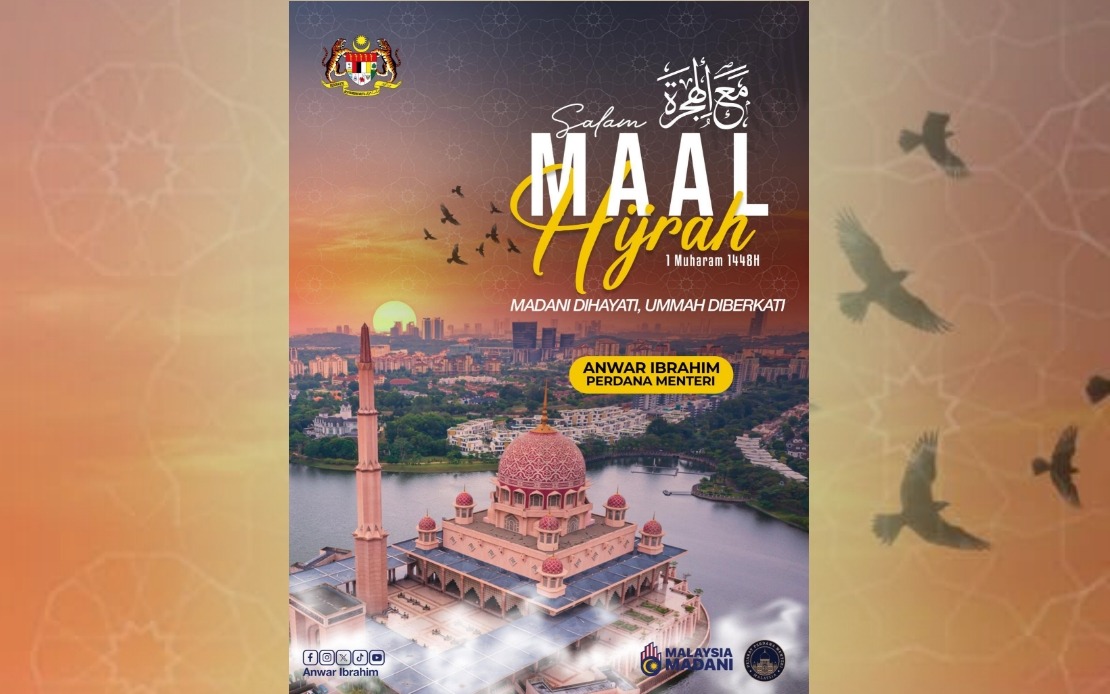
The Department of Islamic Development Malaysia's selection of the theme "MADANI Dihayati, Ummah Diberkati" (MADANI Embraced, The Ummah Blessed) for the National Maal Hijrah Celebration reinforces this broader messaging strategy. By linking the government's MADANI framework—which emphasizes prosperity, stability and inclusivity—to the Hijrah commemoration, authorities attempted to demonstrate how contemporary governance draws inspiration from Islamic historical precedent. This alignment between political messaging and religious observance characteristic of Malaysia's approach to state Islam.
For Malaysian readers, the implications extend beyond ceremonial speeches. Anwar's emphasis on consensus-building and collective action speaks to a government attempting to navigate significant economic and social challenges while managing a multi-party coalition with divergent interests. The elevation of unity as a governing principle suggests both idealism and pragmatism—an acknowledgment that Malaysia's diversity requires inclusive approaches, combined with recognition that securing buy-in across various constituencies remains essential for implementing controversial reforms.
The timing of this message, delivered during Maal Hijrah observance, also reflects Malaysia's calendrical politics, where religious occasions frequently serve as platforms for governmental messaging. By connecting Islamic commemoration to governance themes, the Prime Minister engaged in a mode of political communication deeply rooted in Malaysian practice, though the explicit emphasis on unity over individual leadership or party advantage represented a notable rhetorical choice within that tradition.
Sustaining such emphasis on collective action against the pressures of competitive politics will test whether Anwar's Hijrah-inspired framework can transcend ceremonial articulation to influence actual governance practices. The gap between invoking noble historical principles and implementing policies that genuinely require sacrifice across constituencies remains substantial. How effectively this messaging translates into concrete reforms affecting Malaysian citizens' lives will ultimately determine whether the spirit of Hijrah becomes governing practice or remains inspirational rhetoric.