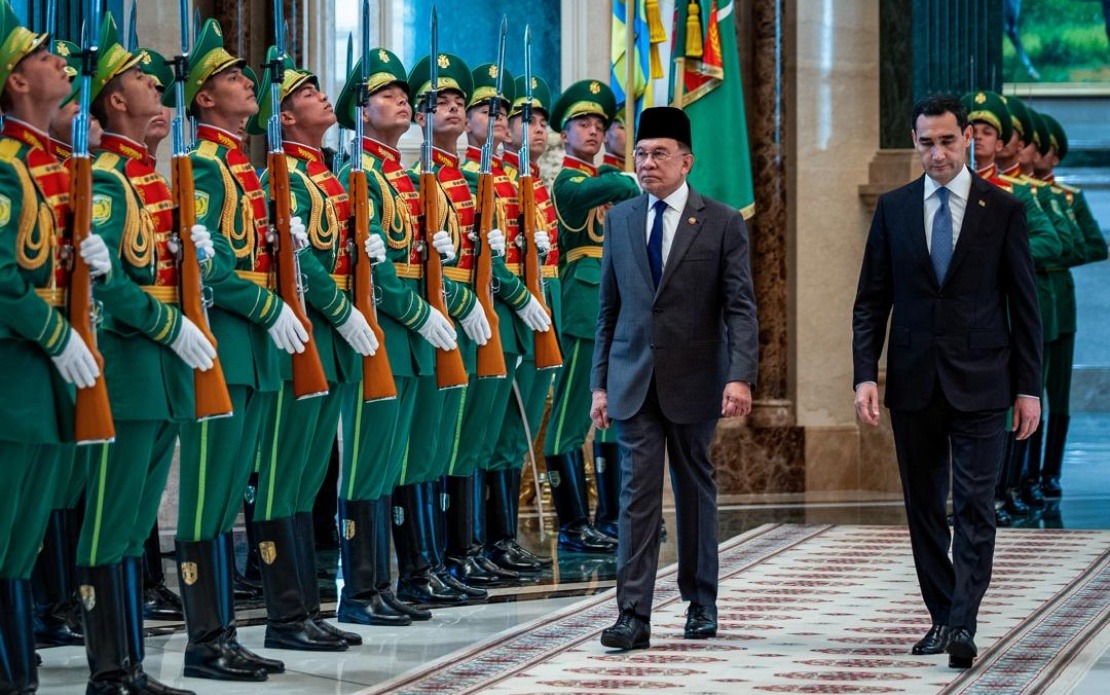
Prime Minister Datuk Seri Anwar Ibrahim was formally received with full ceremonial honours at the Turkmenistan Presidential Palace in Ashgabat on June 19, underscoring the significance Malaysia places on diplomatic ties with the mineral-rich Central Asian nation. The two-day visit, which commenced on June 18, represents Anwar's first official engagement with Turkmenistan since his appointment as Malaysia's 10th Prime Minister in November 2022, coming at the express invitation of President Serdar Berdimuhamedov.
The elaborate welcome ceremony reflected customary diplomatic protocol, with both national anthems performed as Anwar was escorted by an honour guard. This formal reception signals Turkmenistan's commitment to strengthening bilateral relations with Southeast Asia's largest economy and a strategic player in regional geopolitics. Such state-level ceremonies, often choreographed to project national prestige, typically precede substantive negotiations on trade, investment, and strategic partnerships.
Following the ceremonial reception, Anwar was introduced to senior members of the Turkmenistan Cabinet and key government officials, establishing personal connections that facilitate future administrative cooperation. He subsequently presented members of the Malaysian delegation to President Berdimuhamedov, a customary diplomatic practice that personalises relationships and reinforces institutional bonds between nations. These preliminary engagements, though largely procedural in nature, establish the groundwork for candid policy discussions.
The highlight of the visit came during the private four-eyed meeting between the two leaders, where they discussed matters of strategic concern to both governments without the presence of broader delegations. Such intimate settings often yield frank exchanges on sensitive topics that might be constrained in larger forums. Following this confidential discussion, the leaders reconvened for expanded bilateral talks that involved senior officials from both sides, allowing for detailed exploration of cooperation frameworks across multiple sectors.
Turkmenistan, a nation of roughly 6.2 million people straddling the Caspian Sea, represents a significant economic opportunity for Malaysian investors and policymakers. The country possesses substantial natural gas reserves—among the world's largest—and sits at the crossroads of major trade corridors connecting East Asia, the Middle East, and Europe. For Malaysia, engagement with Turkmenistan opens pathways to Central Asian markets and positions the country as a bridge between Southeast and Central Asia, aligning with broader regional integration strategies.
The bilateral agenda likely encompassed trade expansion, investment opportunities in energy and infrastructure, and coordination on regional security matters affecting the broader Asian continent. Malaysia's emphasis on forging partnerships beyond Southeast Asia reflects recognition that economic resilience depends on diversified international engagement. Turkmenistan, meanwhile, seeks to deepen ties with dynamic Asian economies, particularly as it navigates complex geopolitical pressures in the Caspian region.
This visit also carries symbolic weight within the context of Malaysia's foreign policy under Anwar's administration. Since taking office, Anwar has prioritised a balanced, multi-aligned approach to international relations, avoiding excessive dependence on any single power while cultivating relationships across ideological and geographic boundaries. Engagement with Turkmenistan, a country with historical ties to both Russia and growing connections to Western markets, exemplifies this pragmatic diplomacy.
From an economic standpoint, bilateral cooperation could encompass Malaysian investment in Turkmenistan's gas-to-liquids projects, opportunities for Malaysian technology and construction firms, and potential joint ventures in telecommunications and manufacturing. Conversely, Turkmenistan may seek Malaysian expertise in port management, financial services, and halal food production—sectors where Malaysia has developed recognised competencies. Energy cooperation deserves particular attention, as Malaysia's petrochemical and refining industries could benefit from stable gas supplies and collaborative research initiatives.
The visit reflects Anwar's broader diplomatic calendar, which has seen him traverse multiple regions and establish partnerships critical to Malaysia's economic and security interests. By extending engagement to Central Asia—a region often overlooked by Southeast Asian capitals—Malaysia demonstrates strategic vision and commitment to authentic multilateralism rather than alignment confined to conventional blocs. Such outreach also strengthens Malaysia's candidacy for roles in international organisations and enhances its soft power credentials.
Looking ahead, the outcomes of these bilateral discussions will likely materialise in formal agreements or memoranda of understanding covering trade, investment, education, and cultural exchanges. These instruments, typically announced following high-level visits, provide institutional frameworks for sustained engagement beyond the immediate visit period. For Malaysian companies, including those in energy, construction, and technology sectors, such agreements create pathways for market entry and partnership opportunities in a nation strategically positioned along major Eurasian corridors.
The visit ultimately underscores Malaysia's commitment to pragmatic, interest-based diplomacy that transcends geographic proximity. By engaging seriously with Central Asian partners, Anwar's government signals that Malaysian foreign policy embraces diverse relationships capable of generating mutual prosperity and regional stability. As global competition for influence in Asia intensifies, such strategic positioning enhances Malaysia's relevance and leverage in international affairs, positioning the nation as a reliable, principled partner worthy of sustained diplomatic investment from partners across the world.