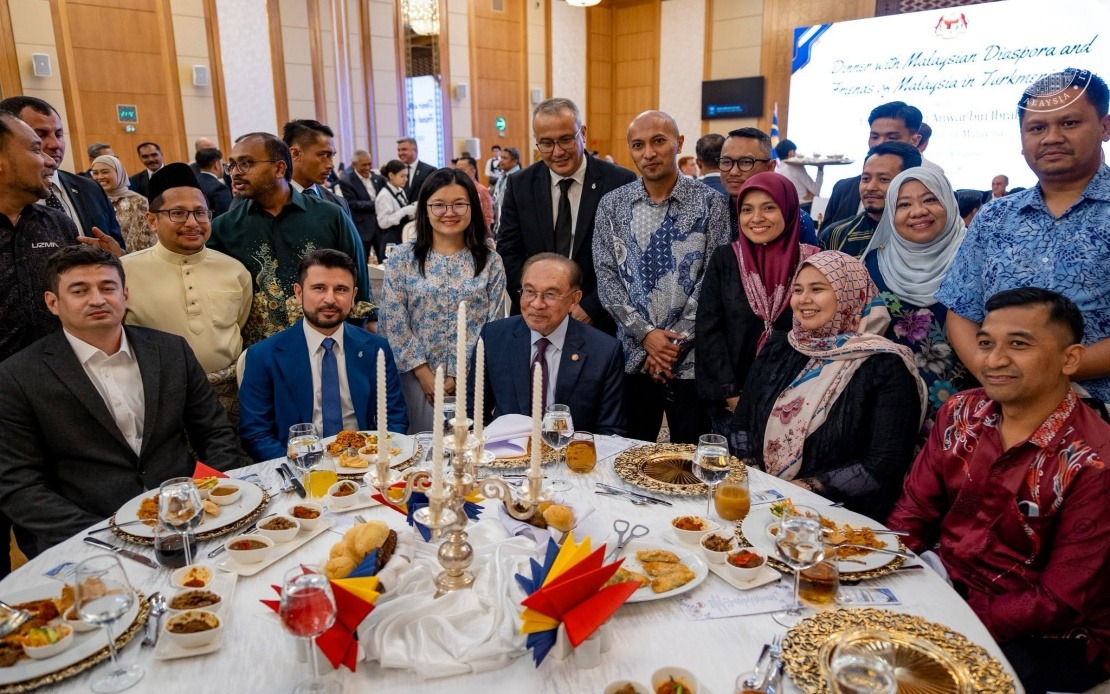
Prime Minister Datuk Seri Anwar Ibrahim has underscored the critical role played by Malaysians living overseas in advancing the nation's standing on the world stage, bringing this message directly to community members during his ongoing two-day official visit to Turkmenistan. The engagement with the Malaysian diaspora in Ashgabat reflected the MADANI Government's broader commitment to maintaining meaningful connections with citizens scattered across the globe, particularly in regions where Malaysia's diplomatic footprint continues to expand.
The encounter in the Turkmenistan capital provided Anwar with an opportunity to articulate how the government views overseas Malaysians as far more than mere expatriates—instead positioning them as instrumental players in Malaysia's international narrative. In a Facebook post following the gathering, Anwar described the experience as emotionally resonant, noting that despite the physical distance separating Ashgabat from Kuala Lumpur, the warmth and sense of togetherness among the assembled Malaysians created a connection that transcended geography.
Crucially, Anwar framed the diaspora's contributions in explicitly diplomatic terms, characterising these citizens as "unofficial ambassadors" who consciously work to enhance Malaysia's reputation and expand the nation's networks on foreign soil. This framing carries particular significance for a government seeking to consolidate soft power capabilities across multiple regions simultaneously. The Prime Minister emphasised that diaspora communities actively advance the nation's interests and dignity through their daily engagements within their host societies, making their role integral to Malaysia's broader foreign policy objectives.
During his remarks, Anwar encouraged members of the Malaysian community in Ashgabat to maintain active connections with home, stressing the importance of staying informed about Malaysia's ongoing development and trajectory. This appeal reflects a government strategy to keep diaspora populations emotionally and informally invested in national progress, recognising that such ties can translate into tangible support for Malaysian interests—whether through business networks, cultural advocacy, or political goodwill—within their adopted countries.
The visit to Turkmenistan itself represents a significant diplomatic initiative in Central Asia, a region where Malaysia has historically maintained limited but growing engagement. Anwar's trip marks his first official visit to the country, arriving at the invitation of Turkmenistan President Serdar Berdimuhamedov, who had visited Malaysia in December 2024. This reciprocal exchange signals an intention to deepen bilateral relations between the two nations, moving beyond traditional transactional engagements.
Anwar articulated that the Turkmenistan visit encompasses objectives well beyond conventional economic metrics. While trade, investment, and economic cooperation naturally feature in any high-level bilateral exchange, the Prime Minister stressed that the mission also aims to cultivate broader friendship, enhance mutual understanding, and identify novel areas where both countries might collaborate productively. This multidimensional approach suggests Malaysia's willingness to engage Central Asia as part of a diversified international strategy rather than viewing the region primarily through a commercial lens.
The strategic importance of this engagement becomes clearer when contextualised within Malaysia's evolving diplomatic posture. Central Asia has emerged as an increasingly significant zone for global competition and cooperation, particularly given its resource wealth and strategic positioning. Malaysia's engagement with Turkmenistan and the broader region reflects an effort to position itself as a serious player beyond its traditional Southeast Asian sphere of influence, while simultaneously leveraging its unique position as a Muslim-majority nation with extensive regional networks.
The emphasis on diaspora engagement during the Turkmenistan visit also reveals how modern Malaysian diplomacy integrates non-state actors into its strategic framework. By publicly acknowledging and celebrating the contributions of overseas Malaysians, the government effectively mobilises soft power assets that exist beyond formal governmental structures. These individuals and communities serve as bridges between Malaysia and their host nations, influencing perceptions and facilitating exchanges at multiple levels of society.
For Malaysian readers and policymakers, the broader implication of Anwar's diaspora engagement strategy involves recognising the intricate interconnections between national identity, overseas representation, and long-term diplomatic influence. As Malaysia seeks to expand its footprint in regions like Central Asia where significant expatriate populations exist, these communities become valuable assets in establishing credibility and deepening connections with local governments and populations. The government's deliberate cultivation of diaspora identity and patriotism thus serves concrete strategic purposes beyond emotional or cultural considerations.
Looking ahead, Malaysia's approach to engaging overseas communities during high-level diplomatic missions may establish a template for future engagements across other regions. This strategy acknowledges that in an interconnected world where information and influence flow through multiple channels, state actors must consciously activate and coordinate all available resources—including citizen networks—to achieve foreign policy objectives. The Turkmenistan visit demonstrates a calculated effort to integrate diaspora engagement into mainstream diplomatic practice rather than treating it as a peripheral or ceremonial component of official visits.