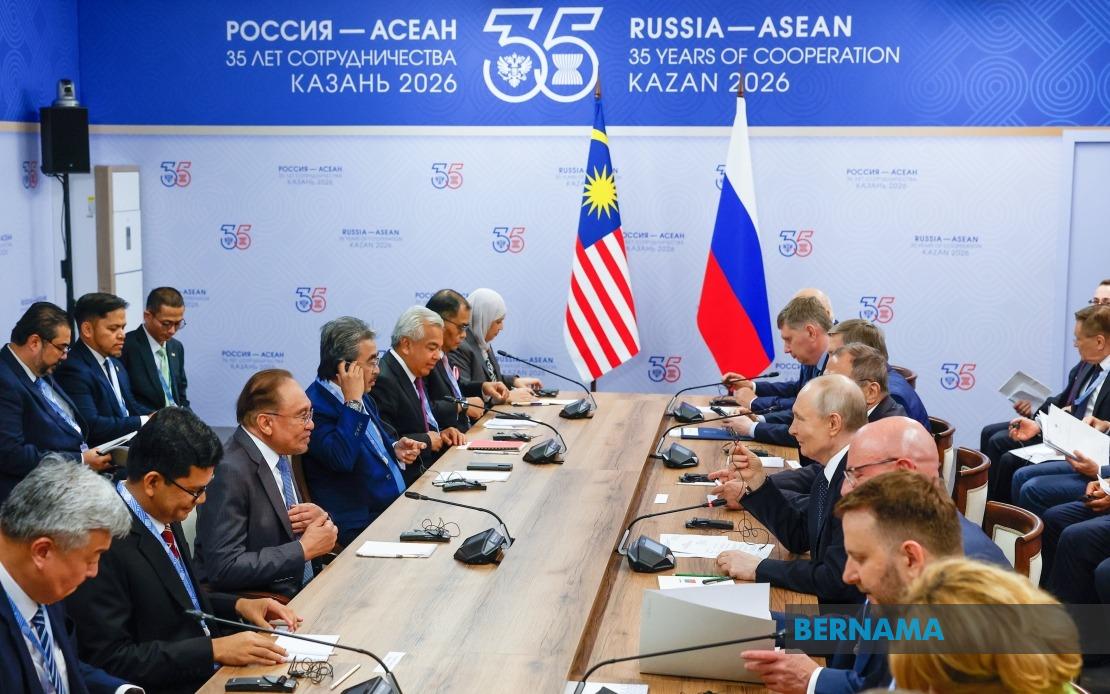
Russian President Vladimir Putin has signalled Moscow's commitment to elevating its relationship with Malaysia, emphasizing the solid groundwork both nations have constructed over nearly six decades of diplomatic engagement. Speaking with Malaysian Prime Minister Datuk Seri Anwar Ibrahim during the ASEAN-Russia Commemorative Summit in Kazan on June 18, Putin underscored that the two countries are approaching their 60th anniversary of formal relations in 2026 from a position of considerable strength, with substantial achievements already on the record and compelling prospects for future collaboration.
The Russian leader framed bilateral ties as resting upon a foundation of accumulated goodwill and practical achievement. Putin highlighted what he described as "substantive positive experience" accumulated through mutual and official cooperation, suggesting that rather than merely maintaining diplomatic courtesy, Russia and Malaysia have built genuine institutional channels and working relationships. He emphasized that the two governments maintain consistent dialogue through their respective ministries, government agencies, and parliamentary bodies, demonstrating a depth of engagement that extends beyond ceremonial exchanges.
A critical institutional mechanism underpinning the partnership is the intergovernmental commission focused on economic, scientific, technical, and cultural cooperation. This body, Putin indicated, functions as the operational hub for translating strategic intentions into concrete joint projects and initiatives. The existence of such formal structures reflects a deliberate commitment by both countries to move beyond rhetoric and establish machinery capable of delivering tangible results across multiple domains of national interest.
Economic expansion represents a particularly encouraging dimension of the relationship. Trade between Russia and Malaysia surged by 12.9 per cent during 2025, a trajectory that Putin characterized as a positive outcome warranting continued attention and cultivation. For Malaysia, the expanding Russian market offers diversification opportunities as Southeast Asia navigates complex geopolitical currents and seeks multiple trading partners beyond traditional Western alliances. For Russia, Malaysia represents an important foothold within ASEAN and an access point to the broader Southeast Asian economic sphere.
Beyond commerce, Putin articulated Russian interest in collaborating with Malaysia across education, scientific research, technological development, tourism, and cultural exchanges. These sectors reflect the multifaceted nature of modern bilateral relations, extending far beyond traditional diplomatic and trade metrics. Educational partnerships, for instance, can build long-term people-to-people connections that transcend political cycles, while scientific cooperation allows both nations to pool intellectual resources on issues of mutual concern, from climate adaptation to technological innovation.
Putin's remarks regarding Malaysia's role within ASEAN frameworks carried particular significance. He acknowledged Malaysia's instrumental position in Russia-ASEAN relations, noting that the first-ever summit-level engagement between Russia and the ten-member bloc occurred in Malaysia back in 2005. This historical footnote underscores Malaysia's diplomatic weight and its capacity to facilitate dialogue between Russia and Southeast Asia during a period when such bridges carry heightened geopolitical importance. Putin's explicit appreciation for Malaysia's continued support for deepening Russia-ASEAN strategic partnership suggests Moscow views the bilateral relationship as a vehicle for achieving broader regional objectives.
The timing of these discussions carries weight within the current geopolitical context. Russia, facing international sanctions and economic isolation from Western powers, has intensified efforts to strengthen ties with nations in Asia and the Global South. Malaysia, as a major Muslim-majority country, significant ASEAN member, and established trading power, holds strategic value to Moscow's regional positioning. Simultaneously, Malaysia maintains pragmatic engagement with multiple powers and has sought to avoid taking explicit sides in great-power competitions, positioning itself as a bridge-builder rather than an aligned participant.
Putin's characterization of Russia-Malaysia relations as grounded in "mutual respect and consideration of interests" carries deliberate language emphasizing non-interference and reciprocal benefit. This framing distinguishes the relationship from hierarchical or extractive arrangements, presenting instead a vision of equals collaborating for shared advantage. Such positioning appeals to Malaysian sensibilities around sovereignty and independent foreign policy, particularly among a public historically attuned to protecting national autonomy from external pressure.
The Russian president's personal gestures—recalling previous meetings with Anwar and conveying wishes to His Majesty Sultan Ibrahim, King of Malaysia—served to reinforce the relational dimension beyond institutional frameworks. Such courtesies, while ceremonial in nature, signal respect for Malaysian leadership and maintain the personal rapport that often proves critical in facilitating government-to-government cooperation at critical junctures. Putin's acknowledgment of Anwar's previous Malaysian leadership positions indicated familiarity with Malaysian political evolution and commitment to continuity across leadership transitions.
The approaching 60th anniversary milestone presents both countries an opportunity to recalibrate their partnership for contemporary challenges. Rather than merely commemorating past cooperation, both Russia and Malaysia appear positioned to leverage the occasion for announcing expanded initiatives and formalizing new collaborative frameworks. The convergence of economic growth, institutional development, and political will suggests the bilateral relationship may enter an intensified phase of development over the coming years.
For Malaysian policymakers and observers, the Russian engagement reflects broader efforts by non-Western powers to consolidate influence within Southeast Asia as traditional alignments undergo transformation. Malaysia's ability to maintain substantive relations with Russia while preserving relationships with Western partners and managing intra-ASEAN dynamics demonstrates the sophisticated balancing act that characterizes contemporary Malaysian diplomacy.
The emphasis on diverse cooperation domains—from trade to culture to technology—suggests both nations recognize that sustainable partnerships require diversified foundations. Economic ties alone can prove fragile when geopolitical tensions mount, but relationships woven through educational, scientific, and cultural threads develop resilience and public support that transcends elite-level decision-making. As Malaysia and Russia approach their six-decade milestone, this multidimensional approach may determine whether the partnership evolves into a defining feature of each nation's strategic positioning or remains merely competent bilateral management.