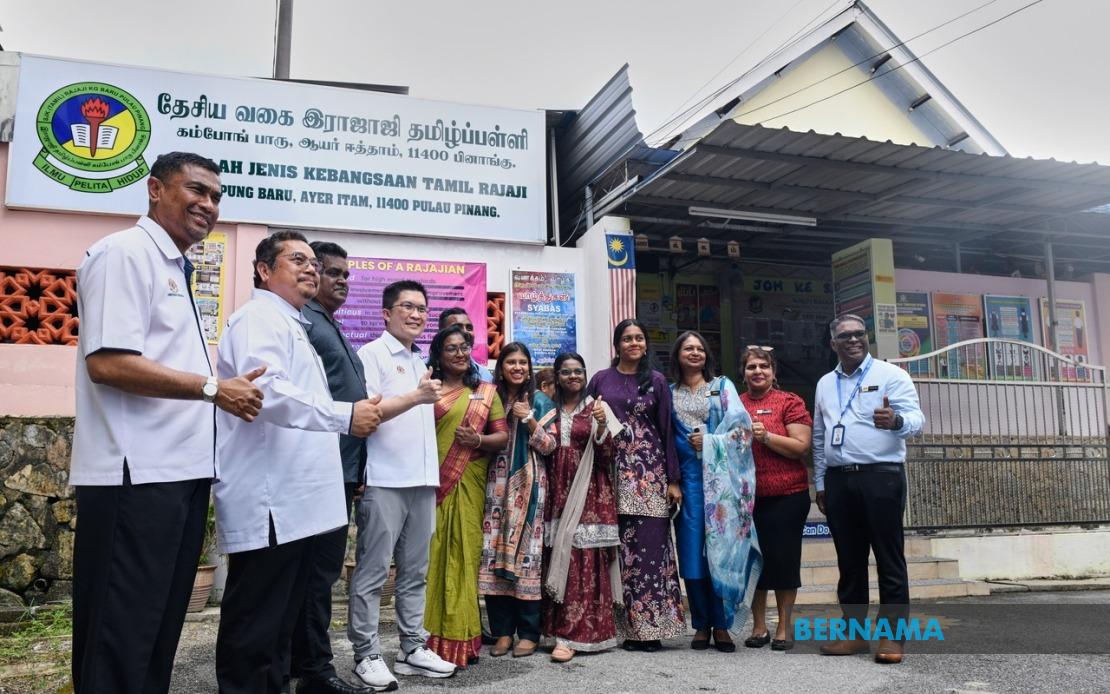
The 76-year-old Sekolah Jenis Kebangsaan Tamil (SJKT) Rajaji in George Town is poised for a significant transformation after the Education Ministry greenlit construction of a new RM8 million campus at a relocated site in Farlim, Bandar Baru Ayer Itam. Deputy Education Minister Wong Kah Woh announced the approval today, marking a pivotal moment for a school that has long grappled with spatial constraints and infrastructure challenges that have hampered its capacity to serve students adequately.
The current campus has become increasingly inadequate for its student population of roughly 100 pupils, forcing administrators to work within severely restricted conditions that limit educational quality and extracurricular opportunities. The relocation represents not merely a change of address but a comprehensive renewal initiative designed to position the institution for sustainable growth and improved pedagogical outcomes. The new facility will be constructed on a 2.3-acre parcel of land situated approximately 500 metres from the school's present location, providing ample space for modern classrooms, recreational areas, and supporting infrastructure.
Penang's state government had already earmarked this strategic plot for SJKT Rajaji's relocation back in 2022, demonstrating sustained commitment to addressing the school's spatial crisis. The subsequent application from the school's board of governors, submitted in 2023 and processed through 2024, navigated various procedural requirements and coordination with local authorities before reaching final ministerial approval. This methodical approach, while requiring patience, ensured that all legal, environmental, and municipal considerations were properly addressed prior to construction commencement.
Construction timelines indicate that the project will require approximately 18 months for completion, positioning the school's transition to its new premises for the 2029 academic session at the latest. This extended schedule allows for careful planning of the relocation process, ensuring minimal disruption to the current student cohort and providing adequate time for infrastructure maturation and preparation of new facilities. The phased approach reflects realistic project management expectations for a facility of this scale and complexity.
A particularly noteworthy aspect of this development is its financing structure, which entirely bypasses direct government expenditure. The entire RM8 million investment will be underwritten by a private developer as part of its corporate social responsibility programme, exemplifying a public-private partnership model that increasingly characterises educational infrastructure expansion across Malaysia. This arrangement reduces fiscal pressure on the state budget whilst enabling necessary educational development, a pragmatic solution that benefits schools and communities without constraining other governmental priorities.
Penang's broader context of Tamil-medium educational development underscores the significance of the SJKT Rajaji project. The state operates a network of 28 Tamil national-type schools, many of which face similar infrastructure challenges reflecting decades of underinvestment and demographic shifts. Datuk Seri S. Sundarajoo, who chairs both the State Housing and Environment Committee and the Penang Tamil Schools Special Committee, outlined an accelerating development agenda encompassing at least three groundbreaking ceremonies scheduled for 2024 alone.
Beyond immediate facility improvements, this initiative addresses a systemic issue affecting Malaysian vernacular education. Tamil schools throughout the country have historically received proportionally less infrastructure investment compared to English and Chinese-medium institutions, partly reflecting demographic distribution and partly reflecting uneven prioritisation in resource allocation. Projects like SJKT Rajaji's relocation signal a reorientation toward redressing these historical imbalances, though such changes require sustained multi-year commitment across multiple constituencies.
The revival efforts Sundarajoo referenced, including those involving SJKT Sungai Bakap and SJKT Juru, suggest a coordinated state-level strategy rather than ad hoc interventions. This systematic approach carries implications for Malaysian education policy more broadly, potentially establishing precedent for how vernacular schooling can be modernised and sustained despite the educational sector's general shift toward dominant-language instruction. The involvement of private sector partners becomes critical in making such improvements fiscally viable.
For families and educators within the SJKT Rajaji community, this development concludes a lengthy period of accommodation within substandard facilities. The new campus will enable expanded enrolment, introduction of specialist teaching spaces for science and technology instruction, and recreational facilities that contemporary educational best practice demands. These improvements should enhance both student outcomes and the institution's attractiveness to prospective families, potentially reversing demographic decline that often accompanies facilities deterioration.
The 2029 target represents a realistic but not distant deadline, requiring immediate planning and coordination across multiple stakeholders. School administrators must simultaneously maintain current operations whilst preparing their community for transition, a logistically complex undertaking that demands careful change management. Parents and students will need advance information about relocation timelines, new facilities specifications, and transportation arrangements to new premises in Farlim.
Moreover, the successful completion of SJKT Rajaji's relocation could establish momentum for similar projects elsewhere. Other states with significant Tamil-speaking populations, including Selangor, Johor, and Perak, operate Tamil schools facing comparable spatial and infrastructural challenges. If the Penang model—combining government land provision, private sector financing, and coordinated state oversight—demonstrates viability, it may provide a replicable template for educational infrastructure modernisation throughout the country.
The broader educational significance extends beyond infrastructure considerations to questions of equity and opportunity. Modernised facilities with contemporary teaching resources enhance prospects for Tamil-medium students to develop competitive academic and technical skills, potentially improving their transitions into secondary education and tertiary pathways. As Malaysia navigates demographic and economic transformations, ensuring that vernacular educational streams receive comparable investment to national-stream schools remains essential for social cohesion and inclusive development.