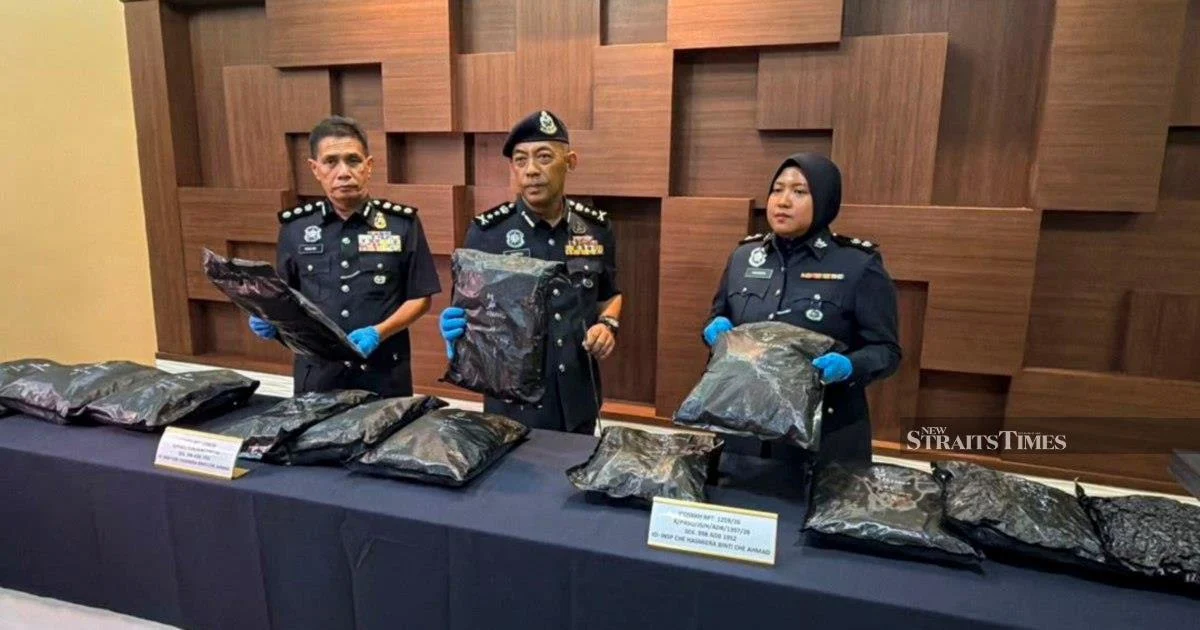
A student from a private higher education institution was apprehended on Monday at Bukit Kayu Hitam while allegedly attempting to bring 14.63 kilograms of cannabis buds into Malaysia from a neighbouring country. The seizure, valued at approximately RM1.17 million, represents a significant drug trafficking operation targeting what appears to be the domestic market or for distribution through educational networks.
The arrest underscores a persistent challenge facing law enforcement agencies along Malaysia's land borders, particularly in Kedah where the Bukit Kayu Hitam checkpoint represents a critical juncture for detecting contraband. The porous nature of the Malaysia-Thailand frontier, combined with established trafficking networks, has made cross-border drug smuggling a recurring issue that continues to threaten public health and national security.
The involvement of a student in this operation raises troubling questions about the recruitment methods employed by organised crime syndicates targeting young people in educational institutions. Rather than working independently, individuals in this demographic are often coerced or incentivised to serve as carriers, attracted by relatively quick financial returns or trapped by debt. The profile of the accused as a student attending a private institution suggests criminals are deliberately targeting individuals with fewer financial constraints but sufficient access to border regions and plausible reasons for frequent travel.
Cannabis trafficking through Malaysian borders has escalated markedly over the past five years, driven by demand within the region and the relative profitability compared to other contraband. The substantial quantity seized in this case—nearly 15 kilograms—indicates this was not a personal consumption quantity but rather a commercial shipment intended for wholesale distribution. At street-level prices in Malaysia, such a quantity could generate significantly higher revenues than the market value assigned by authorities.
The Bukit Kayu Hitam checkpoint, which sits at the Kedah-Perlis border with Thailand, has long served as a flashpoint for drug interdictions. Its significance extends beyond simple geography; it connects Malaysia's developed infrastructure and economic zones with Thailand's more permissive drug environment, creating natural incentives for smuggling operations. Authorities at this location have intercepted numerous high-value drug shipments in recent years, suggesting either improved detection capabilities or alternatively, that detection efforts are merely scratching the surface of much larger trafficking volumes.
Thailand's complicated drug policy landscape, particularly regarding cannabis, creates opportunities for entrepreneurial smugglers willing to assume border risks. While Thailand has relaxed restrictions on medical cannabis, illegal cultivation and trafficking remain widespread. The availability of cannabis in Thai border towns at prices substantially lower than Malaysian street values makes smuggling economically rational for criminal enterprises, even accounting for the substantial legal penalties and enforcement risks.
The student's capture demonstrates that law enforcement agencies continue to operate effectively at designated border checkpoints, yet the sheer volume of attempted smuggling suggests many shipments likely succeed in reaching their destinations undetected. The challenge facing Malaysian narcotics authorities extends beyond apprehending individual couriers; it requires disrupting the supply chains, identifying distribution networks within education sectors, and addressing the demand factors that make such risky enterprises economically attractive to young people.
Educational institutions themselves have increasingly become focal points for both drug consumption and distribution networks. The fact that this individual studied at a private institution suggests that non-government higher education providers may warrant heightened attention from campus security and law enforcement. Socioeconomic disparities within private educational settings, combined with the transient nature of student populations and limited oversight compared to public universities, can create environments where drug trafficking operations establish footholds.
The prosecution of this case will likely proceed under Malaysia's Dangerous Drugs Act, which carries severe penalties including lengthy imprisonment and substantial fines for trafficking offences of this magnitude. The prosecution will need to establish whether the accused acted as a simple courier or possessed knowledge regarding distribution networks, a distinction that can affect sentencing recommendations. For individuals in such situations, cooperation with authorities regarding higher-level organisers sometimes results in reduced sentences, making the case a potential opportunity for intelligence gathering.
Broader implications for Malaysia's border security include the pressing need for enhanced inter-agency coordination with Thai authorities and investment in detection technologies at land checkpoints. The prevalence of student-based smuggling operations suggests that educational outreach programs warning students about criminal recruitment tactics might prove effective in prevention. Additionally, intelligence-sharing mechanisms with private educational institutions could help identify students who might be targeted for exploitation by trafficking organisations.
This arrest reflects the ongoing struggle between law enforcement and sophisticated trafficking networks that continuously adapt their methods. While the seizure represents a significant victory for border authorities, it simultaneously highlights the reality that Malaysian communities continue facing substantial drug supply threats emanating from neighbouring jurisdictions. Without comprehensive approaches addressing demand, prevention, and source-country cooperation, similar incidents will likely continue at regular intervals along Malaysia's maritime and land borders.