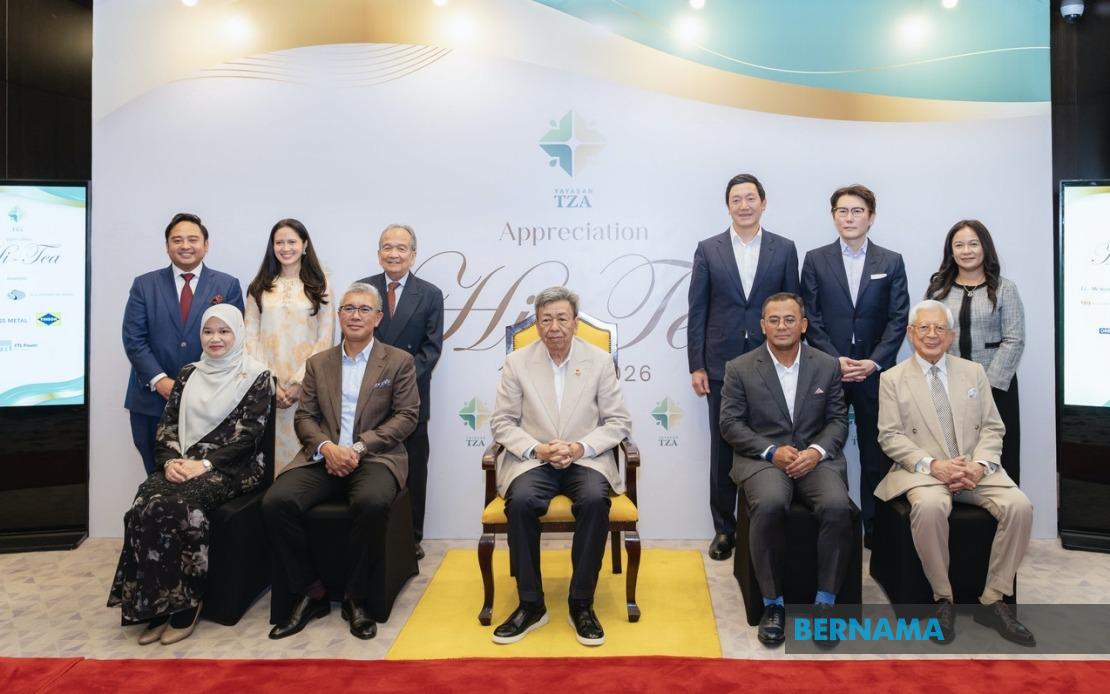
Sultan Sharafuddin Idris Shah, the Sultan of Selangor, attended the Yayasan TZA (YTZA) Appreciation Hi-Tea Ceremony in Kuala Lumpur on June 18, underscoring the royal household's commitment to social development and community welfare programmes in the state. The occasion brought together prominent government officials and corporate leaders, signalling the significance placed on the foundation's work in addressing educational inequalities among Malaysia's lower-income populations.
The Sultan arrived at the venue at approximately 3.50 pm and was formally received by YTZA chairman Tan Sri Arshad Raja Tun Uda and YTZA advisor Tengku Datuk Seri Zafrul Abdul Aziz. The gathering also included Selangor Menteri Besar Datuk Seri Amirudin Shari and Education Minister Fadhlina Sidek, reflecting the cross-sector collaboration essential to scaling social impact initiatives across the country.
Tengku Zafrul outlined the foundation's comprehensive approach to social development, emphasising that YTZA's programmes transcend immediate relief to foster long-term community resilience. The foundation's portfolio spans educational support, environmental sustainability, grassroots outreach, and community celebrations targeting underserved populations. This multi-dimensional strategy recognises that sustainable development requires simultaneous intervention across economic, educational, and social dimensions.
The ACE SPM programme stands as YTZA's principal educational initiative, designed specifically to strengthen examination readiness among Sijil Pelajaran Malaysia (SPM) candidates from B40 households. Education remains a critical lever for intergenerational mobility in Malaysia, yet students from lower-income backgrounds frequently lack access to supplementary coaching, technological resources, and structured preparation frameworks that their more affluent peers take for granted. By targeting this demographic, YTZA addresses a structural inequity within Malaysia's education system.
In 2025, the ACE SPM programme has already demonstrated measurable reach, supporting 467 students across ten Selangor schools while its digital components engaged more than 4,000 learners. These figures suggest the foundation is successfully leveraging technology to overcome geographical and financial barriers to educational access. The digital reach particularly matters for rural and semi-urban communities where quality tuition centres remain scarce and unaffordable.
Tengku Zafrul articulated the foundation's determination to expand ACE SPM's footprint, signalling that current enrollment figures represent merely the initial phase of a larger, multi-year scaling effort. Such expansion ambitions depend critically on sustained corporate patronage and philanthropic support. The ceremony itself functioned partly as a fundraising platform, with the Sultan witnessing significant corporate commitments that will sustain programme growth.
During the event, Kuok Brothers Sdn Bhd and YTL Power International Berhad each pledged substantial financial contributions through a ceremonial cheque presentation before the Sultan. Kuok Brothers committed RM1 million while YTL Power International contributed RM300,000, totalling RM1.3 million in announced support. These pledges reflect corporate Malaysia's growing recognition that inclusive development serves both humanitarian and business interests, particularly as human capital development becomes increasingly central to economic competitiveness.
Beyond educational programmes, YTZA launched Larian KITA@Klang, a community fun run scheduled for October 10 in conjunction with the Sultan of Selangor's Silver Jubilee celebration. This represents the fourth instalment in the Larian KITA series, which combines fitness, community participation, and cultural celebration. Such events serve functional purposes—mobilising communities and generating local economic activity—while reinforcing social cohesion and inclusive identity.
The timing of Larian KITA@Klang alongside the Sultan's Silver Jubilee signals the integration of royal patronage with grassroots community engagement. For Malaysian readers, this underscores how traditional institutions continue adapting to contemporary social challenges. The convergence of royal celebration with inclusive community activities reflects evolving expectations around leadership responsibility in a pluralistic society.
For Southeast Asia more broadly, YTZA's model offers instructive lessons. The foundation demonstrates that sustainable social impact emerges from combining targeted sectoral interventions (educational support), technological innovation (digital outreach), cross-sector partnerships (government, corporate, civil society), and sustained philanthropic commitment. As regional economies grapple with persistent inequality and educational quality disparities, such integrated approaches provide practical blueprints.
The ceremony also highlighted Tengku Zafrul's explicit gratitude toward sponsors, donors, partners, and volunteers, recognising that development work depends on ecosystem-level participation. This acknowledgment underscores a reality often overlooked in policy discussions: social transformation requires collective effort transcending governmental capacity. Corporate Malaysia's willingness to co-invest in B40 educational access suggests an emerging consensus that inclusive prosperity serves collective interests.
YTZA's trajectory—from foundation inception through measurable programme outcomes to expanded ambitions—reflects broader aspirations within Malaysian civil society. As income inequality persists and educational access remains stratified by socioeconomic status, initiatives like ACE SPM become increasingly vital. The Sultan's presence at the appreciation ceremony signals that addressing these challenges commands respect across Malaysia's institutional hierarchy, from monarchy through federal government to corporate leadership.
Moving forward, the foundation's success will depend on translating current momentum into sustained implementation. The 4,000 students reached through digital initiatives and 467 direct beneficiaries represent meaningful impact, yet Malaysia's B40 student population numbers in the hundreds of thousands. Scaling ACE SPM while maintaining quality requires not only financial resources but also systemic integration within schools, teacher training, and digital infrastructure development. YTZA's expansion plans will test whether corporate patronage and philanthropic commitment can achieve the transformative scale that Malaysia's educational equity challenges demand.