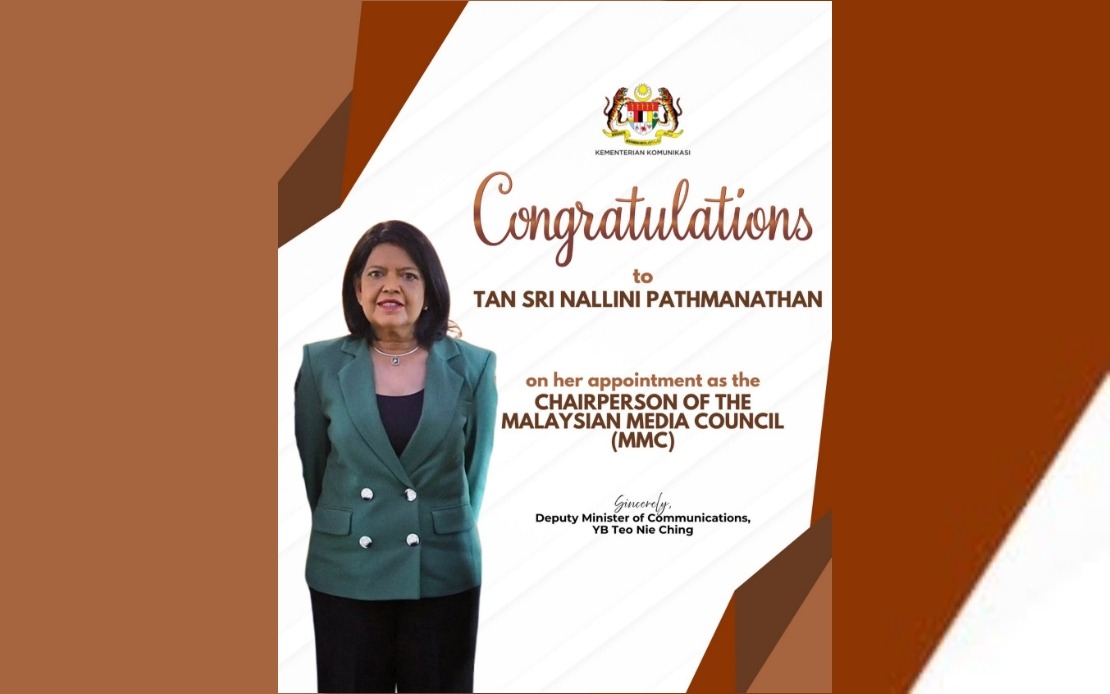
Deputy Communications Minister Teo Nie Ching has thrown her weight behind the appointment of former Federal Court judge Tan Sri Nallini Pathmanathan as chairperson of the Malaysian Media Council, highlighting her track record on constitutional rights and media freedom as a strong foundation for leading the country's new media self-regulatory body. Teo's public endorsement underscores the significance of the appointment and reflects broader confidence within government circles that Nallini's judicial experience positions her well to navigate the delicate balance between protecting press freedom and maintaining media standards.
Nallini's appointment to lead the MMC marks a pivotal moment for Malaysian journalism, coming as it does after the Malaysian Media Council Act 2025 established what many consider an overdue institutional framework for industry self-regulation. The former judge's selection was unanimously endorsed by the MMC Board at a meeting held on May 26, signalling broad consensus among media industry stakeholders and regulatory figures that her credentials warrant the responsibility. For Malaysia's media landscape, the appointment carries particular weight given the country's complex relationship with press freedom and the longstanding debate over how best to balance journalistic independence with professional accountability.
Teo's confidence in Nallini stems partly from specific judgments that have shaped constitutional jurisprudence in Malaysia. In discussing the former judge's career on the bench, Teo highlighted a dissenting opinion Nallini authored in a closely divided citizenship case involving an illegitimate child born to a Malaysian father and foreign mother. The decision was decided 4-3, with Nallini arguing for a purposive and compassionate reading of constitutional citizenship provisions rather than a strictly literal interpretation. This judgment exemplifies the kind of forward-thinking legal reasoning that Teo suggests will be essential in leading a self-regulatory body tasked with protecting media interests while upholding professional standards.
Equally significant is Nallini's judicial stance on digital media liability. In a landmark judgment concerning an online news portal, she ruled that the outlet should not bear responsibility for comments posted by subscribers on its platform. This decision carries profound implications for how Malaysian media outlets operate in the digital age, where user-generated content and social media interaction shape public discourse. By protecting publishers from automatic liability for third-party comments, Nallini's judgment struck a balance that permits robust online journalism without exposing outlets to impossible compliance burdens. Her willingness to develop nuanced legal doctrine around emerging media forms suggests she understands the practical realities facing modern news organisations.
Teo emphasised that Nallini's broader judicial philosophy—one characterised by what she describes as forward-thinking legal acumen coupled with profound humanity—makes her ideally suited for the MMC role. Throughout a distinguished career on the Federal Court, Nallini demonstrated a capacity to grapple with complex constitutional questions while remaining attentive to human consequences of legal interpretation. This combination of analytical rigour and humanistic concern appears central to why Teo and the MMC Board believe she can lead a self-regulatory institution in an environment where media freedom remains a politically and socially sensitive topic.
The establishment of the Malaysian Media Council itself represents a significant achievement, one that Teo notes took approximately five decades of sustained advocacy, formal petitions, and ongoing policy dialogue to realise. The 2025 Act finally codified what many in the Malaysian media industry have long argued was necessary—an independent, industry-led mechanism for maintaining professional standards without requiring direct state intervention. This historical context is crucial for understanding why the choice of chairperson matters. The MMC's credibility and effectiveness depend heavily on public perception that it functions as a genuine self-regulatory body rather than as a vehicle for government pressure on the press.
Teo's statement on the MMC reveals her understanding of why self-regulation carries particular importance in the Malaysian context. She emphasised that journalists occupy a distinctive position in democratic societies, functioning as what is traditionally termed the fourth estate—a check on governmental and corporate power. Given this unique constitutional role, any perception of state control over media would inevitably be interpreted as an attack on press freedom itself. Self-regulation, by contrast, allows the industry to maintain standards and address complaints through mechanisms that are perceived as independent and peer-driven. This distinction becomes even more significant in a country where historical tensions between media and government have occasionally flared into controversy.
The appointment also carries implications beyond Malaysia's borders. Throughout Southeast Asia, questions about how to balance press freedom with media accountability have become increasingly urgent as digital platforms transform how news reaches audiences. Malaysia's approach—establishing an independent self-regulatory council led by a jurist with strong civil liberties credentials—may influence how neighbouring countries approach similar questions. The success or failure of the MMC under Nallini's leadership could help shape regional thinking about whether industry self-regulation can effectively replace or supplement state-based media regulation.
Looking ahead, the challenge facing Nallini will be substantial. She must build the MMC into an institution that journalists trust, that the public sees as legitimate, and that governments respect as a credible alternative to statutory regulation. Her dissenting judgments on citizenship and digital liability suggest she is comfortable taking contrarian positions grounded in principled legal reasoning. Whether these qualities will translate into effective leadership of a fledgling regulatory institution remains to be seen. However, Teo's endorsement and the unanimous support of the MMC Board indicate that Malaysia's media stakeholders have placed significant confidence in her ability to navigate these expectations and establish the council as a genuine guardian of both press freedom and professional standards.