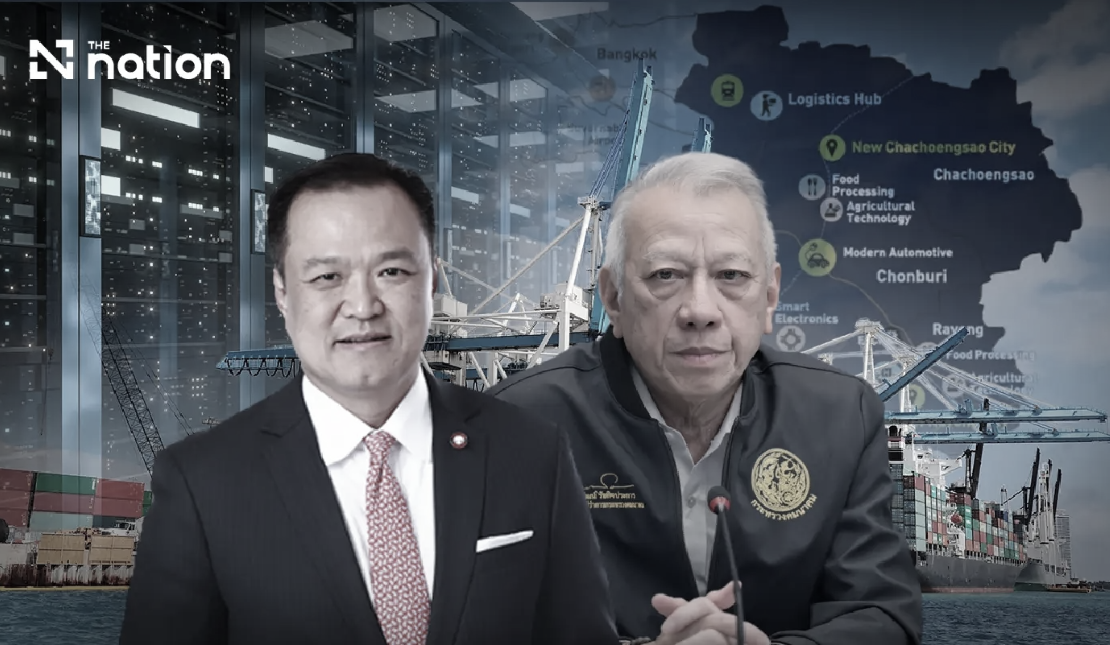
Prime Minister Anutin Charnvirakul has reasserted personal control over Thailand's Eastern Economic Corridor, marking a significant repositioning of the government's flagship investment initiative. The decision, formalised through Prime Minister's Office orders signed on June 15 and acknowledged by Cabinet on Tuesday, transfers oversight of the EEC from Deputy Prime Minister and Transport Minister Phiphat Ratchakitprakarn back to Anutin's direct supervision. The move signals not merely an administrative reshuffle but a fundamental reframing of how Thailand markets its eastern industrial region to the world.
According to Government House sources, the restructuring stems from strategic rather than personal considerations, with Anutin positioning himself as the lead negotiator on Thailand investment projects for international audiences. The Prime Minister intends to leverage the EEC as a pilot development zone, presenting it overseas through an entirely revised lens that departs sharply from its historical identity as a manufacturing hub. This repositioning reflects growing recognition among Thai policymakers that the corridor's traditional economic foundation—heavy industry—faces mounting structural constraints that limit its capacity for continued expansion and competitiveness.
The eastern region's transformation toward food security initiatives represents a calculated bet on sectors increasingly vital to global supply chains. Thailand's established strengths in livestock production, fisheries, commercial agriculture, and horticulture position the EEC to serve as a coordinating hub for countries seeking to diversify and secure their food supply chains. As geopolitical tensions continue disrupting agricultural trade patterns worldwide, and Southeast Asian nations face mounting pressure to ensure food self-sufficiency, Thailand's capacity to position itself as a reliable food security partner carries substantial diplomatic and commercial weight. The government sees this reorientation as particularly attractive to investor nations confronting supply chain vulnerabilities.
Parallel to the food security initiative, the government has identified data centre development as a transformative growth vector for the EEC. This sector represents a dramatic departure from manufacturing-focused regional strategies, reflecting global trends toward digital infrastructure investment. Data centres demand sophisticated coordination across multiple government agencies due to their extraordinary requirements for reliable electricity supply, water resources, and technical infrastructure. The Energy Ministry's preparation of a new Type 9 electricity user category specifically designed for data centre operators underscores the government's commitment to creating an institutional framework that accommodates this sector's unique needs, even at the cost of higher power tariffs reflecting consumption realities.
Thailand's pivot away from heavy industry dependence stems from tangible resource constraints that have become increasingly difficult to ignore. The EEC has encountered persistent bottlenecks in electricity and water supply, both critical inputs for manufacturing expansion. These resource constraints carry escalating procurement costs that erode the corridor's traditional competitive advantages for industrial investment. By diversifying toward less resource-intensive sectors like data centres and food processing, Thai policymakers are acknowledging practical limits to traditional industrial development while attempting to maintain the EEC's relevance as a premium investment destination.
The official explanation characterising the reshuffle as non-contentious deserves scrutiny in light of documented operational tensions between government agencies. Government House sources attributed Phiphat's relinquishment of EEC authority to persistent friction between the EEC Office and the Board of Investment, with the Deputy Prime Minister reportedly preferring to step back from a portfolio generating such institutional conflict. This explanation, while diplomatically framed, nonetheless indicates underlying coordination failures that prompted intervention at the highest levels. For Malaysian observers, the episode illustrates how Southeast Asian governments periodically reorganise institutional responsibilities to resolve interagency disputes that impede policy implementation.
Uncertainty persists regarding Phiphat's own awareness of and consent to the decision. The Deputy Prime Minister publicly stated he had received no advance notification, learning of the orders only as they were read aloud during the Cabinet meeting for formal acknowledgement. His subsequent statement to journalists directing them to ask Anutin for explanatory details suggested either genuine surprise or strategic positioning to distance himself from a potentially unpopular decision. That Phiphat felt compelled to publicly deny that the reshuffle constituted a diminution of his authority or reflected internal Bhumjaithai party tensions indicates the decision carried political significance beyond its technical administrative dimensions.
Government statements explicitly denied that the EEC reshuffle connected to longstanding controversies surrounding the three-airport high-speed rail project, in which Phiphat had taken prominent positions on contract terms. The rail scheme—linking Don Mueang, Suvarnabhumi, and U-Tapao airports—has languished for years as disputes over contract amendments with Asia Era One, the CP Group-linked private operator, remain unresolved. Phiphat had forcefully opposed changing the payment structure from a completion-before-payment model to a build-and-pay arrangement tied to construction progress. The coincidental timing of the EEC reshuffle amid ongoing rail project controversies inevitably invites speculation about whether personnel changes reflect disagreements over specific initiatives, notwithstanding official denials.
Questions raised about the Disneyland project proposed for the EEC further illuminate Anutin's strategic priorities. The Prime Minister reportedly questioned Phiphat about the timeline and feasibility of the entertainment complex, noting the absence of economic analysis justifying the investment returns. This scrutiny suggests Anutin intends to impose stricter investment discipline on EEC projects, evaluating proposals against concrete financial metrics rather than aspirational development narratives. For a corridor that has accumulated numerous announced projects of questionable implementation probability, such stringency could enhance investor confidence by signalling serious commitment to viable ventures.
The EEC restructuring carries implications extending beyond Thailand's borders into the broader Southeast Asian investment landscape. As regional governments compete for foreign capital and technology transfers, Thailand's repositioning toward food security and digital infrastructure addresses global investor priorities more directly than traditional manufacturing concentration. Malaysia, Indonesia, and Vietnam—competing with Thailand for similar investment flows—will monitor whether Anutin's repositioning strategy succeeds in attracting new capital categories previously uncommitted to Thai eastern development. The outcome will likely influence how other Southeast Asian nations frame their own special economic zones and investment pitches.
Anutin's assumption of direct EEC supervision also consolidates power within the Prime Minister's office, reducing delegation to other senior ministers. This centralisation reflects a pattern of Thai governance wherein critical economic initiatives eventually migrate to prime ministerial oversight when coordination across agencies proves challenging. For foreign investors accustomed to dealing with multiple government touchpoints, the concentration of EEC authority may simplify decision-making processes, though it simultaneously creates dependency on a single political figure's continued influence and priorities. The stability and consistency of Thailand's investment environment partly hinges on whether Anutin can maintain sustained focus on the EEC repositioning or whether competing policy priorities eventually dilute his attention.
The food security and data centre focus represents a calculated attempt to future-proof the EEC against technological disruption and geopolitical shifts that have rendered traditional industrial corridors increasingly vulnerable. By emphasising sectors aligned with emerging global imperatives—pandemic-driven food supply anxieties and digitally-driven infrastructure demand—Thailand positions the eastern region as economically resilient across multiple scenarios. This strategic reframing, coupled with institutional consolidation under prime ministerial authority, suggests the Thai government recognises that sustaining the EEC's relevance demands periodic reinvention rather than incremental refinement of existing models.