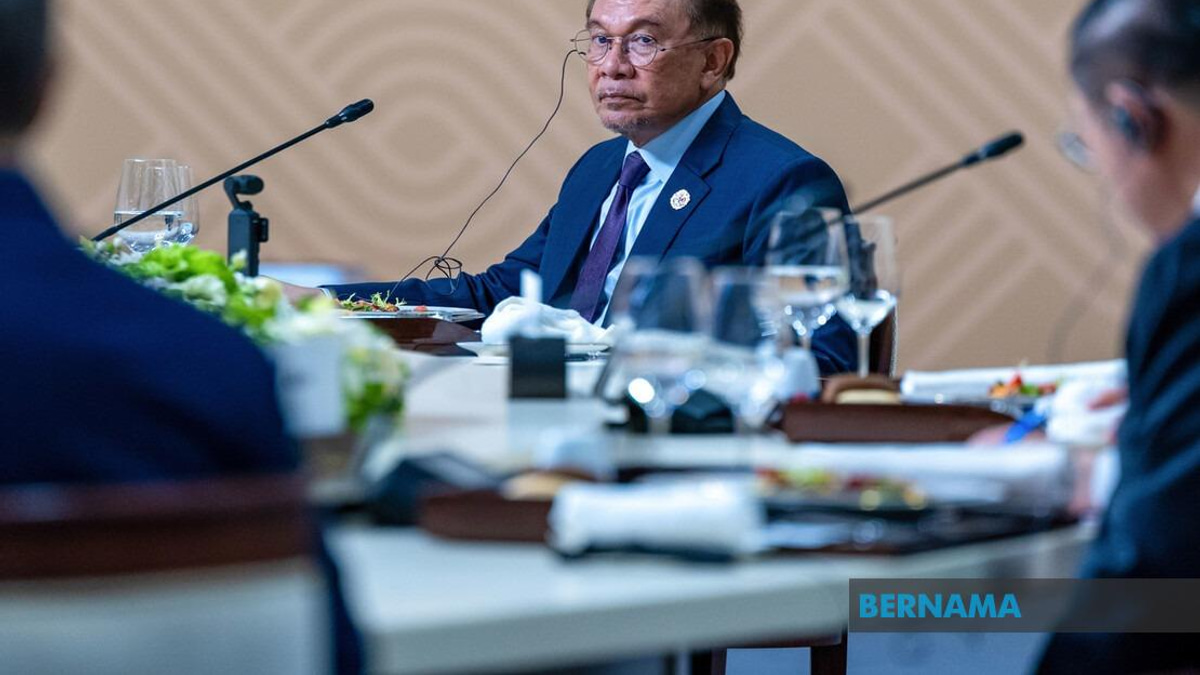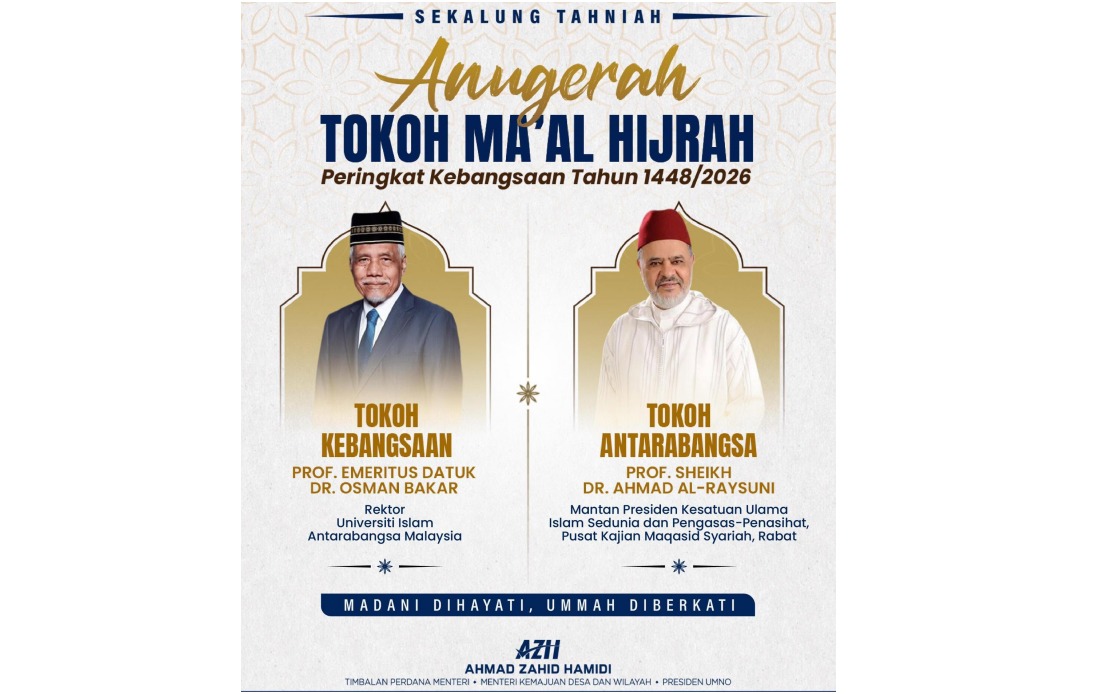
Deputy Prime Minister Datuk Seri Dr Ahmad Zahid Hamidi has called upon the Malaysian Muslim community to draw inspiration from the achievements of this year's Tokoh Maal Hijrah award recipients, emphasizing that their recognition should galvanize broader efforts toward intellectual advancement and social contribution. Speaking in the wake of the awards ceremony held at Masjid Putra in Putrajaya, Ahmad Zahid urged Muslims across the country to maintain their commitment to educational pursuits, meaningful engagement with local communities, and substantive participation in the development of the broader Muslim world as well as the nation itself.
Two distinguished scholars were honoured at the national-level Maal Hijrah celebration, with Prof Emeritus Datuk Dr Osman Bakar receiving the National Tokoh Maal Hijrah Award and Prof Sheikh Dr Ahmad Al-Raysuni, an Islamic jurisprudence expert based in Morocco, securing the International Tokoh Maal Hijrah Award. The accolades were formally presented by the Sultan of Perak, Sultan Nazrin Shah, who presented the recipients with financial prizes, ceremonial trophies, and certificates acknowledging their contributions to Islamic scholarship and community advancement.
Ahmad Zahid highlighted the significance of the awardees' work in strengthening Muslim institutions, advancing intellectual discourse within Islamic traditions, and disseminating teachings that emphasize compassion, practical wisdom, and the tangible benefits of Islamic principles to society at large. His remarks underscored the notion that individual excellence in Islamic scholarship and community leadership serves as a powerful exemplar for broader societal aspirations, particularly in a multi-faith nation where Muslims constitute the majority demographic and carry particular responsibility for demonstrating the constructive potential of Islamic values in a modern context.
Deputy Prime Minister Datuk Seri Fadillah Yusof similarly endorsed the inspirational value of the awards, positioning them within a broader framework of national service and social contribution. Fadillah contended that the recognition of these scholars should motivate all Malaysians—regardless of religious background—to deepen their involvement in nation-building initiatives and strengthen their commitment to collective prosperity. His perspective broadened the appeal of the awards beyond purely religious circles, suggesting that the exemplary conduct of the awardees holds lessons applicable to Malaysia's diverse population.
Central to Fadillah's message was a reframing of the Hijrah—Prophet Muhammad's migration from Mecca to Medina in the 7th century—not merely as a defining historical episode within Islamic chronology but as an enduring philosophical framework. He characterized this foundational Islamic narrative as an embodiment of principles including self-sacrifice, communal solidarity, fortitude in the face of adversity, and purposeful commitment to constructive transformation. By invoking the Hijrah in contemporary governance discourse, Fadillah sought to connect classical Islamic precepts with modern policy imperatives.
Fadillah articulated a vision of societal development grounded in these Hijrah-derived principles, advocating for a Malaysia that combines material prosperity with strong ethical foundations and unwavering adherence to core values. His call for unity-building, spiritual deepening, and expanded charitable activity reflected an understanding that national progress requires integration of spiritual and material dimensions. This framing aligns with broader discourse within Southeast Asian Islamic communities concerning the relationship between religious observance and developmental outcomes.
The recognition of Prof Osman Bakar, a Malaysian scholar with substantial international standing, carries particular significance for the country's position within global Islamic intellectual networks. His selection for the national award acknowledges Malaysia's capacity to produce scholars capable of contributing meaningfully to contemporary Islamic thought. Similarly, the international award granted to Prof Ahmad Al-Raysuni reflects an acknowledgment of cross-regional collaboration and mutual recognition within Islamic academic circles, suggesting that Malaysia views itself as a node within a broader Muslim world engaged in intellectual dialogue and knowledge exchange.
For Malaysian readers, the awards ceremony and subsequent statements by senior government figures underscore the continued prioritization of Islamic scholarship and values-based governance within the country's political framework. Both Ahmad Zahid and Fadillah positioned the honours as catalysts for broader social mobilization around shared Islamic principles, implicitly linking individual scholarly achievement with collective national aspirations. This rhetorical strategy serves multiple functions: it legitimizes government institutions through association with respected scholars, it provides normative guidance to Muslim citizens regarding valued conduct, and it reinforces the government's role as custodian of Islamic interests within Malaysia's constitutional monarchy system.
The emphasis placed by both officials on knowledge-seeking reflects broader regional concerns about maintaining Islamic intellectual vitality in an era of rapid technological and social change. In Malaysia specifically, where Islamic institutions coexist with secular educational frameworks and where questions of Islamic governance remain politically sensitive, the elevation of scholarly achievement represents a measured approach to religious authority that privileges learning and demonstrated expertise over institutional hierarchy alone.
The awards also carry implications for Malaysia's international positioning within the Muslim world. By honouring international scholars and celebrating the contributions of Malaysian Muslims to global Islamic discourse, the country projects an image of sophisticated engagement with contemporary Islamic thought. This positioning potentially strengthens Malaysia's soft power influence in the Southeast Asian region and beyond, particularly among educated Muslims seeking intellectual leadership that balances traditional Islamic principles with engagement with modernity.
Looking forward, the recognition extended to this year's awardees may influence patterns of institutional investment and resource allocation within Malaysia's Islamic education and research sectors. Government officials often use such public commendations to signal priority areas for future policy development. The emphasis on both national and international contributions suggests potential expansion of platforms enabling Malaysian Islamic scholars to participate in global conversations about the religion's contemporary relevance and practical application.
Ultimately, the statements by Ahmad Zahid and Fadillah characterize the Tokoh Maal Hijrah awards as instruments of social inspiration and normative guidance rather than merely ceremonial recognitions. By explicitly connecting scholarly excellence with national development imperatives and framing the Hijrah as a timeless principle guiding contemporary action, Malaysia's deputy prime ministers attempted to mobilize religious ideals toward instrumental policy objectives. For Southeast Asian Muslims observing Malaysia's governance approaches, these awards ceremonies and accompanying political rhetoric offer insights into how Islamic values are negotiated, interpreted, and deployed within plural societies seeking to balance religious and secular governance frameworks.