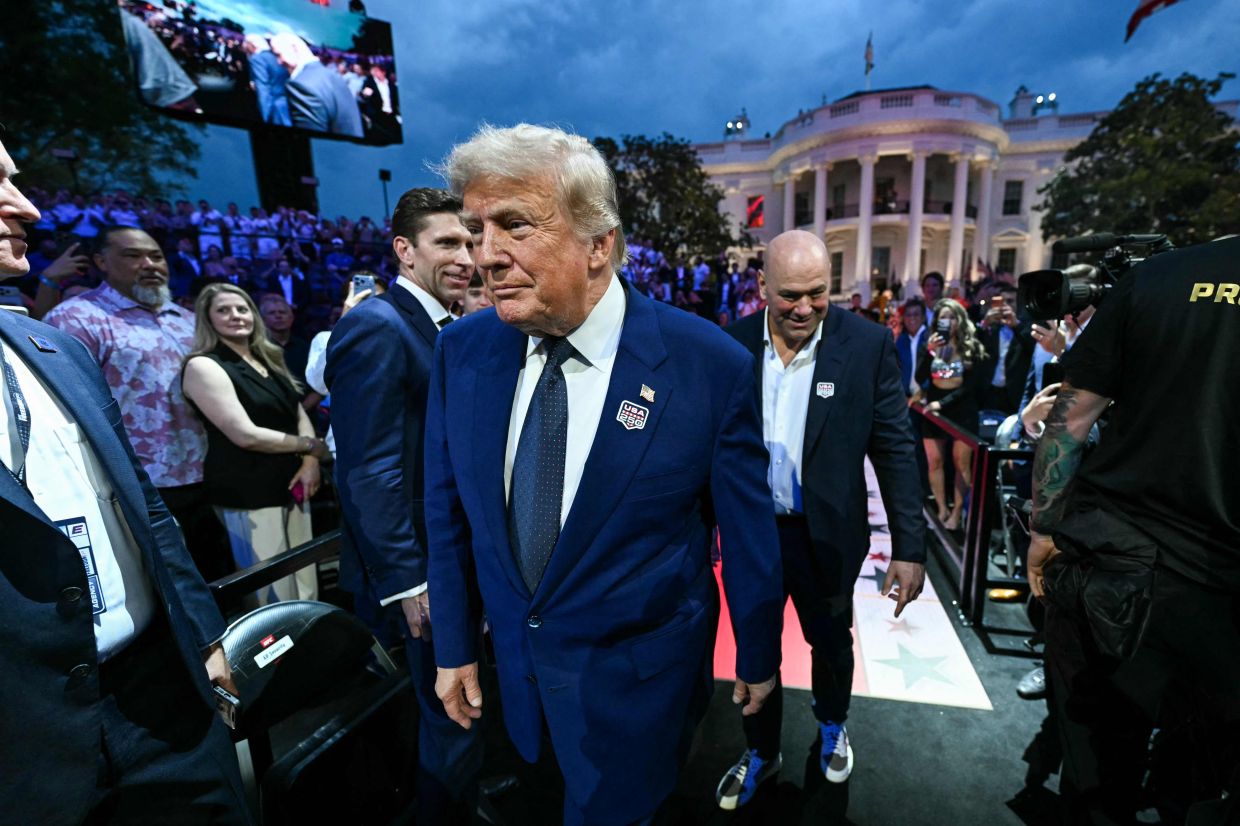
Donald Trump marked his 80th birthday on Sunday by hosting what may be the most unconventional celebration ever held at the White House—a full-scale Ultimate Fighting Championship event featuring seven cage matches on the South Lawn. The decision to bring TKO Group Holdings Inc.'s flagship combat sport to the presidential residence reflects Trump's deep affinity for UFC and his recognition of the sport's powerful appeal among younger male voters who helped secure his 2024 election victory. The event demonstrated how thoroughly the incoming administration has embraced the mixed martial arts organization, despite—or perhaps because of—the spectacle's departure from traditional presidential pageantry.
The evening's festivities kicked off just before 8:30pm under threat of severe weather, with lightning and thunder momentarily delaying the proceedings. Trump and UFC President Dana White, a longtime personal ally, walked through the White House corridors to the arena, setting the tone for what would become a star-studded gathering of Silicon Valley executives, government officials, and entertainment figures. Meta Platforms Inc. CEO Mark Zuckerberg, Paramount Skydance Corp. CEO David Ellison, Treasury Secretary Scott Bessent, and members of Trump's family occupied prominent positions, while podcast host Joe Rogan provided commentary throughout the matches. The presence of military servicemembers, Medal of Honor recipients, and first responders underscored the administration's effort to frame the event as patriotic celebration rather than mere entertainment.
The physical footprint of the UFC Freedom 250 event proved staggering. Engineers constructed a nearly 100-foot-tall structure called the "Claw"—taller than the White House itself—to house the fights and accommodate 4,300 spectators. An additional 120,000 people gathered at the Ellipse for a free viewing experience, distributed through lottery tickets. The South Lawn, historically reserved for ceremonial occasions like the Easter Egg Roll and Congressional Picnic, transformed into a venue that dwarfed any temporary installation previous presidents had attempted. In a TikTok video released on June 2, Trump mused about leaving the structure in place permanently, comparing it favourably to the Eiffel Tower in Paris, though the administration later clarified through court filings that disassembly would commence at 10am Monday morning.
The financial commitment behind the spectacle proved substantial. UFC invested more than US$60 million to stage the event, with the White House asserting the organization covered all costs and handled sponsorship arrangements independently. Yet court documents revealed that more than seven federal agencies allocated significant resources and personnel to the production. Sponsors displayed on the UFC Freedom 250 website included Crypto.com and Dodge's Ram truck brand, while Trump's family venture World Liberty Financial contributed an additional US$250,000 bonus pool for the two top-performing fighters. These arrangements raised eyebrows among transparency advocates; the Public Integrity Project filed a lawsuit characterizing the event as a "volcano of corruption," though the legal challenge ultimately failed to prevent the gathering.
Public sentiment toward the White House fights remained decidedly mixed. A YouGov poll released June 5 found that 51 percent of Americans surveyed disapproved of hosting UFC matches at the presidential residence, while only 27 percent expressed approval. This disconnect between Trump's enthusiasm and broader public skepticism reflects deeper divisions about how the nation's highest office should be used. The event also represented a calculated political gesture toward a demographic crucial to Trump's electoral success. UFC's young, predominantly male audience constitutes a core constituency, and the administration wasted no time formalising its relationship with the organization—both the State Department and Federal Bureau of Investigation have signed partnership agreements with the company.
The promotional buildup showcased Trump's instinct for spectacle and his willingness to conduct official business through unconventional channels. Dana White held the pre-event press conference at the Lincoln Memorial, one of Washington's most iconic and historically significant locations, where fighters engaged in the traditional combat sport theatrics of verbal sparring and victory predictions. Fighter Michael Chandler articulated the gravity of the occasion, noting that audiences would witness "the best version" of himself "on the White House lawn for America's 250th birthday." This framing connected the UFC event to Trump's broader commemoration of the nation's 250th anniversary, which includes a commemorative gold coin bearing his likeness, a sprawling fair on the National Mall, and plans for an IndyCar race through Washington DC streets in August.
The logistical complexity of staging professional fighting at the White House extended into unexpected corners of the residence. The administration established fighter locker rooms on the White House grounds, including within the Indian Treaty Room—a ceremonial space traditionally reserved for official state functions and historic negotiations. This utilization of sensitive historical spaces for combat sport preparations crystallised the event's departure from protocol, even as officials maintained the proceedings represented patriotic celebration. The decision to hold press conferences at the Lincoln Memorial and set up facilities in the treaty room demonstrated how thoroughly Trump's team reimagined the White House and its surrounding landmarks as venues for entertainment and political messaging.
The timing of the event proved strategically significant. Trump would depart for France immediately after the festivities concluded, heading to a Group of Seven leaders meeting already equipped with a UFC championship belt according to the company. This sequencing allowed him to carry symbolic spoils from the celebration directly into high-stakes international diplomacy, potentially using the event as a cultural statement about American values and his personal brand. The contrast between Sunday's brutal combat spectacle and the refined diplomatic discussions awaiting him in France highlighted the eclectic nature of his approach to presidential authority—comfort with contradictions that would have shocked previous administrations.
While UFC President Dana White acknowledged the event would likely represent a financial loss for the organization, other company executives privately suggested alternative assessments. The willingness to absorb significant costs reflected confidence in long-term relationships with the incoming administration and the political capital generated by association with a president who clearly embraced the sport. For Malaysian and Southeast Asian observers, the event illustrated how thoroughly American political culture has transformed, with entertainment, corporate sponsorships, and combat sports now seamlessly integrated into the highest levels of governance. The White House celebrations demonstrated that presidential authority now encompasses entertainment production at unprecedented scales, raising questions about institutional norms and the boundaries between political symbolism and commercial spectacle in democracies worldwide.