Two residents were pulled to safety from a high-rise Housing and Development Board flat after flames engulfed their unit in Singapore's Jurong West neighbourhood during the early morning hours of June 17. The Singapore Civil Defence Force responded to an emergency call at Block 842 Jurong West Street 81 at approximately 3.35am, discovering a fully-involved fire in the living room of a 13th-storey unit. Firefighters entered the smoke-filled space and extinguished the blaze using a water jet, successfully preventing its spread to adjacent properties. Preliminary investigations point to an electrical fault originating in the living room as the likely cause of the incident.
All four members of the household in the affected unit were transported to Singapore General Hospital for medical evaluation and treatment of fire-related injuries. Beyond the immediate rescue, the SCDF implemented a precautionary evacuation protocol that affected approximately 40 other residents from the block, demonstrating the widespread impact such incidents can have across high-density housing developments. The swift response and evacuation procedures prevented a potentially far more serious outcome, though the incident underscores the vulnerability of multi-storey residential complexes to rapid fire spread when electrical hazards go undetected.
An 18-year-old student living directly above the burning unit played a crucial role in raising the alarm and potentially saving lives. The secondary school pupil was awake playing online games when he detected smoke seeping upward through windows of the unit below, a telltale sign that danger was developing. Rather than dismissing the observation, he immediately went downstairs to investigate the source of the smoke and found the external door to the affected flat extremely hot to the touch, indicating advanced fire conditions within. He then forcefully knocked on neighbouring doors to warn residents, giving occupants precious minutes to escape before emergency services arrived.
The teenager subsequently returned to his own unit to alert his family to evacuate immediately. His quick thinking and decisive action cascaded through the building as other residents heeded the warning and left their homes. Shortly afterward, a young woman from the burning unit appeared at his family's door requesting towels, explaining that she needed them to tend to her father's injuries. The student observed that the woman's hair was singed and her face darkened by soot, while he also witnessed a man with severe thermal burns across his back and arms, their skin displaying the characteristic bright red colouration of serious burn injuries sustained in the fire.
The timeline of events reveals how rapidly the situation escalated once the fire reached an advanced stage. According to reports from Lianhe Zaobao, the family had been asleep when the blaze began in their living room, meaning they were entirely unaware of the danger developing within their home. Only the teenage neighbour's vigilance and willingness to act prevented a potential tragedy where occupants might have remained trapped or asphyxiated by smoke while unconscious. This case illustrates a critical safety principle: residents of high-rise buildings depend significantly on neighbours' awareness and communication during emergencies, particularly during late-night hours when building-wide alarm systems may not immediately trigger.
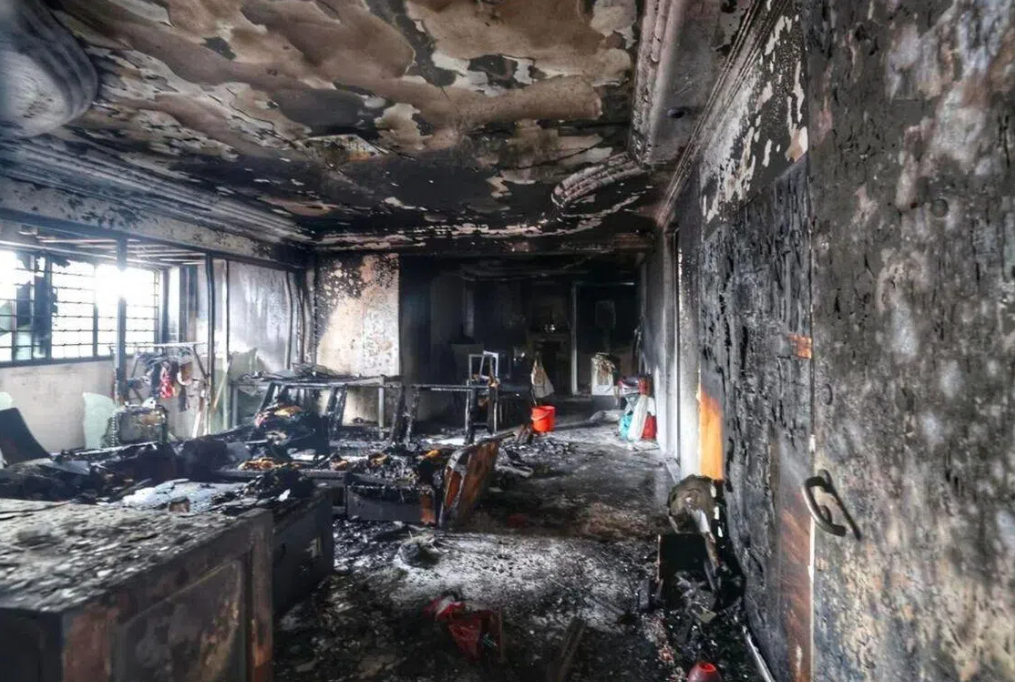
Photographers visiting the scene approximately twelve hours after the fire's extinguishment documented the extensive damage inflicted by the blaze. The interior walls and ceiling of the unit were completely blackened by heavy smoke and heat exposure, while the windows facing the living room had shattered from thermal stress, leaving the flat entirely exposed to the building exterior. These visible signs of the fire's intensity underscored how fortunate the household's survival truly was, and the critical importance of rapid discovery and suppression. A resident from the floor below reported observing at least five fire engines deployed to the scene, indicating the scale of the emergency response mobilised by Singapore's fire authorities.
Electrical fires represent a persistent hazard in residential settings throughout Singapore and Southeast Asia, particularly in densely occupied apartment blocks where cooking appliances, air conditioning units, and charging devices operate continuously. The Singapore Civil Defence Force has released guidance emphasising that such incidents are frequently preventable through careful electrical management practices. Residents are advised to avoid overloading electrical outlets with multiple appliances drawing simultaneous current, as this creates dangerous heat accumulation within wiring systems. Turning off equipment when not actively in use is an elementary but often overlooked measure that reduces both fire risk and energy consumption, benefiting both household safety and utility costs.
Compounding the electrical safety challenge is the growing prevalence of battery-powered devices requiring overnight charging. The SCDF has specifically warned against leaving such batteries and charging devices unattended during extended periods or while residents sleep, as thermal runaway conditions developing within battery cells can ignite with little warning. Another critical recommendation involves ensuring that all electrical appliances and plugs bear the Safety Mark certification issued by Singapore's Consumer Product Safety Office, a designation confirming that equipment meets established safety standards for use in residential environments. Many cheaper imported products lack such certification and pose substantially elevated fire hazards.
Recent statistics compiled by Singapore's Civil Defence Force paint a concerning picture of residential fire trends across the city-state. According to data released in February, the total number of fires increased by 3 percent, rising from 1,990 incidents in 2024 to 2,050 in 2025, representing an upward trajectory that warrants serious attention. More significantly for residents of public housing, 1,051 of these fires—more than half the national total—occurred specifically in residential buildings, suggesting that apartment complexes and Housing Board developments bear a disproportionate share of the overall fire burden. This concentration reflects the challenges of managing fire risk in high-density housing where occupant density, shared electrical systems, and tight building configurations create compounded hazards.
For Malaysian readers and policymakers observing neighbouring Singapore, the Jurong West incident offers valuable lessons for fire prevention in Southeast Asia's rapidly expanding urban residential sectors. Malaysia's own public housing developments and private apartment complexes face similar electrical hazards, and the quick response of the teenage neighbour demonstrates how community awareness constitutes a vital additional layer of protection beyond official fire safety systems. The incident also underscores the importance of regular electrical system maintenance, proper device charging protocols, and the selection of certified electrical equipment as fundamental safeguards. As Southeast Asian cities continue densifying and housing prices push more residents into high-rise accommodation, establishing robust electrical safety cultures and education campaigns becomes increasingly critical to preventing loss of life and property destruction.