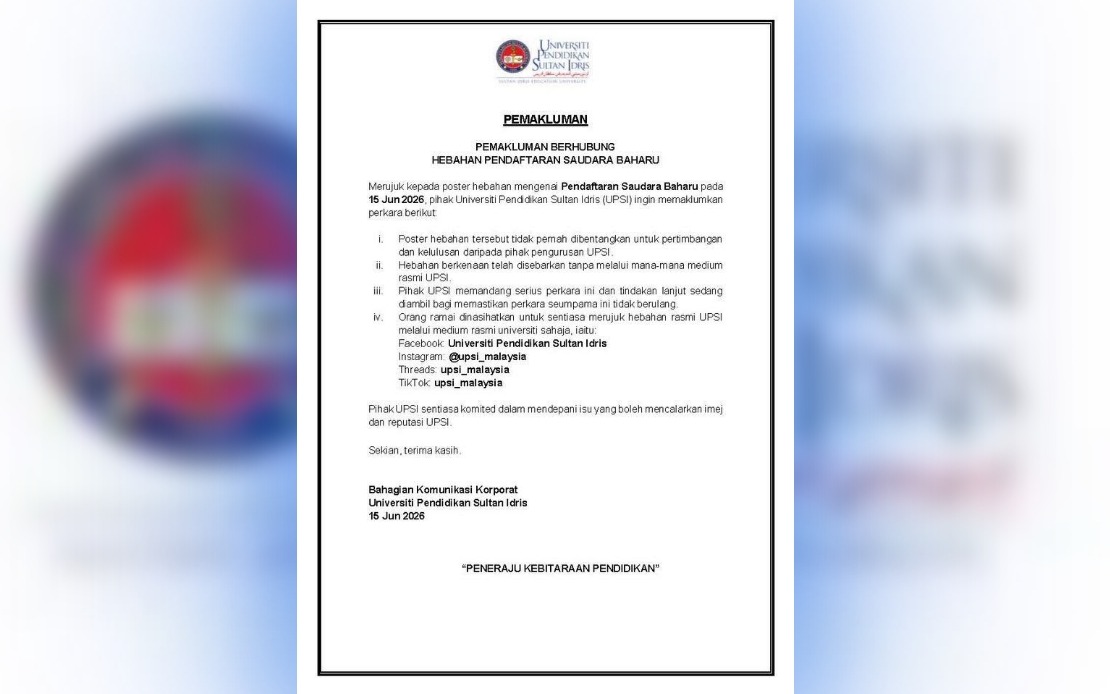
Universiti Pendidikan Sultan Idris (UPSI) has moved to clarify that it played no role in the dissemination of a poster about registering 'saudara baharu' or converts to Islam that recently gained traction across social media platforms. The institution issued a formal statement through its official social media accounts addressing what it described as an unauthorized circulation of material bearing a June 15 date.
The university's position is unequivocal: the poster in question never reached its administrative apparatus for review or approval before being shared online. UPSI emphasized that the document was spread entirely outside its official communication infrastructure, making clear the distinction between legitimate university announcements and the viral material. This clarification represents a standard institutional response to misinformation or unauthorized messaging that could be associated with the university without its knowledge or consent.
In response to the incident, UPSI has indicated that it regards the matter with appropriate seriousness and intends to implement measures designed to prevent similar occurrences in the future. The university's statement carries an implicit warning to various stakeholders—whether staff, students, or external parties—about the protocols governing communication attributed to the institution. The message underscores the importance of utilizing only sanctioned channels when disseminating materials on behalf of UPSI.
The university has reinforced its expectation that members of the public seeking authentic information about UPSI should rely exclusively on announcements distributed through the institution's recognized official platforms. This guidance reflects a broader institutional concern about digital misinformation and the need for clear attribution of information. In an era where social media allows rapid, decentralized sharing of content, universities across Malaysia and the region face similar challenges in maintaining control over their institutional messaging and preventing unauthorized documents from being circulated under their perceived authority.
UPSI's statement also serves as a broader commitment to protecting its institutional integrity and reputation. Universities operate within complex ecosystems where their public image is shaped not only by official pronouncements but also by how external communities perceive their involvement in various initiatives. The circulation of materials—particularly those relating to sensitive matters such as religious conversion—can have significant implications for institutional standing and community relations, which explains UPSI's swift and clear public response.
The incident highlights the vulnerability of higher education institutions in Malaysia to unauthorized use of their name or association in social media contexts. As conversion to Islam and integration of new Muslim community members remain topics of public interest and sometimes controversy, materials addressing these subjects carry particular weight when they appear to originate from established institutions. Universities must therefore maintain clear boundaries between officially sanctioned communications and grassroots or unauthorized content that may reference them.
This situation also underscores broader questions about information verification in the digital age. Social media users frequently encounter content presented as institutional announcements without verifying its authenticity through official channels. The UPSI statement serves as a timely reminder for the public to develop habits of verification, particularly when encountering material that carries the name or apparent endorsement of educational, governmental, or organizational entities. Malaysian media consumers increasingly need to distinguish between official institutional statements and content merely attributed to institutions without authorization.
The university's commitment to addressing threats to its reputation reflects standard institutional practices at Malaysian universities, which generally maintain strict protocols governing public communications. These protocols exist to ensure consistency, accuracy, and alignment with institutional values and policies. When unauthorized materials circulate under an institution's name, it can undermine these carefully maintained standards and create confusion about what the university actually endorses or implements.
For educational institutions operating in Malaysia's diverse and sometimes sensitive social landscape, maintaining clear communication boundaries is essential. Issues touching on religion, conversion, and community integration require particularly careful handling, and institutions must ensure that any public positions they take on such matters reflect genuine institutional decisions rather than unauthorized or speculative content. UPSI's forceful distancing from the viral poster reflects recognition of these sensitivities.
Moving forward, the incident may prompt UPSI and other Malaysian universities to reinforce internal protocols regarding communications attributed to the institution and to enhance monitoring of social media spaces where their names might be invoked. Educational institutions increasingly employ dedicated social media teams and digital communication specialists specifically to manage institutional presence and identify potential misattributions. The broader challenge facing universities involves responding swiftly to misinformation while maintaining productive relationships with their communities.