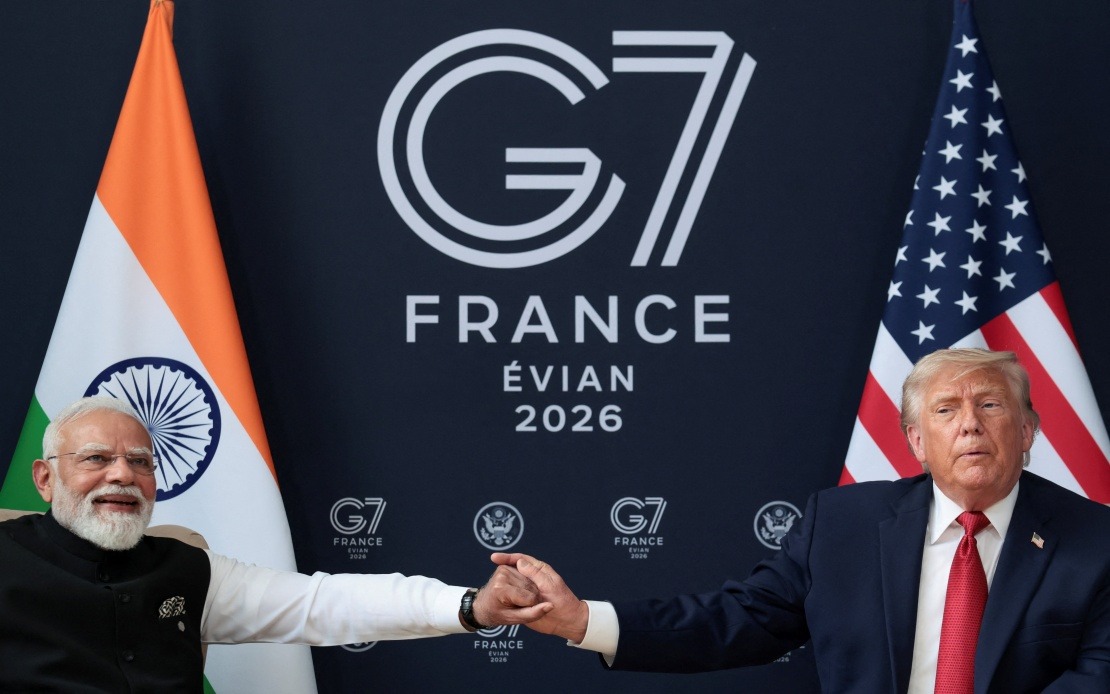
During a meeting at the Group of Seven summit in Evian, France, Indian Prime Minister Narendra Modi and US President Donald Trump reaffirmed their commitment to finalising a comprehensive bilateral trade arrangement, marking what New Delhi characterised as a turning point in months of intensive negotiations between the world's two largest democracies.
India's External Affairs Ministry released a joint statement emphasising that both leaders had observed with "particular satisfaction" the momentum achieved in talks toward an interim bilateral trade agreement. The language reflected genuine optimism that protracted discussions, which have repeatedly stalled over tariff schedules and market access provisions, may finally be approaching resolution. Modi and Trump instructed their respective negotiating teams to accelerate work on crafting an accord that balances the interests of both economies while delivering tangible commercial benefits.
The timeline for completion has become increasingly urgent. The US Trade Representative Jamieson Greer will travel to India within the coming week to advance discussions at a technical level, signalling that negotiators believe momentum can be maintained and a framework agreement could emerge within months. This intensive engagement represents a sharp departure from the slower pace of earlier rounds, suggesting both governments recognise the strategic importance of cementing economic ties amid broader regional considerations.
Trump characterised Modi as one of the toughest negotiators he has encountered, a backhanded compliment that underscored the Indian leader's reputation for driving hard bargains on issues ranging from agricultural tariffs to manufacturing safeguards. The US president's remarks, delivered with pointed humour, acknowledged that New Delhi has consistently resisted American pressure to open certain protected sectors, particularly in agriculture and dairy, where India maintains some of the world's highest tariff walls to shield domestic farmers.
The history of US-India trade relations over the past two years reveals the fractious nature of these discussions. Trump's 2025 administration imposed steep 25 per cent tariffs on Indian goods while simultaneously penalising Indian purchases of Russian crude oil—moves that inflamed tensions and prompted threats of retaliatory measures from New Delhi. These confrontational measures set the stage for the interim agreement inked in February, which saw the United States reduce its duty rate to 18 per cent and India reciprocating with various concessions on agricultural and manufactured imports.
That February understanding was presented as a stepping stone toward a more comprehensive arrangement, yet negotiations since then have progressed in fits and starts, hampered by disagreements over which sectors should receive preferential treatment and how deeply each side was prepared to liberalise. The interim accord provided breathing room but left fundamental issues unresolved, including India's desire to maintain protections for its labour-intensive manufacturing base and agriculture sector against cheaper American competition.
For Malaysia and the broader Southeast Asian region, the evolution of US-India trade relations carries substantial implications. A functioning US-India trade partnership, if successfully concluded, could reshape regional supply chains and investment flows. India's growing economic weight in South Asia and its expanding technological capabilities make it an increasingly important trading partner for countries throughout Asia-Pacific, and any expansion of Indian market access to US consumers could redirect some manufacturing away from Southeast Asian production hubs.
Moreover, India's willingness to negotiate with the United States, despite lingering tensions over tariffs and trade defence mechanisms, demonstrates New Delhi's commitment to balancing its strategic autonomy with pragmatic economic engagement. This approach mirrors the careful diplomacy Southeast Asian nations must employ in managing relationships with both Washington and Beijing, where economic interdependence coexists with geopolitical rivalry.
The broader context involves India's integration into Western-led economic frameworks, particularly as New Delhi tilts toward stronger security and technology partnerships with the United States and its allies. A successful trade agreement would underscore this trajectory and potentially encourage other nations in the region to deepen their own commercial ties with Washington. For Malaysian policymakers monitoring shifts in regional economic architecture, the US-India trade negotiations offer a barometer of whether the Trump administration intends to rebuild relationships with key Asian partners or pursue narrower protectionist agendas.
Greer's imminent visit to New Delhi suggests that both governments believe sustained diplomatic momentum can yield concrete results. The decision to signal progress publicly at the G7 meeting—rather than remaining silent on sensitive negotiations—implies confidence that an agreement is achievable and that demonstrating political will at the leadership level can help negotiators overcome remaining technical obstacles. This strategy reflects an understanding that trade agreements ultimately require political commitment from the highest levels.
As talks advance toward a final agreement, observers across Asia will be watching closely to discern whether the US-India accord represents the first step toward broader regional trade liberalisation or merely a bilateral arrangement that leaves surrounding economies grappling with existing tariff structures. The outcome will significantly influence how other Asian nations calibrate their own trade and investment strategies in relation to both superpowers.