Vietnamese police in Phu Tho province have successfully dismantled an international scheme to transplant a major online fraud operation from Cambodia to Vietnamese soil, resulting in charges against four suspects including a Chinese national and three locals. The operation, detected and shut down before it could become fully functional, represents a growing challenge facing Southeast Asian law enforcement as criminal syndicates seek to evade tightening security measures by shifting bases across borders.
The investigation began when authorities identified a network with documented connections to foreign-controlled scam enterprises operating in Cambodia. These criminal groups, facing increased regulatory pressure from Cambodian authorities, were actively scouting locations and preparing infrastructure within Vietnam to continue their fraudulent activities uninterrupted. The timing of the operation highlights a troubling pattern whereby transnational crime networks adapt and relocate rather than disband when their primary operating jurisdiction becomes inhospitable.
Zhao Wei Zhong, a 37-year-old Chinese citizen, served as the architect of the relocation scheme. According to police records, he entered Vietnam under explicit instructions from an overseas-based associate to establish the groundwork for receiving what would have been a significant influx of personnel from Cambodia. His primary responsibility involved securing residential facilities and arranging logistical support systems necessary to house and operate the incoming workforce within Vietnamese borders. This division of labour between international coordinators and local operatives has become a hallmark of sophisticated transnational fraud operations seeking to minimize detection risk.
Zhao's background in the scam industry proved instrumental to his recruitment capabilities. Having spent considerable time operating within Chinese-run fraudulent enterprises based in Cambodia, he possessed both technical knowledge of how such operations functioned and established personal relationships with potential local accomplices. It was through these Cambodian connections that he identified and subsequently enlisted two Vietnamese nationals to assist with the Vietnamese phase of the operation. This network-leveraging approach demonstrates how criminal expertise and social capital accumulated in one jurisdiction can be weaponized for expansion into neighbouring territories.
The two Vietnamese nationals recruited by Zhao were Tran Thi Thu Huong, 24, and Dình Nam, 27, both from Bac Ninh province in the north. Police determined that their roles were carefully compartmentalized to reduce individual exposure and complicate investigation pathways. Huong and Nam provided essential services including translation capabilities to bridge communication between Zhao and other participants, transportation logistics to move personnel and equipment across provincial boundaries, and reconnaissance work to identify suitable facilities that would attract minimal attention from local authorities. Their involvement illustrates how criminal syndicates strategically recruit locals who possess cultural knowledge and reduced exposure to suspicion.
A fourth suspect, Nguyen Thanh Long, a 43-year-old Hanoi resident, occupied a complementary position within the conspiracy. His contribution focused specifically on arranging the broader logistical framework that would support the operation's establishment and early functioning. While his exact responsibilities remain detailed in law enforcement records, his arrest suggests involvement in resource procurement, facility acquisition, and possibly liaison work between the primary organizers and the local support network. The four-person structure reflects how modern transnational crime operates through specialized roles rather than unified command structures.
Vietnamesc authorities moved decisively once they determined that the relocation plot had advanced sufficiently to warrant intervention. On June 17, following a comprehensive evidence-gathering phase, Phu Tho province police formalized charges against three of the suspects. Zhao Wei Zhong, Tran Thi Thu Huong, and Nguyen Thanh Long faced accusations of organizing the illegal residence of foreign nationals within Vietnam, a charge that carries serious penalties reflecting the national security implications of such activity. All three were remanded to pretrial detention pending further judicial proceedings. Dình Nam, the fourth suspect, received the same criminal charges but was subjected to a less restrictive movement limitation order confining him to his residential address rather than custodial detention, suggesting either a lesser degree of culpability or cooperation with investigators.
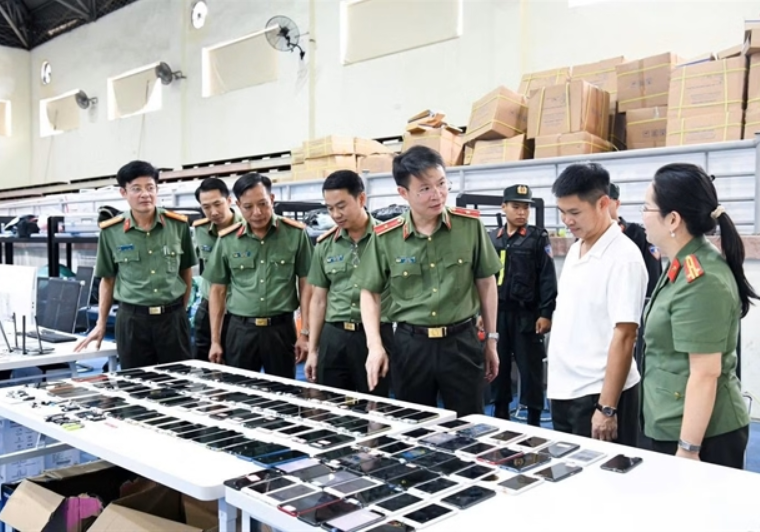
The seizure of equipment from properties associated with the suspects provides tangible evidence of the operation's sophistication and intended scale. Police recovered 73 computers, 134 mobile phones, 34 USB storage devices, 20 Wi-Fi routers, and additional paraphernalia explicitly intended for the fraudulent call centre infrastructure. This haul suggests the operation was substantially prepared and awaited only the arrival of personnel from Cambodia to commence generating fraudulent income. The breadth of seized equipment indicates this was not a small-scale operation but rather a substantial enterprise with significant capital investment and organizational complexity.
The successful interdiction of this scheme carries significant implications for Vietnam and the broader Southeast Asian region. The case demonstrates that criminal networks maintain mobility and adaptability, readily abandoning established bases when facing governmental pressure to establish operations elsewhere. For Vietnam specifically, it highlights vulnerabilities in border security and the challenges inherent in detecting sophisticated transnational criminal coordination that often involves multiple nationalities and cross-border operational planning. The incident also underscores how Cambodia's security improvements can inadvertently displace rather than eliminate organized fraud, creating secondary security burdens for neighbouring countries.
From a regional perspective, this operation exemplifies the interconnected nature of Southeast Asian organized crime. The involvement of Chinese nationals operating originally in Cambodia and targeting Vietnam reflects how transnational criminal enterprises treat the region as a unified operational theater rather than separate jurisdictions. Chinese organized crime groups have increasingly diversified their geographic footprints across Southeast Asia, establishing networks that span multiple countries and leverage local partnerships to obscure their control structures. For Malaysian authorities and other regional law enforcement agencies, the case serves as a cautionary indicator of how quickly criminal operations can relocate and adapt to new environments.
The investigation also raises questions about the effectiveness of existing bilateral and multilateral cooperation mechanisms in Southeast Asia regarding transnational crime. While the Vietnamese police success demonstrates capable domestic capacity, the fact that the operation had advanced substantially before detection suggests gaps in early warning systems and cross-border intelligence sharing. Strengthening regional cooperation frameworks, particularly regarding financial crime detection and personnel movement monitoring, would enhance collective capacity to identify and disrupt such operations before they achieve operational status in new territories. The case ultimately reinforces that addressing organized fraud in Southeast Asia requires sustained coordination extending beyond individual national responses.