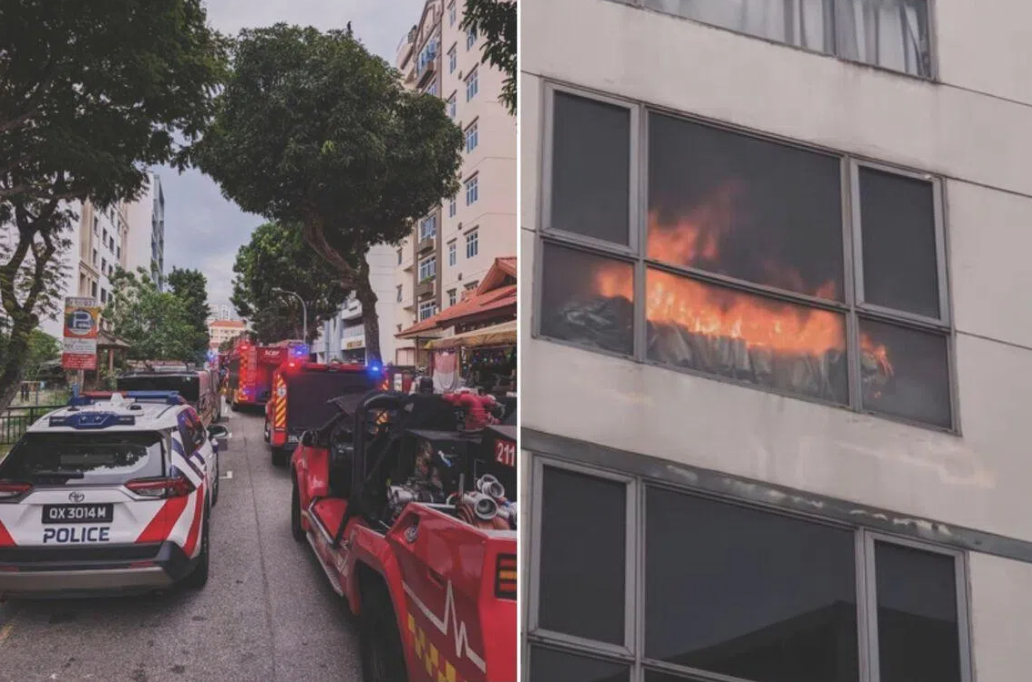
Five residents were forced to evacuate from a condominium in Singapore's Geylang district on Sunday after a power-assisted bicycle battery caught fire while charging unattended in a residential unit. The Singapore Civil Defence Force responded to the incident at 9 Lorong 26 Geylang, identified as Casa Aerata condominium, at 5.35pm on June 21. The neighbouring occupants were swiftly removed from the building as a precautionary measure by police and emergency responders, though fortunately no one sustained injuries in the incident.
The fire originated from a PAB battery that had been left plugged in and unattended within the living room of a seventh-floor apartment. The SCDF deployed a hosereel and compressed air foam backpack system to contain and extinguish the blaze. Preliminary investigations confirmed the fire was electrical in nature, originating directly from the power-assisted bicycle. The incident highlighted the particular hazard posed by these increasingly popular urban mobility devices when not handled with appropriate caution, a concern that resonates across Southeast Asia as adoption of such devices grows in major cities.
The swift response prevented what could have escalated into a more serious situation. According to an account by Cai Yinzhou, Member of Parliament for Bishan-Toa Payoh GRC, he arrived at the scene after observing smoke and hearing emergency sirens in the vicinity. He immediately coordinated efforts to clear the area directly below the burning unit in anticipation of structural failure, a precaution that proved necessary when the window eventually shattered from the intense heat generated by the fire. His presence and quick thinking underscored the importance of community vigilance in residential safety.
The SCDF has since reiterated critical safety guidelines for users of active mobility devices, particularly emphasising the dangers of non-original battery components. The use of counterfeit, third-party, or substandard batteries in PABs and personal mobility devices significantly increases the risk of thermal runaway and combustion. These batteries often lack the safety mechanisms and quality control standards built into original equipment manufacturer products, making them substantially more prone to malfunction under normal charging conditions.
Equally concerning is the practice of extended and overnight charging, which the authorities specifically discourage. Leaving these devices plugged into power sources for prolonged periods without monitoring creates conditions where overcharging can occur, degrading battery integrity and elevating fire risk. Many users charge overnight for convenience, unaware that this practice compounds the dangers inherent in using inferior battery technology. The SCDF's warning targets both PABs and personal mobility devices more broadly, as the entire category of active mobility devices shares similar electrical hazards.
Statistical trends reveal an evolving safety challenge across Singapore's residential sector. In the first two months of 2025, the SCDF documented 304 electrical fire incidents at residential properties, of which 34 involved active mobility devices of various types. Within the AMD category itself, which encompasses PMDs, PABs, and personal mobility aids, the data shows a complex picture. Overall AMD-related fires declined from 67 incidents in 2024 to 49 in 2025, suggesting some improvement in safety awareness or device quality.
However, this aggregate improvement masks concerning divergences in specific device categories. Personal mobility device fires specifically increased from 25 cases in 2024 to 31 cases in 2025, representing a 24 percent rise. This subset of the data warrants particular attention from regulators and retailers, as PMDs appear to represent a growing proportion of the active mobility fire problem. The shift in fire patterns suggests that enforcement efforts and consumer education may need to be recalibrated to address PMDs as a distinct risk category rather than treating all active mobility devices uniformly.
For Malaysian readers, the incident carries relevance beyond Singapore's borders. Rapid urbanisation across Southeast Asia, including Malaysia, has driven substantial adoption of PABs and PMDs as last-mile transport solutions in cities like Kuala Lumpur, Penang, and Johor Bahru. The safety challenges documented in Singapore are likely mirrored in Malaysian urban centres where similar devices proliferate. Local regulations governing the sale, use, and charging of these devices may need review to align with emerging safety intelligence from the region.
The incident also underscores the broader consumer safety issue of counterfeit and non-compliant batteries entering the regional market. Manufacturers and authorised dealers across Southeast Asia should be implementing robust supply chain controls to prevent substandard components from reaching consumers. Meanwhile, residential building management associations and residents' committees could proactively educate occupants about safe charging practices and device maintenance, particularly in high-density housing where fire risks are amplified by proximity and shared infrastructure.
Building on this foundation, the incident demonstrates that individual user behaviour, device quality, and regulatory oversight must align for effective safety. A user who charges an unattended PAB overnight using a non-original battery creates multiple compounding hazards that no single intervention can fully mitigate. Conversely, even quality devices become hazardous under negligent charging practices. The SCDF's emphasis on using original batteries, avoiding extended charging sessions, and maintaining supervision during power-up periods represents a holistic safety framework that residents throughout Southeast Asia should adopt.
Governments and regulators across the region might consider whether current standards for battery safety in active mobility devices are sufficiently stringent, or whether additional certification and testing requirements are warranted before devices enter the market. Consumer education campaigns should emphasise not merely the dangers of specific behaviours, but the multiplicative risk created by combining poor-quality components with unsafe usage patterns. As PABs and PMDs become more ubiquitous in Malaysian and Southeast Asian cities, embedding safety culture among both manufacturers and users represents a critical investment in urban residential safety.