Hanoi police have brought smuggling charges against two women following an extensive investigation that exposed an elaborate scheme to illegally distribute hundreds of containers of frozen chicken feet throughout Vietnam, circumventing strict regulations designed to protect domestic food supplies from disease risks. The operation, which spanned three years and generated more than VNĐ347 billion in undeclared revenue, represents one of Southeast Asia's more audacious attempts to circumvent biosecurity protocols by falsifying import documentation and exploiting supply chain vulnerabilities.
The two suspects, identified as Nguyen Thi To Loan, 47, and Trang Tuyet Ngoc, 45, allegedly coordinated the importation of chicken feet originating from countries experiencing active poultry disease outbreaks. Loan operated as the driving force behind ABF Food Import-Export JSC, a company registered in Ninh Binh Province, while Ngoc held a senior administrative position at An Binh Group, providing crucial operational support for distributing the contraband across multiple provinces. Both women have reportedly admitted to all charges against them, according to Hanoi police.
Between 2023 and 2026, the pair orchestrated the importation of 339 refrigerated containers of frozen chicken feet, deliberately misrepresenting the goods on customs documentation as products destined solely for processing and subsequent re-export. This classification is critical under Vietnamese law because poultry products sourced from nations with confirmed poultry disease activity face strict restrictions—they may enter Vietnamese territory exclusively for value-added processing and onward export, with domestic sale absolutely prohibited. The regulatory framework exists specifically to prevent potentially contaminated foreign poultry from entering domestic food chains where public health risks could spread uncontrollably.
Instead of adhering to these legal requirements, Loan allegedly instructed Ngoc to systematically distribute the entire chicken feet consignment across Vietnam's domestic market. Investigators determined that more than 10,000 metric tonnes of the contraband poultry products were sold to food-service establishments, restaurants, and food distributors operating across multiple provinces including Hanoi, Cao Bang, Ninh Binh, and Quang Ninh. The scope of this distribution network underscores how deeply the illegal product had penetrated Vietnam's food service industry, potentially exposing thousands of restaurants and food handlers to biosecurity risks.
The economic dimensions of the smuggling operation are substantial. The imported goods carried a declared value exceeding US$13 million, yet the operators paid zero import duties on the shipments, representing a significant loss to government revenue alongside the circumvention of disease control mechanisms. The absence of customs duties suggests sophisticated coordination with border officials or deliberate exploitation of documentation loopholes that allowed the containers to pass through inspection points without proper scrutiny.
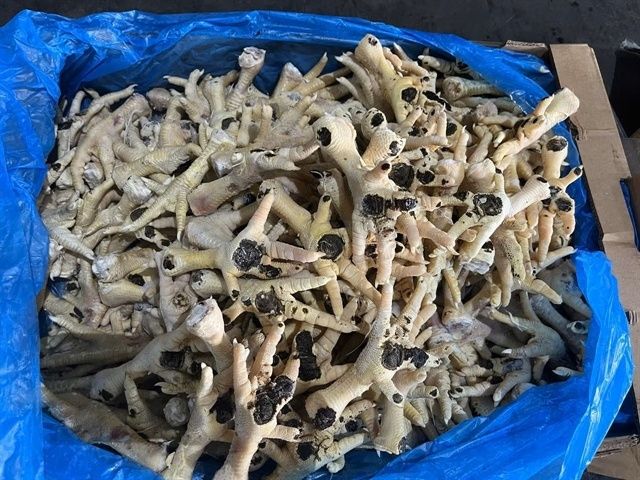
When authorities conducted raids on cold storage facilities associated with the operation, they uncovered more than 2,000 metric tonnes of frozen chicken feet still held in warehouses. At the An Viet 2 freezer facility located in Hanoi's Quang Minh Industrial Zone, police discovered over 1,000 metric tonnes, among which approximately 260 metric tonnes had already exceeded expiration dates and displayed visible signs of degradation including mold growth and persistent foul odours. Most concerningly, investigators found evidence that these spoiled products appeared to be staged for continued distribution, indicating an apparent willingness to supply decomposed poultry products to food establishments.
A second enforcement action at the THL cold storage warehouse in Lang Son province yielded an additional 1,030 metric tonnes of frozen chicken feet. The discovery of such massive quantities stored across multiple facilities demonstrates the scale of infrastructure the smuggling network had established to support their illegal operation. The systematic nature of these storage arrangements suggests this was not an isolated incident but rather a well-organized enterprise with the capacity to manage hundreds of tonnes of contraband simultaneously.
Hanoi police have formally charged both Nguyen Thi To Loan and Trang Tuyet Ngoc under Article 188 of Vietnam's 2015 Penal Code, which addresses smuggling offences. The charges carry serious legal consequences reflecting the severity of circumventing biosecurity regulations and food safety standards. For Malaysian readers, this case provides important context regarding how neighbouring countries address food safety violations, particularly given the prevalence of regional food trade and the risk that contaminated products might cross Southeast Asian borders before being intercepted.
The investigation remains ongoing as Vietnamese authorities work to establish the involvement of additional individuals and organisations potentially implicated in the smuggling network. Investigators are attempting to map the full supply chain, identify downstream recipients who purchased and distributed the chicken feet to retail outlets, and determine whether customs officials or other government personnel facilitated the operation. This expanded investigative scope suggests authorities believe the smuggling operation likely involved coordination beyond the two primary suspects, possibly including corrupted customs agents or complicit cold storage facility operators.
The case highlights persistent vulnerabilities in enforcement of food import regulations across Southeast Asia, where the combination of high product demand, substantial profit margins on prohibited goods, and occasionally inconsistent border controls creates opportunities for sophisticated smuggling operations. Vietnamese authorities have demonstrated their capacity to identify and prosecute such schemes once discovered, yet the three-year duration before detection raises questions about monitoring effectiveness. For Malaysia and other regional nations, the case underscores the importance of robust customs cooperation and information-sharing mechanisms to prevent contaminated poultry products from circulating across borders, particularly given the mobility of cold chain logistics and the challenge of tracking products once they enter informal distribution networks.